
Key Takeaways
- The Russian military conducted another set of massive, coordinated missile strikes on Ukrainian critical infrastructure.
- Russian politicians continue to promote openly genocidal rhetoric against Ukraine.
- The Kremlin continues to pursue its maximalist goals and is likely issuing vague statements about its intent to mislead Western Countries into pressuring Ukraine into negotiations.
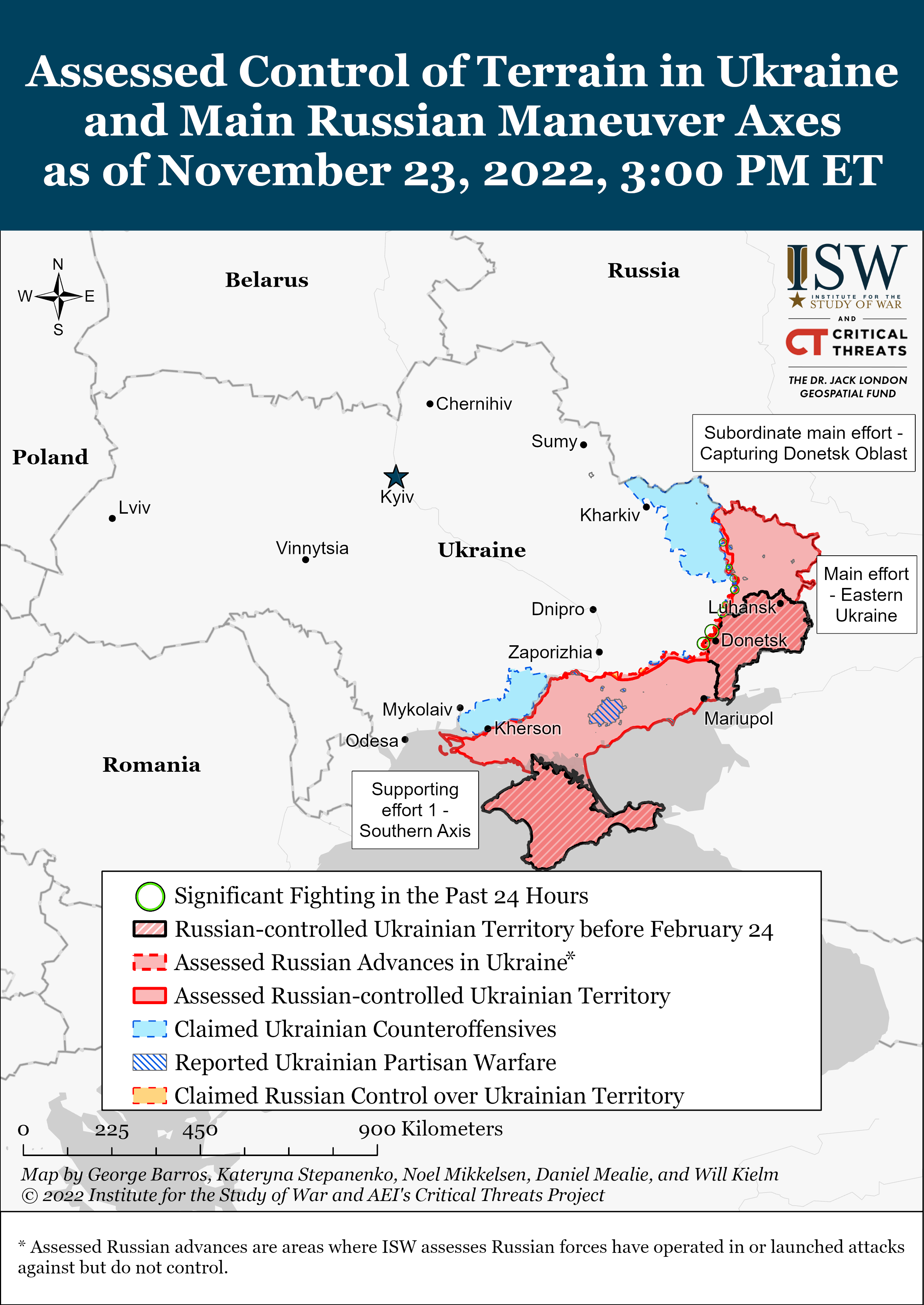
- Russian sources claimed that Ukrainian forces continued counteroffensive operations in the directions of Kreminna and Svatove.
- Russian forces continued offensive operations around Bakhmut and Avdiivka.
- Russian forces continued defensive operations on the east (left) bank of the Dnipro River in Kherson Oblast.
- The Kremlin is continuing crypto-mobilization efforts at the expense of other Russian security services.
- Russian forces and occupation officials continued to forcibly relocate residents and confiscate their property.
The Russian military conducted another set of massive, coordinated missile strikes on Ukrainian critical infrastructure in a misguided attempt to degrade the Ukrainian will to fight. Ukrainian Air Force Command reported on November 23 that Russian forces launched 70 cruise missiles and five drones at Ukrainian critical infrastructure targets. Ukrainian Air Force Command reported that Ukrainian air defenses shot down 51 of the Russian cruise missiles and all five drones. The Ukrainian General Staff reported that Russian forces struck residential buildings, thermal power plants, and substations in the city of Kyiv as well as in Kyiv, Vinnytsia, Lviv, and Zaporizhia oblasts. Ukrainian, Russian, and social media sources claimed that Russian forces also struck targets in Ivano-Frankivsk, Odesa, Mykolaiv, Kherson, Cherkasy, Dnipropetrovsk, Sumy, Poltava, Kirovohrad, and Kharkiv oblasts. Ukrainian officials reported widespread disruptions to energy, heating, and water supplies as a result of the Russian strikes. ISW has previously assessed that the Russian military is still able to attack Ukrainian critical infrastructure at scale in the near term despite continuing to deplete its arsenal of high-precision weapons systems. Ukrainian Deputy Defense Minister Hanna Malyar stated that the Russian military mistakenly believes that the destruction of energy infrastructure will direct Ukrainian efforts to protect rear areas and divert Ukrainian attention away from the front in eastern and southern Ukraine. Malyar stated that Russia’s campaign against critical infrastructure will not weaken the motivation of Ukraine’s civilian population, and the Ukrainian Security and Defense Council Secretary Oleksiy Danilov asserted that Russian missile and drone strikes will not coerce Ukraine into negotiations.
Prominent Russian politicians continue to promote openly genocidal rhetoric against Ukraine. Moscow City Duma Deputy and pro-Kremlin journalist Andrey Medvedev posted a long rant to his Telegram channel on November 23 wherein he categorically denied the existence of the Ukrainian nation, relegating Ukrainian identity to a “political orientation.”Medvedev called Ukraine a pagan cult of death that worships prisoner executions and called for the total “liquidation of Ukrainian statehood in its current form.” This rhetoric is openly exterminatory and dehumanizing and calls for the conduct of a genocidal war against the Ukrainian state and its people, which notably has pervaded discourse in the highest levels of the Russian political mainstream. As ISW has previously reported, Russian President Vladimir Putin has similarly employed such genocidal language in a way that is fundamentally incompatible with calls for negotiations.
The Kremlin has not backed down from its maximalist goals of regaining control of Ukraine but is rather partially obfuscating Russia’s aims to mislead Western countries into pressuring Ukraine to sue for peace. Kremlin Spokesperson Dmitry Peskov stated on November 21 that changing the current government in Ukraine is not a goal of the Russian “special military operation” in Ukraine, observing that Russian President Vladimir Putin “has already spoken about this.” Putin had said on October 26 that Ukraine has “lost its sovereignty” and come fully under NATO’s control. Putin’s speech at the Valdai Discussion Club on October 27 again rejected Ukraine’s sovereignty, noting that Russia “created” Ukraine and that the “single real guarantee of Ukrainian sovereignty” can only be Russia. Putin has also consistently upheld his talking point that Ukraine is a Nazi state that must be “denazified.” Putin’s demands amount to a requirement for regime change in Kyiv even if he does not explicitly call for it in these recent statements. The fact that Peskov refers back to these comments by Putin makes reading any serious walking-back of Russian aims into Peskov’s comments highly dubious.
The Kremlin’s obfuscation of its aims likely intended for a Western audience is nevertheless confusing Russian war supporters. Peskov’s statement likely aimed to mitigate the effects of Vice-Speaker of the Russian Federation Council Konstantin Kosachev’s pro-war rant declaring that Russia can only normalize relations with Ukraine following the capitulation of the Ukrainian government. The two contrasting statements confused the pro-war community. A Wagner Group-affiliated milblogger sarcastically observed that Russia is aimlessly fighting a war without a clear goal in response to Peskov’s statement. ISW has reported on similar reactions to the Kremlin’s decision to exchange Ukrainian prisoners of war from Mariupol, whom Kremlin officials and propagandists vilified as “Nazis” and ”war criminals.”
The Kremlin’s hesitance to publicly commit fully to an extreme nationalist ideology and to the war is also bewildering propagandists who preach such ideology to the Russian masses. Russian political and military “experts” on a Russian state TV show pushed back against Russian propagandist Vladimir Solovyov’s claim that Kherson Oblast is fully Russian, which would justify the use of nuclear weapons. The “experts” said that the use of nuclear weapons to defend territory that is not fully occupied is irrational and even said that NATO poses no threat to Russia. Russian propagandists have been making outlandish nuclear threats and accusing NATO of planning to attack Russia throughout Putin’s regime and especially before and during the February 2022 invasion of Ukraine; such dismissal of common Kremlin talking points in such a forum is unprecedented. ISW has also previously reported that Russian extreme nationalist ideologist Alexander Dugin accused Putin of not fully committing to the pro-war ideology. Putin has generally sought to balance extreme nationalist talking points to gather support from the nationalist-leaning community and a more moderate narrative to maintain the support of the rest of the Russian population. Russian military failures and the increasing sacrifices Putin is demanding of the Russian people to continue his disastrous invasion are bringing his deliberate obfuscation of war aims and attempts to balance rhetorically into sharp relief, potentially fueling discontent within critical constituencies.
The post ISW Russian Offensive Campaign Assessment, November 23 appeared first on Kyiv Post.