
Since his rise to power in October 2019, Tunisian President Kais Saied has anchored his legitimacy in a prodigious crusade he claims to be waging against endemic corruption. Certainly widespread graft has for decades been a destabilizing force in Tunisia and a hindrance to its democratic consolidation. Tunisians have long perceived corruption as the third main problem in their country after unemployment and economic mismanagement, according to the Organisation for Economic Co-operation and Development.
Three years later, however, Saied’s words have been little more than a tool to legitimize the measures he has put in place since July 25, 2021, to monopolize power, including sacking the prime minister, dissolving Parliament, and staging a referendum this past July to further erode checks and balances.
Not only is Saied grinding down the sole democracy to emerge from the Arab Spring movements, he is also failing to fulfill the core promise on which he built his entire political platform. Corruption cannot be fought while a head of state operates unilaterally and undermines the independence of his country’s institutions. The hopes that led so many Tunisians to initially cheer for Saied’s power grab last year and supported the passage of his referendum a year later are built on a chimera.
Saied’s populist slogans have not translated into any concrete actions to eradicate systemic corruption. A study published in October estimated that corruption is costing Tunisia 4 percent of its GDP, which would be $1.54 billion of its projected $38.5 billion GDP for 2022. Goods, including fuel and food items, are also smuggled into and out of the country, incurring some $4.2 billion in contraband profits transferred between Tunisia and neighboring Algeria and Libya alone. Oligopolies control the Tunisian market, and daily corruption is widespread, even as citizens struggle to make a living.
Fighting the Corruption Fighters
Instead of targeting the corrupt, Saied has been busy settling scores against individuals and entities opposing his dictatorial actions. Several opponents were subject to political trials in military court in recent months, even as the government fails to wage any serious campaign against the notoriously corrupt. (I, too, have been targeted: individuals whom my watchdog organization, Raqabah Observatory, has accused of corruption with what we believe is irrefutable evidence have filed 13 complaints against me as president of the group, including four convictions in absentia in the past 1 ½ months.)
Saied also is targeting the country’s independent regulatory bodies. In August 2021, he closed the headquarters of the National Anti-Corruption Body and referred its files to the Ministry of Interior. As a consequence, the system for declaring earnings and following up on cases of conflict of interest among senior state employees was suspended. In September 2021, he dissolved the Provisional Body for Monitoring the Constitutionality of Laws. He also has disrupted hundreds of open investigations, as well as procedures to protect whistleblowers, many of whom have thus become victims of reprisal. In March of this year, he issued a decree on “penal reconciliation,” which allows business owners to escape prosecution or conviction by payment of fines or the creation of national, regional, or local development projects.
Press freedom has shrunk, too, during the past year, and a new decree issued in September opens the door for serious crackdowns on journalists, bloggers, dissidents, and civil society activists, under the pretext of fighting disinformation and fake news.
Eroding Checks and Balances
Rooting out corruption requires rule of law, separation of powers, a free press, and protection of independent bodies tasked with monitoring public structures and exposing and reporting abuses. It is true that these conditions had not all been in place prior to Saied’s self-coup last year, but his draconian measures such as eroding checks and balances and discouraging whistleblowers are providing even more fertile ground for corruption, especially given Tunisia’s massive economic crisis. Food products are being rationed and store shelves are empty of staple goods as prices soar, exacerbated by grain shortages inflicted by Russia’s full-scale invasion of Ukraine in February. The fuel shortage also is worsening. The Tunisian government recently reached a preliminary agreement with the International Monetary Fund on a $1.9 billion loan.
At Raqabah Observatory, we have noticed a serious drop in the rate of response to public information requests we have directed to public bodies, falling from 93 percent response between July 25, 2020 and July 25, 2021, to only 59 percent in the same period from 2021 to 2022. We also have seen many judicial investigations into financial corruption disrupted amid Saied’s feud with judges, as he randomly sacked 57 of them in a June 1 purge of the judiciary, accusing them of corruption, adultery, and protecting terrorists.
Even before Saied’s election in 2019, Tunisia’s democracy had not achieved the desired development or social justice, mainly because of bureaucracy, corruption, and the failure of the government to carry out its central role of providing services to citizens. Over more than a decade, Tunisia has moved from a corrupt dictatorship under former President Zine al-Abidine Ben Ali prior to the revolution of 2011, then to a corrupt democracy, and now to a corrupt autocracy. The system has changed, but its essence, its deep state, and its rentier economic and financial elite have not.
Tunisia’s civil society forces must continue to stand up strongly for a restoration of democracy. It is particularly important for them to unite in the fight against this growing authoritarian turn of the new regime. There is no other way to address the corruption that is paralyzing the economy and bulldozing citizens’ livelihoods. The hollow one-man show that Saied has made out of the country will deepen the corruption crisis and sink its economy further.
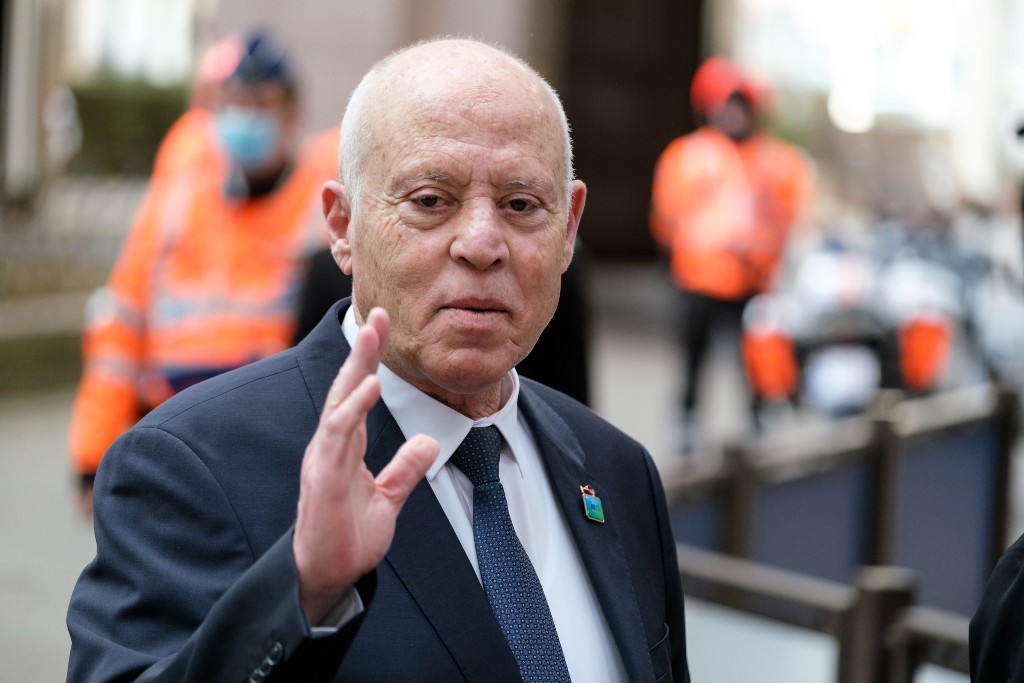
IMAGE: President of Tunisia Kais Saied arrives for an EU-Africa Summit on February 17, 2022 in Brussels, Belgium. (Photo by Thierry Monasse/Getty Images)
The post Fighting Tunisia’s Rampant Corruption with Autocracy – Kais Saied’s Chimera appeared first on Just Security.