
American leaders have made numerous visits to the Philippines, a long-standing military ally in Southeast Asia. But Vice President Kamala Harris’ stop on Tuesday in the country’s archipelagic province of Palawan represents something new. She is the first U.S. official to go there, in what observers say is meant more as a message to China than one to the Philippines.
Read More: What Kamala Harris Brings to the White House
Harris toured a coast guard vessel and spoke to Philippine officials in Palawan to underscore America’s values and hopes for the region: “respect for sovereignty and international integrity, unimpeded lawful commerce, the peaceful resolution of disputes, and freedom of navigation.”
[time-brightcove not-tgx=”true”]
The Vice President’s visit, along with talks in Manila on Monday about increased joint defense projects, leaves the Philippines in a precarious position—straddling the line between the interests of its colonizer-turned-ally in the U.S. and its largest trade partner in China. Across the region, countries have been put in a similar tight spot, increasingly forced to choose a side where they might prefer to stay above the fray in the competition for global influence between the U.S. and China.
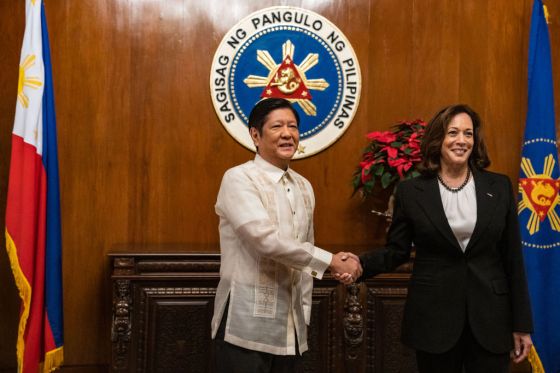
Haiyun Jiang—Pool/Getty ImagesU.S. Vice President Kamala Harris meets with Philippines President Ferdinand “Bongbong” Marcos Jr. at Malacanang Palace in Manila on Nov. 21, 2022.
Ferdinand Marcos Jr., who was elected president of the Philippines in May, said in July that, like many of his regional counterparts, he would pursue “a friend to all, an enemy to none” foreign policy. But this aim has become more untenable as differences between the world’s two superpowers grow over issues concerning human rights, economic policy, and the rule of law.
Read More: The West Will Work With the Philippines’ Next President, Even If He Is a Dictator’s Son
It’s no coincidence Harris visited Palawan. Just off its west coast is the South China Sea: a waterway that has become a regional flashpoint after Beijing lay claim to virtually all of it and its encompassing islands, citing historic maps. China is not the only claimant—the Philippines, Vietnam, Malaysia, and Taiwan have also staked claims to overlapping maritime territories. But China has bolstered its presence in recent years, building artificial islands from the sea’s obscure reefs and sandbars and arming them with missile systems. A U.N.-backed tribunal in The Hague, Netherlands, invalidated most of China’s sweeping claims in 2016, but Beijing ignores the ruling and continues to militarize the region.
Read More: Just Where Exactly Did China Get the South China Sea Nine-Dash Line From?
Local tensions in the South China Sea eased some after the Philippines, which lodged the complaint against China to The Hague, under former President Rodrigo Duterte did not enforce the tribunal’s ruling. Duterte was keen on pivoting the Philippines away from its deference to the U.S.. As Duterte was reluctant to hold Beijing to account to smooth diplomatic relations, Chinese incursions in the contested waterway increased.
Since Marcos Jr. succeeded Duterte, he has sought to restore the Philippines’ relationship with the U.S., whose military still actively challenges China’s claims in the South China Sea. At the same time, Marcos Jr. insists that Harris’ visit will not strain Manila-Beijing ties. “I don’t think it will cause problems,” he told Philippine reporters last week. But Lucio Pitlo, a research fellow from Manila-based think tank Asia Pacific Pathways to Progress Foundation, says China will definitely be keeping an eye on the visit and will “surely express serious concern about” the U.S.’s increasing military footprint in the country.
Resetting the relationship with the U.S.
Several key treaties over past decades form the bedrock of the partnership between the U.S. and the Philippines. A 1951 Mutual Defense Treaty states that both nations will provide support to each other in the event of an external attack. This has been reaffirmed by a 1998 Visiting Forces Agreement and a 2014 Enhanced Defense Cooperation Agreement, allowing the U.S. military to access bases in the Southeast Asian nation and store defense equipment there. The two militaries also regularly hold joint exercises.
By virtue of its geography, the Philippines has strategic value for the U.S. in its competition with China. Besides having the South China Sea to its west, the major island of Luzon—which contains the country’s capital Manila—is only 360 km south of Taiwan.
Read More: The U.S. Risks Catastrophe If It Doesn’t Clarify Its Taiwan Strategy
Derek Grossman, a senior defense analyst at the global policy think tank RAND Corporation, says the reinvigorated U.S.-Philippines alliance under Philippine leader Ferdinand Marcos Jr. has “real security implications for China in the South China Sea.”
Gregory Poling, director of the Southeast Asia Program and Asia Maritime Transparency Initiative at the Washington-based Center for Strategic and International Studies, said the Philippines will find it “very difficult to stay neutral” if conflict arises in Taiwan and the U.S. becomes involved. Some 150,000 Filipinos residing in Taiwan would be at risk, and the Philippines may “deal with a refugee crisis along with other externalities,” he adds.
In a September interview with Japanese outlet Nikkei Asia, the Philippine envoy to the U.S. Jose Manuel Romualdez—a cousin of Marcos Jr.—said Manila would let Washington use its bases in the event of a Taiwan conflict, “if it’s important for us, for our own security.” It’s a tonal shift from when Duterte, who wanted to boot U.S. forces out of the archipelago, was in charge. In a 2016 trip to Beijing, Duterte proclaimed that it was “time to say goodbye to Washington.”
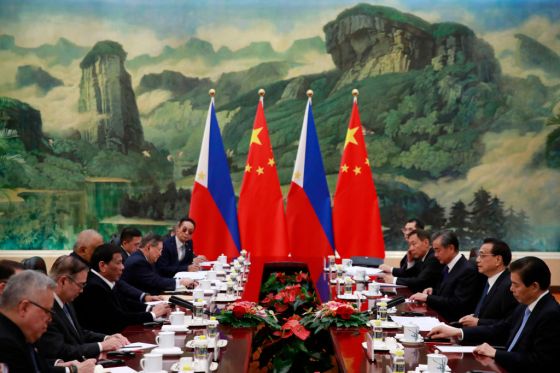
How Hwee Young—Pool/Getty ImagesPhilippine President Rodrigo Duterte and Chinese Premier Li Keqiang speak to each other during their meeting at the Great Hall of the People, in Beijing, China, on Aug. 30, 2019.
Read More: Beijing’s Adroit Diplomacy Is Isolating the U.S. in Asia
But while Marcos Jr. has taken a different tack than his predecessor, he is cautious not to alienate China as he pursues revamping ties with Washington. He met with China’s Xi Jinping on the sidelines of the Asia-Pacific Economic Cooperation Summit in Bangkok, Thailand, last week shortly before Harris’ visit, promising an improvement of the Manila-Beijing relations.
Marcos wants to avoid a repeat of the past. After a Philippine vessel squared off with Chinese boats within the Philippines’ exclusive economic zone back in 2012, China imposed trade barriers on bananas from the Philippines. Banana exports to China fell by around 27% to 473,000 metric tons in 2012 from 650,000 tons the year prior. The fruit is one of the country’s major agriculture exports, and its growers believed the dispute was to blame for their economic losses.
Treading a fine line with China
China’s foreign ministry issued a statement after the meeting in Bangkok last week saying it must work together with the Philippines against “bullying” in the South China Sea—something Beijing and Washington each accuse the other of doing with their military movements in the region. Marcos Jr., for his part, clarified that his foreign policy doctrine has always been to engage with all parties, especially concerning the maritime dispute. “Let’s not allow anyone to dictate what we should do,” he told reporters last week.
In a briefing in Palawan, Harris reiterated America’s support for the 2016 ruling from The Hague on the South China Sea dispute, adding that the U.S. “will continue to rally our allies and partners against unlawful and irresponsible behavior” in the region. Washington also promised to give Manila $7.5 million worth of assistance to its maritime law enforcement agencies.
Beijing has yet to react to Harris’ statement, although its response is expected to be much more muted than the response to Democratic House Speaker Nancy Pelosi’s visit to Taiwan in August. The Philippines is not disputed territory. The day before Harris’ trip, China’s foreign ministry said it is not against the U.S. interacting with other states in the region—but it should be for “peace and stability and not damaging to other countries’ interests.”
Read More: Pelosi Leaves Taiwan With the Island—and World—in a More Precarious Position
Richard Heydarian, a Manila-based political scientist and senior lecturer of international affairs at the University of the Philippines, says Philippine-China ties won’t break down over the South China Sea territorial row. But it’s Washington’s increasing military investments on the archipelago that Beijing will be wary of, particularly when it comes to potential future conflict over Taiwan. “Both the South China Sea and the Taiwan crisis are nudging the United States and Philippines to fortify their alliances,” he says.
To reap the benefits of amicable relations with both China and the U.S., as the Philippines and many of its counterparts across Southeast Asia seek to do, says Anna Malindog-Uy, a geopolitical analyst at the Asian Century Philippines Strategic Studies Institute in Manila, the Philippines must “prevent at all costs the possibility of becoming a pawn of any superpower to encircle another superpower.”