
It was two minutes past the stated start time for “The Gett,” and there was still a substantial line of people waiting to use the bathroom. The two women sitting behind me at the Rattlestick, a minuscule West Village theater, were not at all happy about the situation.
“They should have known to go before they got to the theater,” said one.
“Oh no, now he’s getting up,” groaned the other, as an elderly man got to his feet, threatening to join the line. The conversation was so lively — and so audible — that when another man sitting next to me got up abruptly, the women leaned forward to ask if they had offended him. Assured they had not, they resumed their chatter, speculating that the bathroom line was performance art and that we were in fact already watching the play.
Fortunately, they were wrong about that. But after the last toilets flushed and the lights went down, I began to wonder if their conversation itself was a piece of performance art. Not because “The Gett” is overly concerned with bathrooms, but because it celebrates exactly this kind of endearingly strident and opinionated womanhood — and produced, in me, something of the same confusion about what exactly we were seeing.
Chronicling one woman’s post-divorce journey of self-discovery, “The Gett” initially feels something like “When Harry Met Sally,” updated for a 21st century, energetically Jewish audience: En route to a Christmas-for-Jews party, Ida, a poet with Mrs. Maisel’s manically verbose energy (played by Liba Vaynberg, who also wrote the script), meets Baal (Ben Edelman), a walking Everlane advertisement with a gravelly voice and an I-read-too-much-Bukowski-to-be-a-good-boyfriend hairdo. Of course the elevator breaks, of course they bicker on the phone with the fire department, and of course they’re half in love by the time they arrive at the party.
But we don’t find out much about the ensuing relationship, because most of the play takes place two years later, in the wake of Ida and Baal’s divorce. Reeling from the collapse of her marriage, Ida tries to rebuild her identity as a single woman by dating frantically and using her divorce lawyer as a therapist. (The short-lived boyfriends and the lawyer are all played, very amusingly, by Luis Vega.) Mama, Ida’s concerned mother (Jennifer Westfeldt, of “Kissing Jessica Stein” fame) is constantly trying to get in touch, leaving rambling voicemails that touch on Kabbalah, sex toys and the Jewish lawyers that all her friends’ kids are dating.
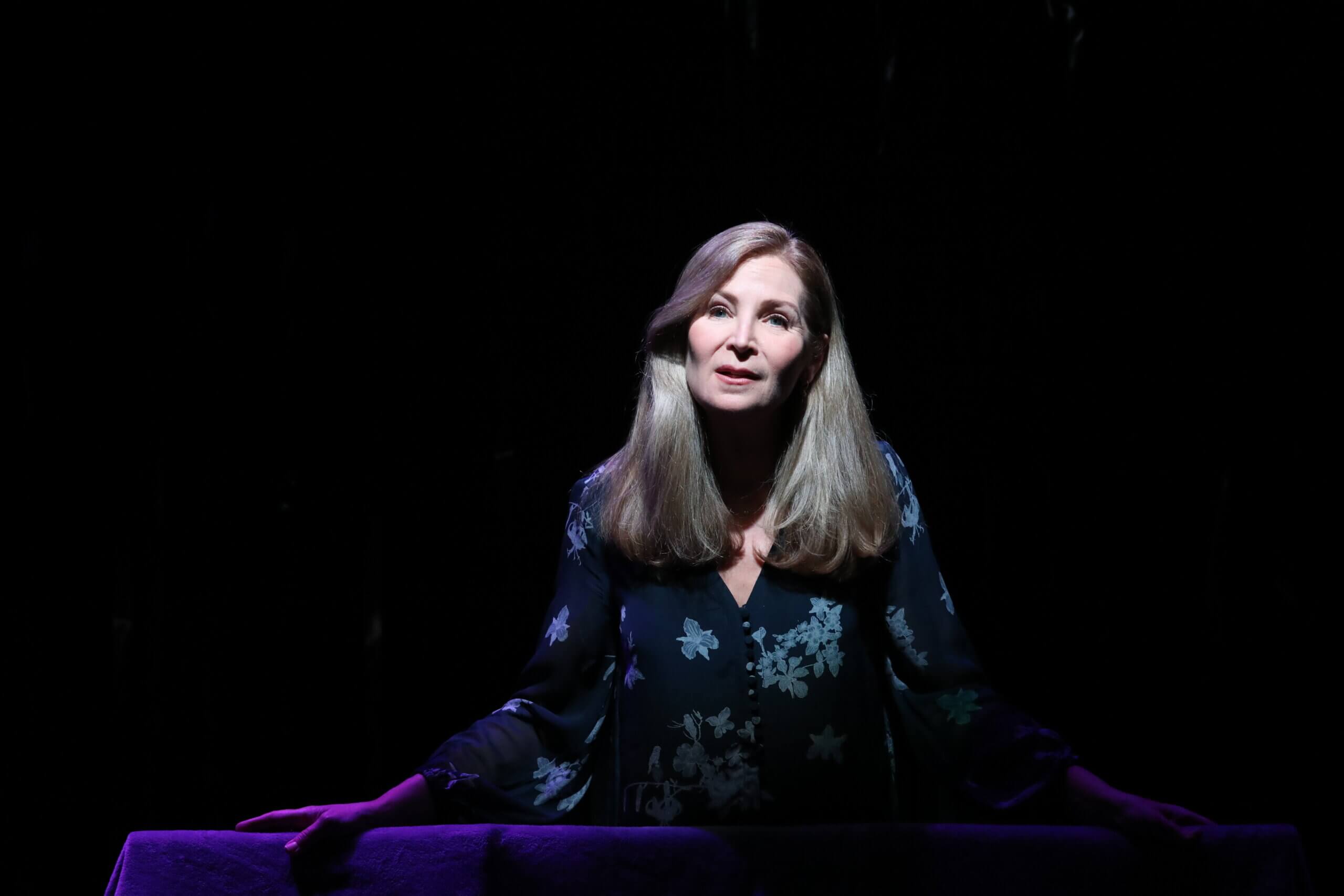 Jennifer Westfeldt in “The Gett”: “Anyway, this is your mother. I just thought I would call.” Courtesy of Rattlestick Theater
Baal and his hair, meanwhile, also make frequent appearances. Most of them are imaginary, such as when he interrupts Ida’s dates as a kind of Ghost of Marriage Past. But one happens in real life — although Baal doesn’t seem particularly religious, he asks Ida for a gett, a traditional document of Jewish divorce used mostly in Orthodox communities. Though Baal’s reasons for wanting the gett remain obscure, the process of obtaining one forces the couple to meet again.
“The Gett” excels at applying an Ephron-esque energy to a story that lies outside the bounds of conventional rom-coms: that of a woman trying to rebuild her life after a divorce, without a new love interest waiting in the wings to give her life new meaning. In one surprisingly tender scene, Baal appears in Ida’s thoughts to deride an earnest and somewhat schmucky tech bro she’s brought home: “Does he listen to podcasts?” It’s a creative way to show how the memory of past relationships can foreclose new ones.
The play also gets a lot of mileage from distilling the habits and foibles of a certain middle-class Jewish milieu. The audience loved Ida’s description of chintzy menorahs “shrugging” next to Christmas trees in New York lobbies, and laughed in recognition during Mama’s monologues, which flirt with Rothian stereotypes of the nagging Jewish mother before subverting them: Mama emerges as the only person with any understanding of Ida’s situation and real advice to give her.
But “The Gett” falls short when it attempts to be a cosmic saga. The play labels each stage of Ida’s life — her meet-cute with Baal, their divorce, her subsequent attempts at other relationships — as one of the seven “days of creation.” This technique seems intended to yield a reimagined Genesis that culminates in a thriving single woman, not an Edenic couple. But the attempt to muscle a creation myth into a kind of seven-step recovery program feels gimmicky, and adds an unnecessary chronological element to a play that already zigzags through time, skipping ahead months or years without warning.
 Luis Vega in one of his many, many roles. Courtesy of Rattlestick Theater
This focus on the grandiose obscures the compelling human drama of Ida’s life. Since the play never reveals why Ida and Baal divorce, or even what drew them together besides a shared talent for elevator banter, it remains unclear why he’s so insistent on a gett, or what it means for Ida to grant him one. Without that information, it’s hard to feel too invested in the climactic scene during which a mumbling rabbi (Luis Vega, again) delivers the much vaunted document and Ida experiences deep but unspecified emotions.
Introducing herself at the start of the play, Ida breaks the fourth wall á la “Fleabag” and addresses the audience directly. Referencing the burgeoning genre of films about divorce in Haredi communities, she says that her story is not like those. Yet she doesn’t seem to know what exactly her story is, and eventually she stops trying to find out, saying instead that “I don’t have one answer. I don’t want one anymore.” Vaynberg, Ida’s creator, has such a strong picture of the conventions — of love, of divorce, of Jewish womanhood — that her character defies. But she doesn’t spend much time telling us who Ida really is, and by the end of the play I had little more understanding of this central character than I did when she first appeared on stage.
In the play’s final scene, Ida uncovers a set of Shabbat candles and lights them. She’s all alone, and the audience finally gets a glimpse of who she is when she’s not staving off her mother or appeasing her boyfriends or mourning Baal. The moment feels less like a confident ending than a tentative, searching, beginning.
Maybe it’s Vaynberg’s next play.
“The Gett” runs at Rattlestick Theater through Dec. 11.
Related
The post In this Ephron-esque romcom, Sally meets Harry — then gets divorced two years later appeared first on The Forward.