
Here are the two most Jewish lines of dialogue you’re likely to hear this awards season.
“Irving, I need my oven” and “This is brisket?”
The first, as Jewish as the sh’ma, appears early on in James Gray’s “Armageddon Time,” the second toward the beginning of Steven Spielberg’s “The Fabelmans,” from the lips of a Jewish mother-in-law to God’s ears. Both films are the work of directors who have at times mined their personal histories for entertainment — but never so directly.
Gray, an indie darling who attracts A-list talent and the occasional blockbuster budget, has made a clutch of intimate films about his native New York, with “Two Lovers,” “We Own the Night” and “Little Odessa” all playing out in the Russian Jewish enclave of Brighton Beach. He also made “Ad Astra,” a space epic about an astronaut searching the cosmos for his absentee father.
In “Close Encounters of the Third Kind,” one of the only films that Spielberg scripted, Richard Dreyfuss’ obsessive and sensitive Roy Neary is a clear stand-in for Spielberg’s father, Arnold.
So, both men, while having divergent styles and audiences, have made Sci-Fi Daddy Issue films.
The new projects have no genre to hide behind, save the portentous one of “semi-autobiographical” or, less comfily, “Jewish.”
“I didn’t want it just to be autobiographical. I wanted it to be personal, which is much more important,” Gray told the Los Angeles Times. “Autobiographical is I’m reciting the facts of the case. And personal means that your emotional life and what is important to you emotionally is in the work.”
Spielberg has been developing “The Fabelmans” for years with regular collaborator Tony Kushner. He called it, surprisingly, the “first coming-of-age story I’ve ever told,” and began production shortly after Arnold Spielberg’s passing in 2020, at the age of 103. It is a clear effort to pay tribute to his late parents.
Taken together, the films, one set over a few months in Queens in the fall of 1980, the other spanning from 1951 to around 1965 in New Jersey, Arizona and California, explore the fluid form of Jewishness in America — its drawbacks, its assets and its comparative privilege. Yet both directors, in their ambition to faithfully reproduce their lives, have made films that, while about Jewish people, don’t feel all that Jewish.
The dark house with no lights, the darkness of the past
In their cul-de-sac in suburban New Jersey, the Fabelmans have the only dark house in the winter of 1951. Young Sammy asks for Christmas lights for Hanukkah (he gets Lionel trains instead).
Spielberg renders his aunts and grandparents with Old World accents and covers his family table with challah, latkes and brisket. The family is well-off, if not yet wealthy. Burt (Paul Dano) is an electrical engineer who’ll make a pioneering move to computers.
Sammy Fabelman’s idyllic life will soon be shattered by a revelation that his mother, Mitzi (Michelle Williams), is in love with his father’s best friend Bennie (Seth Rogen). The film offers a clue to Bennie’s role in the drama to come when he hoists grandma Fabelman over the threshold and she calls him a “Cossack.”
Related
But actual Cossacks are far removed from Sammy’s daily concerns or even daydreams — not so for 11-year-old Paul Graff (Banks Repeta) in “Armageddon Time.”
When Paul’s grandfather Aaron Rabinowitz (Anthony Hopkins) tucks him in, he recounts the family migration: how Aaron’s mother fled to Liverpool from Ukraine after a band of drunk soldiers stabbed her parents to death.
“Never forget the past,” Aaron tells Paul. “You never know when they’ll come back for you.”
This is quite the contrast to Sammy Fabelman, who, under the glow of an oscilloscope, falls asleep with his mother’s words echoing through his mind: “Movies are dreams.”
There is a starker, more somber note in Gray’s film, which, while somewhat concerned with a creative awakening — including an out-of-place scene at the Guggenheim redolent of both the Art Institute of Chicago sequence in “Ferris Bueller” and the “A+” scene from “A Christmas Story” — is far more interested in how a history of persecution can lead to complicity in other structures of oppression, especially when one strives for a better life.
Aaron’s memory of being turned away from Ivy League schools because of a Jewish quota moves him to transfer Paul to a private school. While there, Paul’s old classmate, Johnny (Jaylin Webb), who is Black and on the run from Child Protective Services, walks by the playground. Paul’s wealthier, gentile peers see them talking and call Johnny the N-word. Paul doesn’t object and, when he tells Aaron what happened, his grandfather upbraids him.
“Next time those schmucks say anything, you be a mensch,” Aaron says, noting how other minorities have “never had your advantages.” Whether Aaron’s read “The Great Gatsby,” or James Gray is vaguely recalling its opening lines, remains unclear. But the takeaway is how to properly wield your privilege — even if the film indicates how difficult it is to do this and also get ahead.
By the end, Paul fails Johnny after the two steal a computer. Paul’s father, Irving (Jeremy Strong), assuages his guilt and tells him to “be thankful when you’re given a leg up.” The Graffs (originally the Grassersteins) learned from their own history, but took the wrong lesson.
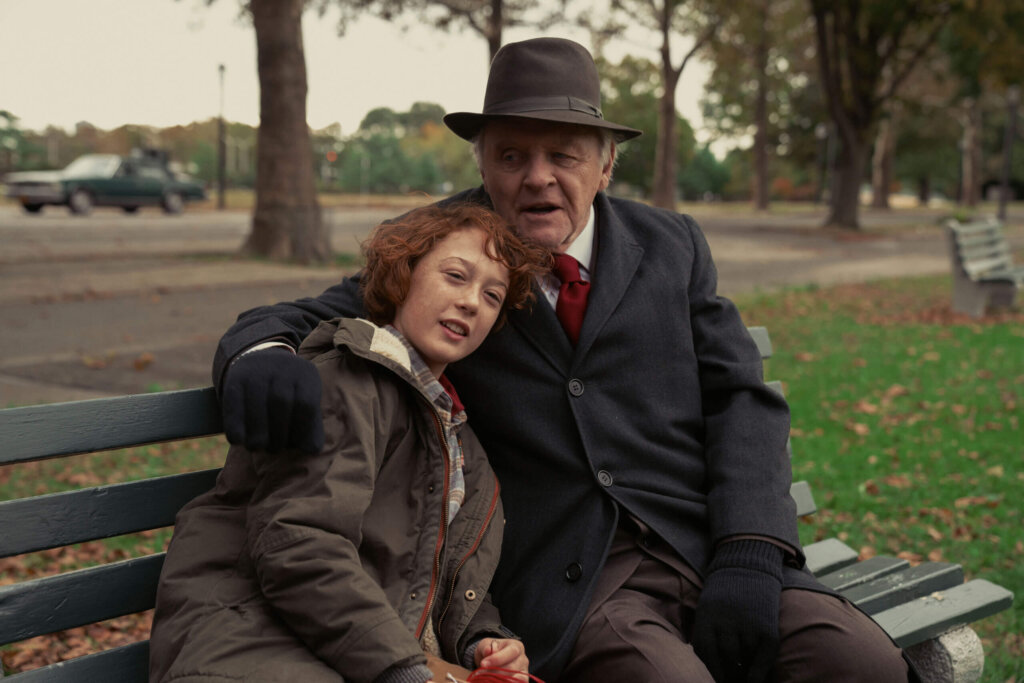 Banks Repeta as Paul and Anthony Hopkins as Aaron in Jame’s Gray’s “Armageddon Time.” Courtesy of Focus Features
Discrimination and art
In “The Fabelmans,” antisemitism makes an almost perfunctory appearance in the third act, as Sammy and his family relocate to Northern California. It’s there because of Spielberg’s high school experience and, perhaps, because he feels obliged as the founder of the USC Shoah Foundation.
As Spielberg told The Hollywood Reporter, the one semester of antisemitic bullying made stories of the Holocaust “personal for me.”
But the message was also general. “Whether you’re Jewish or not, many kids know what it’s like to be bullied,” he added.
Sammy’s classmates call him “Bagelman.” A Christian girlfriend runs a sort of kiss-based catechism from her bedroom, which has walls lined with images of Elvis and Jesus. Bullies try to make him apologize for killing Christ, prompting a bloody nose and a confrontation with Burt and Mitzi.
It’s one more way station on the road to the traumatic divorce Spielberg has been documenting his whole career. But the crux of Spielberg’s film is his artistic ambition. More, it’s how he exists as an uncomfortable blend of his childlike mother and his practical father, two incompatible people who produced a son whose gift they never knew quite how to nurture.
Mitzi, who buys a monkey from a pet store and, at one point, drives toward the eye of a hurricane (“Of course it’s safe, I’m your mother”), refuses to call Sammy’s films a hobby. Burt, distressed at his son’s poor grades, tries to talk him out of a creative path until, in the final minutes, he relents. It’s possible Burt gives up because Sammy’s having a panic attack, or maybe because he already got a conveniently timed letter from CBS in the mail.
As in Gray’s film, the most concrete — if eccentric — advice comes from a Jewish immigrant, who peppers his sage wisdom with Yiddish. Sammy’s great uncle Boris (Judd Hirsch) tells him art is dangerous, and even hurts, grabbing Sammy’s cheeks to demonstrate.
“Remember the pain,” he says, in the same solemn tone as Aaron tells Paul to remember his past.
While Boris says Sammy will be a “shonda for his loved ones,” art is not what tears the family apart — even if Sammy discovers the family secret through his filmmaking. Kushner and Spielberg gave Hirsch a bit part (and a likely Oscar nomination) to voice a theme that doesn’t quite track with how the story plays out. Sammy’s moviemaking may prove painful, but it doesn’t cause his family shame, only provides him the tools to process his troubled home life. If it lifts the scales from his eyes about Burt and Mitzi, it didn’t end the marriage.
Still, Boris’ spiel about art plays to a larger, first- or second-generation anxiety that a creative endeavor is not a stable vocation. In “Armageddon Time,” when Paul says he wants to be an artist, his parents say he should look into computer graphics: “That’s a growth industry.”
Deeply personal, deeply felt — shallowly Jewish?
Spielberg and Gray’s films are both tearful experiments in shattering the distance between self and subject. Where they overlap, they reveal patterns of Jewish life and anxiety. Historically, with a few exceptions (Barry Levinson’s “Avalon” comes to mind and, on stage, Kushner’s “Caroline or Change”), this level of Jewish autodrama has largely been comedic in tone.
“Radio Days,” which took a sort of Jean Shepherd approach to Woody Allen’s childhood, and Neil Simon’s “Brighton Beach Memoirs,” which offered a shmaltzier insight into ancestral memories of pogroms and advocacy for other minorities, were wholly different than the narratives at the level of “Belfast” or “Roma” that Gray and Spielberg are vying for.
“Armageddon Time,” with a humble budget and “The Fabelmans,” with a John Williams score, Janusz Kamiński cinematography and the undeniable cachet of being the “Spielberg origin story,” both abound in intimate and well-observed moments. Spielberg recreated home movies and even his childhood homes. Mitzi strikes Sammy after serving matzo brei and Gray’s real-life children broke down crying on set during a scene where Irving beats Paul.
Much of the humor so central to Jewish striving is sidelined, showing itself only in moments that disrupt the overall tone. What’s more, the tragedies and ancient questions of peoplehood are by turns generalized or overspecified.
The startling effect is that these films, while featuring specific pieces of Judaica my own family owns and checking all the boxes for authenticity, somehow lack a Jewish gestalt.
Gray set out to make an “anti-nostalgia movie.” “It’s a movie that’s about Jewish people, rather than entirely or exclusively about Jewishness or antisemitism,” Kushner said of “The Fabelmans,” lauding the “easy way Jewishness lives” in Spielberg’s film. Perhaps ease and anti-nostalgia are in some sense at odds with a Jewish sensibility we’ve come to recognize.
Neither director was aiming to make the new “Augie March” or “Duddy Kravitz” or even the comprehensive Jewish histories of James Gray or Steven Spielberg, only to tell their own stories, over a set span of time. They want to strike a chord with all audiences.
That these stories could feel so universal is a mark of Jewish progress. But, I can’t help but also feel, deep in my kishkes, that it is a loss for Jewish storytelling.
Related
The post In ‘Armageddon Time’ and ‘The Fabelmans,’ tales of two Jewish childhoods. But are the movies Jewish? appeared first on The Forward.