
The cryptocurrency crisis, worsened by the dramatic collapse of fast-growing crypto exchange FTX in mid-November, has raised questions about the future of these digital currencies. Bitcoin, the largest and most well known among them, has fallen to a two-year low in recent days. But one of the cryptocurrency’s most prominent backers is doubling down.
On Nov. 17, El Salvador’s President Nayib Bukele, who last year made his country the first in the world to adopt Bitcoin as legal tender, responded to the crypto slide with a pledge that the government would purchase one Bitcoin every day going forward. On Nov. 22, Bukele’s administration sent a bill to El Salvador’s Congress that would allow it to sell $1 billion in so-called “volcano bonds”—government debt, denominated in U.S. dollars and paying out 6.5% interest a year to bond holders—in order to buy even more of the cryptocurrency and build a coastal “Bitcoin City.”
[time-brightcove not-tgx=”true”]
It may be difficult to understand why Bukele remains so enthusiastic about a policy that has been, by almost all metrics, a disaster. Bukele’s attempt to get Salvadorans to use the notoriously volatile cryptocurrency has left the country looking like a much riskier place to invest. The policy has stalled El Salvador’s negotiations with the International Monetary Fund (IMF) for a $1.3 billion loan, needed to plug big gaps in its public finances. Bukele’s government has been courting alternative sources of cash, announcing new trade talks with China on Nov. 9. But few economists believe Salvadoran vice president Félix Ulloa’s claim that China is willing to help El Salvador with the all-time-high $21 billion debt burden it owes to foreign lenders. If it can’t find new creditors to help service that debt, El Salvador runs the risk of a default early next year.
Though Bukele has refused to disclose how much taxpayer money he has spent on Bitcoin, the best guess, based on his purchase announcements, is $107 million, with a further $200 million on administration and infrastructure—equivalent to nearly 4% of the developing country’s 2023 budget. El Salvador’s Bitcoin holdings are now worth less than $40 million.
To cap it all, Salvadorans just aren’t that into Bitcoin: an in-person survey of 1,269 residents published by the José Simeón Cañas Central American University (UCA) in October found that less than a quarter of respondents had used the cryptocurrency in 2022. Just 17% said the Bitcoin rollout had been a success, while 66% said it was a failure. And 77% want Bukele to stop using public funds to buy Bitcoin.
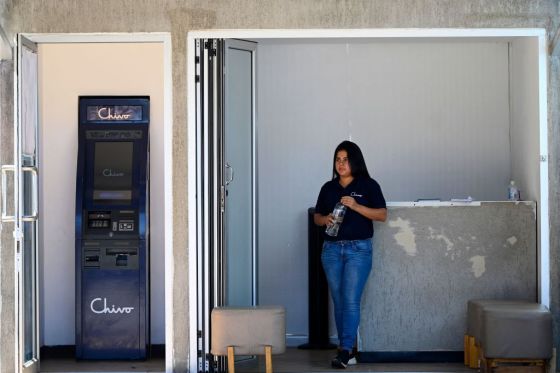
Marvin Recinos—AFP/Getty ImagesA government worker is seen at an ATM of the state-owned Chivo electronic wallet in San Salvador, on November 17, 2022.
And yet, Bukele’s Bitcoin policy hasn’t hurt his approval rating, which has remained reliably above 85% since he took office in 2019. In fact, the cryptocurrency is arguably giving the President exactly what he wants. On the world stage, Bitcoin has pulled media focus from El Salvador’s long-running problem with gang violence, and from the authoritarian moves that Bukele has made to deal with it, including mass arrests, ousting supreme court judges who oppose his agenda, and launching an unconstitutional bid for reelection in 2024. At home, Bitcoin is a key part of the narrative that Bukele is pushing, both of El Salvador—as a rejuvenated, innovative country, delivering new opportunities for young Salvadorans—and of his presidency. He presents himself not as a classic strongman, but as a provocative young visionary challenging the Western financial elite.
That means Bukele has little incentive to abandon Bitcoin—despite mounting losses for his country, says Tiziano Breda, Central America analyst at Crisis Group. “It’s Bukele’s ultimate [goal] to rebrand the country,” he says. “And he doesn’t seem like a person who can admit failure. He will go until the last consequences of this experiment.”
Why Salvadorans don’t care about Bitcoin
Most credit the President’s wide-ranging crack down on gang violence for his sky-high approval ratings. Bukele has overseen the arrest of more than 50,000 alleged gang members and a dramatic fall in El Salvador’s murder rate. Watchdogs say that has come at the cost of “eviscerating human rights” both for gang members and innocent Salvadorans caught in the crossfire. But civil society pushback has been relatively weak, Breda says, with Bukele successfully dismissing protest groups and critical media as puppets for the two establishment parties who ruled El Salvador for three decades before him.
Though most Salvadorans don’t like Bitcoin, they view the policy more as an eccentricity of Bukele’s than as a serious threat to economic security, says Ricardo Castaneda, a San Salvador-based economist at the Central American Institute for Fiscal Studies. Mounting concern about public finances hasn’t yet translated into severe economic pain, he says: the government has shielded the population from the worst of global inflation by subsidizing gasoline prices. And remittances from the U.S., which make up a staggering 26.7% of El Salvador’s GDP, have not slowed.
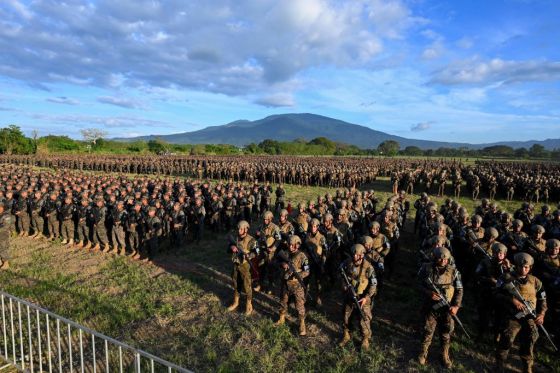
Marvin Recinos—AFP/Getty ImagesSoldiers listen as El Salvador’s President Nayib Bukele addresses them near a military barracks on the outskirts of San Juan Opico,west of San Salvador, on November 23, 2022.
Bukele, meanwhile, insists that Bitcoin is the long-term solution to El Salvador’s economic problems. Like most crypto enthusiasts, he says the price will soon rally and eventually deliver huge profits to El Salvador. In the meantime, the President’s Twitter account shows an endless stream of retweets of foreign crypto influencers: they’re celebrating El Salvador’s coffee and beaches, and sharing tales of Salvadorans who left their country decades ago and now, apparently thanks to Bitcoin, have decided to return.
A looming credit crunch
There are clouds on the horizon for Bukele’s Bitcoin dream, though. El Salvador has to come up with a way to pay around $667 million in bonds that come due in January 2023, and another $1 billion in 2025. The government has announced plans to buy back portions of that debt by using reserves from its central bank, in hopes of inspiring enough confidence in the market to allow it to sell new bonds. Analysts say such moves might help El Salvador avoid default next year. But with shrinking cash reserves and unsustainably high levels of debt to service, the risk will remain.
If Bukele can’t find buyers for his “volcano bonds” or another way to plug the fiscal hole, he may be forced to return to negotiations with the IMF. The lender would likely make a loan conditional on Bukele removing Bitcoin as legal tender and introducing tighter regulations on the use of cryptocurrencies, to reduce the risk of criminal groups using El Salvador to launder money.
Bukele will only accept those terms when the economy starts to struggle enough that Salvadorans feel it, per Castaneda. “There is already a small crack there,” he says, noting that 58% of respondents to the October UCA poll identified El Salvador’s greatest problem as the economy—a 15% spike from May and the highest proportion in the last decade. (The drop in concern about crime likely helped). “If things don’t improve, that crack will get bigger and bigger, and then the applause will turn into boos.”
Until then, Bukele will likely keep rolling the dice on Bitcoin. “He’s like a gambler in a casino who’s losing,” Castaneda says. “Instead of walking away or being more careful, they go all in.”