
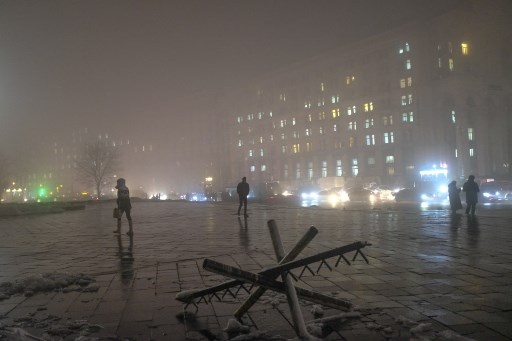
Ukraine is still battling to restore water and power to millions of its citizens after Russia’s latest mass missile strike on civilian infrastructure on Wednesday, Nov. 23 battered an already crippled electricity grid.
The situation is a grim one right across the entire country with winter setting in and temperatures in the capital of Kyiv hovering just above freezing.
Such is the scale of the power outages that their effects are clearly visible from space.
“The situation with electricity remains difficult in almost all regions,” Ukrainian President Volodymyr Zelensky said on the evening of Thursday, Nov. 24. “However, we are gradually moving away from blackouts — every hour we return power to new consumers.”
Kyiv
More than 24 hours after Russian strikes smashed Kyiv, mayor Vitaliy Klitschko said late Thursday that 60 percent of homes in the capital were still suffering emergency outages.
Water services had been fully restored however, city officials said. But the shelling had killed seven people at Vyshgorod, on the outskirts of the capital, said Oleksiy Kuleba, head of the Kyiv Regional Military Administration.
Khmelnytsky
The western region of Khmelnytsky was one of the worst affected by power outages, with just 35 percent of its normal capacity, but that was enough to connect critical infrastructure, according to Serhiy Hamaliy, the head of the regional administration.
Kherson
The recently-liberated southern city of Kherson has been largely without power and water since Russian forces destroyed critical infrastructure when they were forced to retreat earlier this month.
Residents also now face a new threat – shelling from the Russian army in its new positions on the other side of the Dnipro River. A fresh round of strikes Thursday killed at least four people, a senior official there said.
Kharkiv
About 300,000 residents in the eastern Kharkiv region, near the border with Russia, were still without power on Thursday evening, but electricity supply had been restored for nearly 70 percent of consumers, AFP reports.
“We’ve restarted power supplies,” said Ihor Terekhov, mayor of Kharkiv city, adding that water was being restored to homes and municipal workers were reconnecting public transport.
“Believe me, it was very difficult.”
Nuclear power stations
Wednesday’s attacks disconnected three Ukrainian nuclear plants automatically from the national grid and triggered blackouts in the neighbouring country of Moldova, where the energy network is linked to Ukraine.
All three nuclear facilities had been reconnected by Thursday morning.
Why is Russia doing this?
After numerous defeats on the battlefield, Russia is now resorting to trying to bomb Ukrainian civilians into submission. It then hopes Kyiv will be forced into negotiations on terms favourable to the Kremlin.
The Kremlin said Ukraine was ultimately responsible for the fallout from the strikes, and that Kyiv could end the strikes by acquiescing to Russian demands.
Ukraine “has every opportunity to settle the situation, to fulfil Russia’s demands and as a result, end all possible suffering of the civilian population,” Kremlin spokesman Dmitry Peskov said.
What is Ukraine’s response to this?
There is absolutely no indication that the tactic will work. “The way they fight and target civil infrastructure, it can cause nothing but fury,” said Oleksiy Yakovlenko, chief administrator at a hospital in Ukraine’s eastern city of Kramatorsk, Donetsk Region.
And in a BBC interview with Olena Zelenska on Wednesday, the Ukrainian first lady said: “We are ready to endure this.
“We’ve had so many terrible challenges, seen so many victims, so much destruction, that blackouts are not the worst thing to happen to us.”
What is in store over the coming weeks?
Russia is expected to launch more missile strikes against civilian infrastructure and the World Health Organization has warned of “life-threatening” consequences and estimated that millions could leave their homes as a result.
How is the rest of the world trying to help?
European Parliament President Roberta Metsola this week launched an appeal to get vitally needed equipment to the EU’s war-torn eastern neighbor.
“Ukrainians are currently without electricity as a result of Russia’s attacks on critical civilian infrastructure,” Metsola said.
Dario Nardella, mayor of the Italian city of Florence, who heads a network of local authorities in Europe, said he was looking to coordinate a group of 200 cities around the continent to send generators they have in storage to Ukraine.
“We’ve got the potential of sending several hundred, even industrial-sized, generators which will be able to produce quite a lot of power,” Nardella said.
Andriy Yermak, chief of staff at the Ukrainian presidency, said that generators were needed to help ensure people’s basic needs as Russia continues to bombard Ukraine.
But he said the top priority for Kyiv was to get other heavy equipment needed for the “immediate recovery” of the country’s power grid.
“We need to ensure generation and sustainable distribution of energy to sustain our economy,” Yermak said.
The post EXPLAINED: Grim State of Ukraine’s Energy Infrastructure This Morning appeared first on Kyiv Post.