
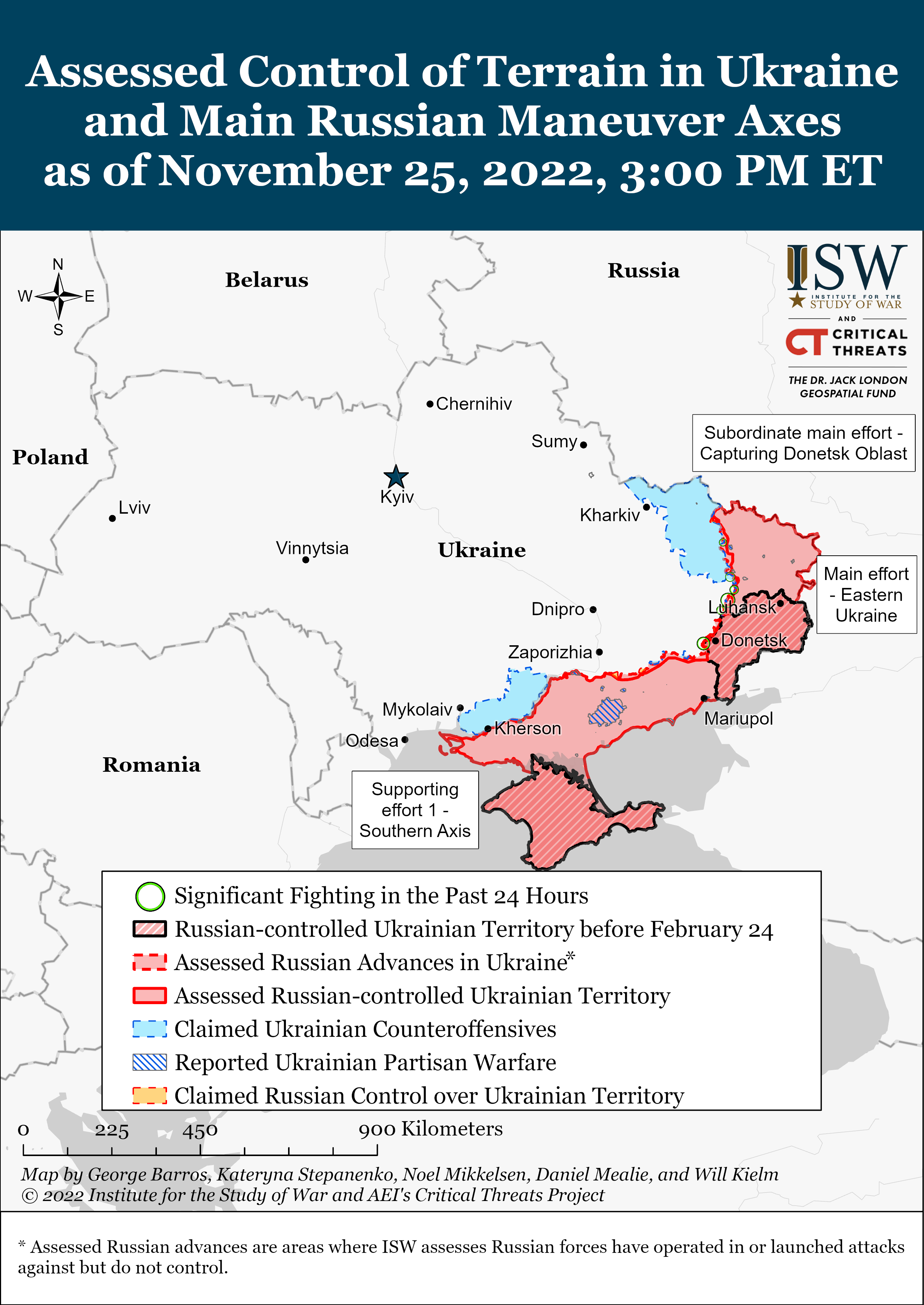
Key Takeaways
- Reports of a group of understaffed and ill-supplied mobilized personnel are dividing the Russian information space.
- President Vladimir Putin falsely presented a meeting with hand-picked women as an open discussion with mothers of mobilized personnel.
- An investigation by Forbes’ Ukrainian service revealed that the war in Ukraine has had a serious financial impact on the Russian Federation’s annual budget.
- The Russian MoD may have increased the frequency of POW exchanges to soothe discontent in the Russian information space.
- A Ukrainian official confirmed that Ukrainian forces killed Iranian military advisors in Russian-occupied Crimea and threatened to target Iranian military presence on Ukrainian territory.
- Russian military leadership may be circulating a document stating that Russia needs to mobilize five million personnel to win the war in Ukraine, which Russia cannot do.
- Russian forces conducted limited counterattacks to regain lost positions northwest of Svatove and Russian sources claimed that Ukrainian forces continued counteroffensive operations toward Kreminna.
- Russian forces continued to conduct offensive operations in the Bakhmut and Avdiivka areas, and influential Russian figures may be setting informational conditions to deflect blame for a lack of progress in the Bakhmut area.
- Russian forces continued to establish defenses south of the Dnipro River in Kherson Oblast and around critical ground lines of communication (GLOCs) connecting Crimea to southern Kherson Oblast.
- Russian sources and officials continue attempts to shape the narrative around a likely second partial mobilization while denying the potential for general mobilization.
- Russian officials are continuing efforts to stimulate demographic change in occupied areas of Ukraine by deporting Ukrainian residents and replacing them with imported Russian citizens.
Reports of poorly staffed, provisioned, and supplied Russian mobilized personnel are dividing the Russian information space, exposing the tension between milblogger mobilization narratives, Wagner Group narratives, and actual Russian efforts to alleviate morale issues. Mobilized personnel from Serpukhov, Moscow Oblast, claimed on November 23 that the Russian military command sent them into battle without proper training, uniforms, or protective gear, leading them to suffer mass casualties. These personnel also claimed that command only feeds the mobilized personnel once a day despite having enough food to provide more meals.[1] A Russian source reported that the Serpukhov mobilized personnel now face a military tribunal for desertion, but the men later released a second video denying that they are deserters and stating they are willing to serve on the second and third lines of defense rather than the front line.[2]
Russian milblogger responses split between calling for compassion for the mobilized personnel and punishment only for leadership, and punishment for the entire unit. A Russian milblogger claimed that these Russian personnel abandoned their positions in Makiivka, Luhansk Oblast, and left other members of their unit to be executed when surrendering to Ukrainian forces (an accusation that the Ukrainian government is investigating).[3] Some Russian milbloggers, including at least one channel affiliated with the Wagner Group, sympathized with the Serpukhov personnel and criticized the Russian training and command issues that led to this situation.[4] These milbloggers also criticized other Russian milbloggers who, they say, wrongfully condemned the Serpukhov personnel for Russian military command, training, and provisioning issues out of their control. One Russian milblogger even claimed that military personnel do not refuse to fight, but that they do not want to be “cannon fodder.”[5] Alexander “Sasha” Kots, a milblogger whom Russian President Vladimir Putin recently appointed to the Russian Human Rights Council, called for objectivity when viewing the video and said he would raise the issue with Putin in his new position on the Human Rights Council.[6] However, some milbloggers still criticized Kots for being too soft on the Serpukhov personnel and called for increasingly harsh penalties.[7] The mixed responses from milbloggers with various Kremlin and external affiliations about ongoing mobilization issues further illustrates the extent of the erosion of Russian morale and the increase in confusion among the pro-war Russian nationalist community resulting from poorly-executed mobilization and other force generation efforts.
Russian President Vladimir Putin falsely presented a meeting with 18 hand-picked women holding influential positions in the Russian political sphere as an open discussion with the mothers of mobilized personnel on November 25, two days before Russian Mother’s Day.[8] Russian media publicized the meeting in an apparent attempt to assuage discontent from relatives of the mobilized and appeals from genuine mothers’ and wives’ groups.[9] Putin used the meeting to pledge to improve conditions for the mobilized, to call on Russians to distrust unfavorable media reports surrounding mobilization, and to display solidarity with the families of Russian soldiers.[10] Meanwhile, the calls of relatives of Russian soldiers have reportedly not received a response. A Russian news channel posted a video on November 24 in which a Russian woman claims that authorities will not meet with her even though she has been looking for her soldier son who disappeared in March.[11] The Council of Mothers and Wives posted that unidentified individuals began to surveil their members following their November 21 announcement of a roundtable discussion to consider the problems facing conscripts.[12] YouTube channel Moms of Russia posted a video appeal to Putin in which several mothers asked Putin to prevent the mobilization of their only child.[13] ISW saw no evidence of a response to the video from Putin. The Council of Mothers and Wives reportedly also expressed the belief that the invitation to Putin’s meeting of mothers only applied to specially selected individuals.[14]
An investigation by Forbes’ Ukrainian service revealed the extent of the financial strains that the war in Ukraine has imposed on Russia’s annual budget. Forbes found that Russia has spent $82 billion dollars on the first nine months of the war in Ukraine, amounting to one quarter of its entire 2021 annual budget of $340 billion.[15] The investigation emphasized the impact that mobilization had on military-related expenditures since October and observed that providing for the 300,000 mobilized cost an additional $1.8 billion per month in addition to the increased costs of providing ammunition, equipment, and salaries to mobilized recruits, which in total amounted to a $2.7 billion increase following mobilization. ISW has previously reported on the detrimental effects of mobilization and the Kremlin’s overall war effort on the Russian federal budget.[16] In addition to the massive impact the first nine months of the war have had on the federal budget, ISW has also observed that local Russian administrations on the regional level have disproportionately borne the brunt of mobilization in a way that will continue to have reverberating social and financial impacts into 2023.[17]
The Russian Ministry of Defense (MoD) may have increased the frequency of prisoner of war (POW) exchanges in an attempt to soothe discontent in the information space regarding its prior failures to negotiate the return of Russian POWs. Russian and Ukrainian sources reported three concurrent POW exchanges between November 23 and 25. Russian and Ukrainian officials exchanged 35 Russian POWs for 35 Ukrainian POWs on November 23, 50 Russian POWs for 50 Ukrainian POWs on November 24, and nine Russian POWs for nine Ukrainian POWs on November 25.[18] The frequency of POW exchanges over the past few days is an inflection in itself- the Russian MoD has been notably restrained in the conduct of such exchanges and has faced significant criticism over its apparent lack of regard for Russian POWs in recent months.[19] The increased frequency of POW exchanges is likely meant partially to address discontent from Russian milbloggers, who reported on the most recent series of exchanges with a relatively neutral tone and emphasized the equal ratio of exchange.[20]
A Ukrainian official confirmed that Ukrainian forces killed Iranian advisors in Russian-occupied Crimea in October and stressed that Ukraine would target any Iranian military presence on Ukrainian territory. Ukrainian National Security and Defense Council Secretary Oleksiy Danilov confirmed that Ukrainian forces killed the Iranian military advisors in a November 24 interview with the Guardian.[21] Danilov did not specify how many Iranian advisors Ukrainian forces killed, but an October 10 Jerusalem Post report put the figure at 10 Iranian military advisors.[22] US National Security Council Spokesperson John Kirby confirmed on October 20 that Iranian military personnel are in Russian-occupied Crimea to assist Russian forces in operating Iranian-made drone in attacks on Ukrainian civilians and civilian infrastructure.[23] Danilov also threatened that Ukrainian forces would target any Iranian military presence on Ukrainian territory.[24] The confirmation and threat will likely not dissuade Iran from continuing to support Russia through the provision of high-precision weapons systems. ISW has previously assessed that Iran may be supplying drones and potentially ballistic missiles to the Russian Federation to more clearly establish an explicit bilateral security relationship with Russia in which they are more equal partners.[25]
Russian leadership may be distributing a document among Russian servicemembers stating that Russia needs to mobilize five million personnel to win the war in Ukraine, an impossible task for the Russian Federation. The Ukrainian General Staff Deputy Chief Oleksiy Hromov stated on November 24 that the military-political leadership of the Russian Federation has prepared a document titled “Conclusion of the War with NATO in Ukraine” and has begun distributing it among Russian servicemembers.[26] The document reportedly identifies shortcomings of the Russian Armed Forces and notes the need for Russia to mobilize five million Russians to win the war in Ukraine.[27] It is unclear whether Russian leadership considers the five million figure a possible target or whether it is an unreachable projected force requirement, reasonable or not, that suggests that they cannot achieve their objectives in Ukraine. Russia’s chaotic and ineffective conduct of partial mobilization with the target of 300,000 mobilized personnel suggests that the mobilization of five million Russians is an impossible task for the Russian Federation. Russian leadership may have drafted and distributed the document in the fashion of Soviet-style after-action reports that deflect responsibility from the overarching strategic leadership failures of the war and place culpability for failure on the operational and tactical failures of the Russian military. Hromov, however, provided no additional details and ISW has been unable to obtain any corroboration or independent reporting about the document.
See the full report here.
The post ISW Russian Offensive Campaign Assessment, November 25 appeared first on Kyiv Post.