
The Russian invasion of Ukraine may have made President Volodymyr Zelenskyy a hero in the European Union (EU). But the 27-member body of the continent is not yet ready to make Ukraine a full-fledged member, for which Zelenskyy is trying very hard.
At the emotional level, all the 27 EU nations are with Ukraine in its fight against Russia. Never before have the EU countries provided as much economic and military help as they are rendering to Ukraine.
But when the issue of making it a fellow EU member comes, they are setting compassion aside. They are not providing Ukraine any relaxation in many criteria and various accession procedures for becoming an EU member.
What the EU has done so far is that it is offering Ukraine financial help to prepare itself for meeting the EU criteria. It has proposed an unprecedented support package for Ukraine of up to €18 billion for 2023.
This will come in the form of highly concessional loans, disbursed in regular installments as of 2023 (€18 billion support package to Ukraine for 2023 (Europa.eu).
This “stable, regular and predictable financial assistance” – averaging €1.5 billion per month – will help cover a significant part of Ukraine’s short-term funding needs for 2023.
The EU has said: “Reforms will accompany support under the instrument (financial package), to enhance further the rule of law, good governance, anti-fraud and anti-corruption measures in Ukraine.
Therefore, while considering the evolution on the ground, financial support will be framed by policy conditions geared towards strengthening Ukraine’s institutions and preparing the ground for a successful reconstruction effort, as well as supporting Ukraine on its European path (to become an EU member).”
It further says that building on previous Macro-Financial Assistance packages, this Macro-Financial Assistance+ (MFA+) instrument “will be accompanied by reforms to help Ukraine advance on its path to becoming a member of the EU.
This means that the Ukrainian government will have to complement the financial support with sectoral and institutional reforms, including anti-corruption and judicial reforms, respect for the rule of law, good governance, and modernization of the national and local institutions. We will check that these reforms have been effectively implemented when paying out the installments.”
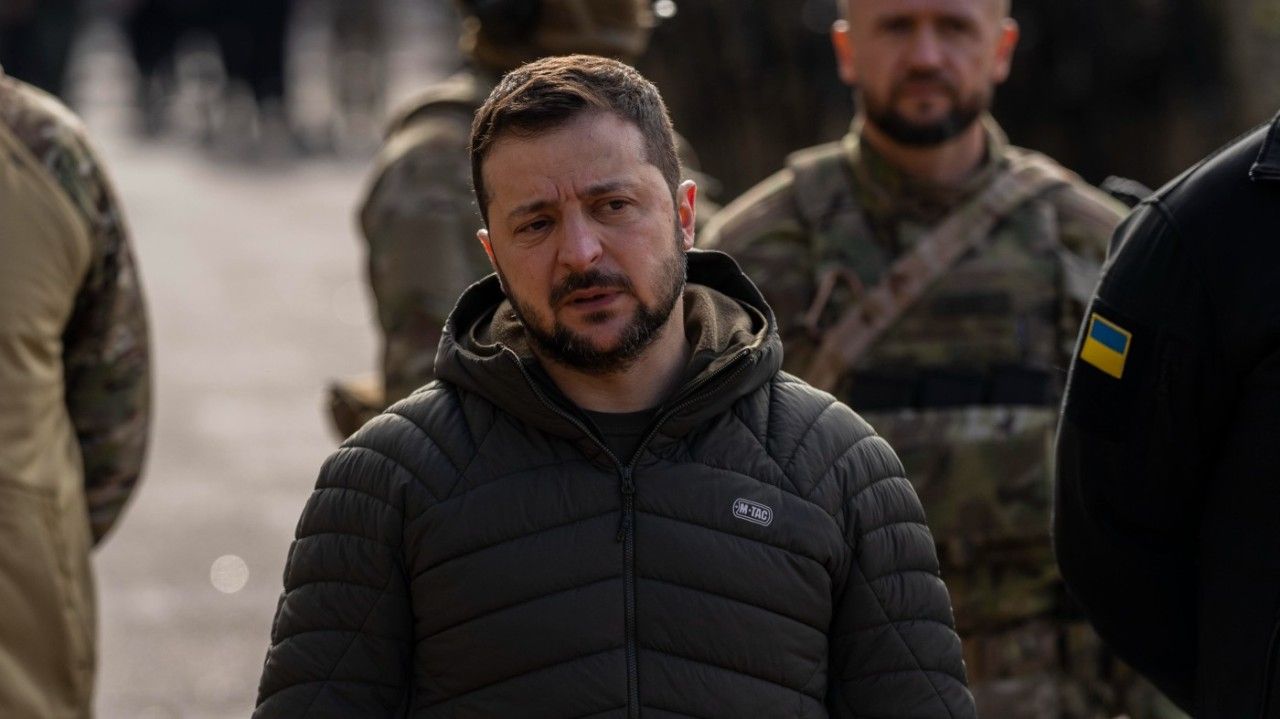 Ukrainian President Volodymyr Zelenskyy (Twitter)
It may be noted that an EU-aspirant country has to meet three primary conditions, also known as the “Copenhagen criteria” – having stable and democratic institutions, being a functioning market economy, and implementing the European Union’s legislative corpus (the “acquis,” in EU parlance).
The Commission also monitors the effective implementation of more than 60 years of EU policies and laws, divided into more than 30 chapters, which include areas like transport policy, taxation, financial services, agriculture, and public procurement, to name a few.
What this means is that though the EU granted Ukraine a “candidate status” in June at a rapid pace, for the country to become a full EU member, it needs to adopt and implement all the EU policies, including the political provisions that go beyond the trade and economy-related areas.
If the EU members granted the candidate status very quickly, it was mainly out of solidarity with Ukraine after Russia’s aggression, which otherwise probably would have remained an associate country.
Fragile Rule Of Law In Ukraine
The ongoing war may have changed Zelenskyy’s profile; otherwise, his democratic credentials as a President were deeply suspect in Europe. There are doubts about whether Ukraine has the institutions to preserve democratic governance and human rights.
The European Commission has noted in past Ukraine’s shortcomings in the rule of law, mainly external interference with the courts at all levels and in the anti-corruption institutions. The rule of law remains utterly fragile in Ukraine, with a lack of transparency in the procurement system and a weak judiciary.
It is also noteworthy that oligarchs exercise disproportionate influence in Ukraine’s media landscape, while the country lags in some areas related to human rights. The EU is unhappy about that.
The EU is also upset that Ukraine does not have a European-style party system based on socio-economic interests and values but predominantly leadership-based parties without clear political goals. Susceptible to external financial interests, the elected representatives often undermine reform they have officially committed to vis-à-vis the EU and their electorates, the EU notes.
Ukraine does not have a functioning market economy and the ability to absorb the competition within the EU. The EU has noted several deficiencies in this regard: a big shadow economy, the absence of an anti-monopoly policy, and widespread corruption that deters investors and slows economic growth. Ukraine’s banking sector continues to suffer from underperforming and predominantly state-owned enterprises.
An authoritative report published in 2021 by the European Court of Auditors, the EU institution tasked with evaluating the spending of taxpayers’ money through the EU budgets, highlights the problem of “grand corruption” in Ukraine (CSSAnalyse314-EN.pdf (ethz.ch).
 File Image
Grand corruption essentially describes the oligarch’s unhealthy and informal links to the media, the political parties, and the government, which, in turn, influence the law-enforcement agencies, the courts, and the state-owned enterprises.
According to this report, the use of high-level power and state capture by the few hinders competition and economic growth, harms the democratic process, and helps to maintain a norm that justifies petty corruption in society. It also says that public trust in the judiciary and law-enforcement agencies remains very low.
Considering all this, one may agree with Henrik Larsen, Senior Researcher in the Swiss and Euro-Atlantic Security Team at the Center for Security Studies (CSS) at ETH Zürich and a former Political Adviser with the EU Delegation to Ukraine, when he says that solidarity with Ukraine in surviving a war of aggression must be accompanied by realism about the country’s ability to draw closer to EU membership.
Viewed thus, while Ukrainians are currently locked in a fight for national survival, the prospect of potential future EU membership gives the country, which has an authoritarian past, an added meaning to the country’s war effort. And that is a road map towards integration with a “democratic” Europe.
But, whether President Zelenskyy is the right man to have the capability to tread that path remains to be seen.
- Author and veteran journalist Prakash Nanda has been commenting on politics, foreign policy on strategic affairs for nearly three decades. A former National Fellow of the Indian Council for Historical Research and recipient of the Seoul Peace Prize Scholarship, he is also a Distinguished Fellow at the Institute of Peace and Conflict Studies.
- CONTACT: prakash.nanda (at) hotmail.com
- Follow EurAsian Times on Google News