It was 2002, and Justin Rose was on a losing streak. The 20-year-old South Boston native had washed out of the University of Maine after just one semester, held a string of terrible jobs, and had just gone through a bad breakup with a girlfriend. He was hawking cellphones at the Emerald Square Mall in North Attleboro, Massachusetts, when a Marine walked into his store. Rose went into his standard pitch but lost the sale. The Marine Corps recruiter did not. Three weeks later, Rose shipped out to the Marine Corps Recruit Depot in Parris Island, South Carolina, for basic training.
The war in Afghanistan was about to enter its third year, and the war in Iraq was looming on the horizon. “I’ll see you in a couple years,” Rose told his parents. He’d be on active duty, a rifleman, and probably see service overseas. At least that’s what the recruiter told him. “It turned out, I was actually a communications guy in the Marine Corps Reserves,” Rose recalled. “So I came home 13 weeks later.”
A few years would pass before Rose shipped out for his first deployment, arriving in October 2005 at Camp Lemonnier in the sun-bleached nation of Djibouti in the Horn of Africa. His unit had been cobbled together from Marines based, like him, in Massachusetts. The rest hailed from California and Kansas. One of those Midwestern Marines was Jase Derek Stanton.
As part of the Third Provisional Security Company, Rose and his fellow Marines manned the guard towers and entry control points for the largest American outpost on the African continent. They had only been in-country for about a month when one of the Marine reservists from Kansas got drunk, vomited several times, and passed out on the ground outside his quarters. The next thing that Marine recalled, according to a summary in court documents, was waking up to find his pants pulled down and Stanton on top of him, touching his penis. The Marine shoved Stanton away and returned to his own quarters, but didn’t report the assault. A few weeks later, he would wake up to find Stanton assaulting him again. This time, he reported it. But that didn’t stop Stanton, who was acquitted at court martial. And neither did the Marines.
On New Year’s Eve 2005, Justin Rose headed to Camp Lemonnier’s cantina for celebratory $2.50 beers with his fellow Marines before heading back to his “hooch” around 1:30 a.m. Sometime after daybreak, Rose woke up to find someone stroking his penis. Disoriented for a moment, he lept down from his raised bunk and gave chase as a man dressed in red dashed out of his quarters and into another tent. He found Stanton, dressed in red, feigning sleep in his bed; Rose was certain Stanton was the attacker. So Rose did what he had been trained to do. He went to his team leader, a young corporal, and reported the assault. The first question he heard was: “Are you sure you’re not making this up?”

U.S. Marines stand at attention before a sexual assault awareness and prevention 5k race held aboard the Marine Corps Recruit Depot in Parris Island, S.C., on April 25, 2012.
Photo: U.S. Marines
Stigma and Shame
Serving in the U.S. armed forces is dangerous, especially for women. Despite being a minority, making up only 16.5 percent of the military, nearly 1 in 4 U.S. servicewomen reports being sexually assaulted — a rate far higher than that of men. Years of analysis of the issue, handwringing, and incremental reforms have failed to stem what has been called an “epidemic.”
But sexual assault of men in the military is also widespread and vastly underreported. Each day, on average, more than 45 men in the armed forces are sexually assaulted, according to the latest Pentagon estimates. For women, it is 53 per day, according to a September 2022 Pentagon report that uses a new euphemism “unwanted sexual contact” as a “proxy measure for sexual assault.” Nearly 40 percent of veterans who report to the Department of Veterans Affairs, or VA, that they have experienced military sexual trauma, or MST — sexual assault or sexual harassment — are men.
Men, civilian or military, are less likely to report sexual assault, to identify experiences they have had as abusive, and to seek formal treatment for such harms. A 2018 study of active-duty, reserve, and National Guard personnel noted an overall lack of awareness of sexual assault of men in the military, an inclination to blame or marginalize male victims, and substantial barriers to reporting sexual assault — including stigma, a lack of confidence in leadership, and feeling “trapped” by the physical confines of deployment. The 2022 Pentagon report found that about 90 percent of men in the military did not report a sexual assault they experienced in 2021; about 71 percent of women failed to report such an attack. “Underreporting of MST,” according to a 2019 study by researchers from the VA’s Rocky Mountain Mental Illness Research, Education, and Clinical Center in Colorado, “may derive from men’s concerns about stigma, shame, rape myths, lack of past empathic response to disclosures of MST, and the perceived implications of reporting MST for one’s masculinity and sexuality.” For these same reasons, they noted, male MST survivors are at “elevated risk for a vast array of adverse health outcomes.” The trauma of sexual assault can, for example, result in depression, anxiety, nightmares, flashbacks, post-traumatic stress disorder, anger management issues, self-blame, and low self-esteem, among other ill effects.
A decade ago, most veterans who submitted compensation claims for sexual assaults during their military service were denied benefits by the VA. In the years since, the VA has granted claims for military sexual trauma at an increasing rate. More than 103,000 veterans, of all genders, are now formally recognized by the VA as having been sexually traumatized during their service.
From 2011 to 2021, the total number of MST claims filed by men skyrocketed more than 119 percent, from 1,352 to 2,969, according to statistics provided to The Intercept by the VA. By the end of June, more than 2,550 male veterans had filed claims in 2022, almost double the number in 2011 and already 85 percent of last year’s total.
Over the last decade, the number of claims granted by the VA has grown from just 27.8 percent of all claims submitted for compensation by men in 2011 to 68.5 percent last year. Despite the precipitous growth, male claims have consistently been rejected at a higher rate than those of women, and the grant rate has lagged an average of 13 percent below that of women. The VA had no answer for the disparity, telling The Intercept via email that “it would be speculative to provide an explanation as to any difference in the grant rate.”

Justin Rose holds a challenge coin he received while deployed to Camp Lemonnier in Djibouti in 2005.
Photo: Alyssa Schukar for The Intercept
Trust Betrayed
After being assaulted, Justin Rose was made to recount the details again and again, to his squad leader, his platoon sergeant, Jase Stanton’s squad leader, and a chaplain. The trust he placed in his noncommissioned officers to keep his story quiet was quickly betrayed as word spread across the camp. Rose was branded the Marine who had been groped and hadn’t done anything about it. He became the target of jokes and tried laughing along, but inside he was in agony and began questioning himself. Why hadn’t he done anything about it? Why hadn’t he kicked Stanton’s ass? He did the right thing, on paper at least, but it didn’t feel right. “A real Marine would have fought back,” he later wrote. He began to blame himself for his assault and his failure to react as others — and even he — expected. “My inaction that night crippled me, and I had no way to fix it,” he recalled.
Rose returned stateside, remained on active duty, and was promoted to corporal before being called to testify at Stanton’s court martial. But before the trial, he was contacted by Stanton’s military attorney who grilled him about his drinking at the cantina and how close a look he got of his fleeing assaulter. “When you’re in the Marines and an officer calls, you just answer the questions. In hindsight, now that I’ve been a company commander and have been involved with court martial hearings, I realize that was probably improper,” Rose told The Intercept.
“My inaction that night crippled me, and I had no way to fix it.”
The defense dissected his testimony, twisted it around, and used it to attack his credibility. Rose recalled that the defense counsel said his drinking of three beers at the cantina, hours earlier, had clouded his mind; that he had failed to get a clear look at the man who assaulted him; and that his failure to confront Stanton called into doubt whether the assault even occurred. Rose and four fellow Marines who provided evidence against Stanton were instead accused of colluding to ruin his career.
“The main consensus was that we were trying to conspire against Stanton for cultural and social differences,” Rose told The Intercept. “He was a Midwesterner from a religious background, and we were from the Northeast and not accustomed to his kind of Christian fundamentalism.” The military judge ruled in Stanton’s favor and he walked free.
“By the time it was over,” Rose later wrote, “the Marine Corps had failed me three times: It had failed to take my claims seriously; then made my attacker out to be the victim and me the criminal; and finally failed to provide adequate support and resources in the aftermath of my assault — whether through access to sexual-assault counseling or something as simple as believing my story.”
Rose had had enough. He found that he couldn’t wear the same uniform as the man who had assaulted him and the many others who allowed Stanton to get away with it. “The military justice system said that I was a liar for something that I had no reason to lie about. If I was going to lie about anything, it certainly wouldn’t be that I was sexually assaulted and didn’t do anything about it,” he said. “It ended up being the reason that I left the Marine Corps. It shook my confidence in myself. It was a point of self-doubt. It was a point of shame.”
In 2007, the same year he left the Marines, Rose joined the Massachusetts National Guard. He would deploy to Afghanistan in 2011, where he saw combat and suffered a traumatic brain injury while serving as a Security Forces platoon leader for a Provincial Reconstruction Team in Uruzgan Province.
Stanton served in the Marines for several more years before leaving the corps and getting involved in Kansas politics. He worked as the campaign manager for Republican congressional candidate John Rysavy and as a field coordinator for the Republican senatorial campaign of Todd Tiahrt, a 16-year member of the U.S. House of Representatives. In 2010, Rysavy lost his primary, capturing just 2 percent of the Republican vote. In 2014, Tiahrt lost in the Republican primary, failing in a bid to reclaim his House seat from Mike Pompeo, who was later become U.S. Secretary of State.
Politics was not, however, Stanton’s only pursuit.
String of Assaults
Over the next decade, Stanton would be implicated in a string of sexual assaults. In 2007, after he had been acquitted at court martial, Stanton’s reserve unit — based out of Kansas City, Missouri — took part in one of its monthly weekend trainings. One night, according to court records obtained by The Intercept, he and other Marines went out drinking and after the bar closed, headed back to their base to sleep. Stanton attempted, multiple times, to grope two of the men. One of them, after repeatedly telling Stanton to stop, threatened to hurt him and later reported the incident, according to court documents.
In Johnson County, Kansas, in July 2008, Stanton attended a farewell party for a member of the military being deployed to the Middle East. One party-goer drank heavily and passed out, after which Stanton laid him out on a couch, pulled off his pants, and performed oral sex on him, according to the court records obtained by The Intercept. After a friend of the victim contacted the police, Stanton was charged with aggravated sodomy and aggravated sexual battery and resigned from Tiahrt’s campaign.
During the investigation, the Johnson County prosecutor contacted Rose and interviewed him about his assault by Stanton, though Rose was never called to testify. In the end, Stanton was convicted but served no prison time. Instead, he was given probation and required to register as a sex offender — but failed to properly do so.
While Rose and others had information about Stanton’s past that they shared with civilian authorities, the civilian world had no formal record of Stanton’s military legal proceedings. As the deputy attorney of nearby Riley County, Kansas, Bethany Fields prosecutes major crimes like murder, rape, and other forms of sexual assault, but she had no documentation on Stanton. “The military court martial proceeding didn’t follow him into civilian life, so there was no way for local law enforcement to know about it,” she told The Intercept. She also failed to find any records of Stanton’s court martial for the assaults at Camp Lemonnier.
Stanton’s probation meant that he was facing prison time if he was convicted again, but after failing to provide full information when registering as a sex offender, he disappeared from the radar of the criminal justice system until resurfacing a few years later in Fields’s Riley County.
“The military court martial proceeding didn’t follow him into civilian life, so there was no way for local law enforcement to know about it.”
On June 7, 2015, two soldiers, one 19 years old and the other 22, from the Army post at Fort Riley, were drinking at Tubby’s, a sports bar in Manhattan, Kansas, where they met Stanton. At closing time, the men went back to Stanton’s home where he poured shots and fixed them mixed drinks. The teenager passed out and woke to find Stanton “was sitting on top of him and was sodomizing him,” according to court documents. He scrambled to his feet and fled to the bathroom. When he emerged, he saw his friend passed out with his pants and underwear pulled down to his knees. The 19-year-old soldier pulled his friend’s pants up and attempted to contact his superiors and then family members, but couldn’t reach either. He then called the Army’s Sexual Harassment/Assault Response and Prevention hotline and arranged to meet with a SHARP representative at a nearby Starbucks. The teenage soldier was unable to wake his friend and left him at Stanton’s home. Both victims went to the hospital separately and received sexual assault examinations that revealed “a foreign DNA profile that matched Stanton.”
Stanton later texted a friend that he had a “three-way while that moron Boston kid [the 22-year-old] was asleep in the living room.” At trial, Stanton explained that he meant that he, according to summary documents, “messed around” with a friend and the teenage soldier, even though he had initially told a police detective that he had not had sexual intercourse with the teen. Arrested on June 9, 2015, Stanton was charged in Riley County with aggravated criminal sodomy.
A decade after being assaulted by Stanton at Camp Lemonnier, a decade after being doubted by the Marine Corps and accused of lying at court martial, a decade after Stanton had walked free, a detective from Kansas — where testimony about prior acts of sexual misconduct is admissible in court — called Rose to say that he was building a case against Stanton.
At trial, Stanton testified that he and the teenager had engaged in consensual oral and anal sex. The teenager countered that he had been unconscious. “At no point did I knowingly or intentionally hurt anyone,” Stanton maintained.
The 22-year-old victim did not appear at the trial — but Rose did. Then an Army captain with a wife and 2-year-old child, he flew to Kansas to tell his story once more. It was his 34th birthday.
This time, Rose’s testimony along with the victims of the 2005, 2007, 2008, and 2015 assaults was enough to sway the judge, who noted a distinct pattern. “They involved alcohol, they involved partying, usually asleep or perhaps passed out. … Most of them were in the military,” observed Judge Meryl D. Wilson.
“It’s very troubling — this is not the first time you had taken advantage of someone,” said Wilson. “The sad things about these situations is it doesn’t just impact you.” Wilson found Stanton was guilty of one count of aggravated criminal sodomy for his assault of the teenage soldier and sentenced him to 49 years in prison. He was also sentenced to 18 years (to be served concurrently) for failing to properly register as a sex offender in Kansas.

The National Museum of the Marine Corps in Triangle, Va., on Nov. 18, 2022.
Photo: Alyssa Schukar for The Intercept
Pentagon Dysfunction
Last July, an investigation by The Intercept found that sexual assault of U.S. military personnel in Africa was far more common and widespread than the Pentagon reported to Congress.
The Pentagon’s Sexual Assault Prevention and Response Office compiles annual reports that claim to include all allegations of sexual assault involving U.S. military personnel. Between 2010 and 2020, the Pentagon listed just 73 cases of sexual assault in the U.S. Africa Command, or AFRICOM, area of operations. Yet criminal investigation files, obtained by The Intercept via the Freedom of Information Act, show that military criminal investigators logged at least 158 allegations of sexual offenses in Africa during that same period.
The case files revealed that these charges of sexual misconduct involving U.S. military personnel occurred in at least 22 countries in Africa, including 13 nations that do not appear in the annual Department of Defense reports. Some of the allegations accuse members of the military, while others recount attacks on U.S. personnel by civilians on or near U.S. outposts. For 2006, the year that Justin Rose reported his assault by Jase Stanton, the Defense Department’s official annual report doesn’t even offer a breakdown of such attacks by country.
A March 2020 report by a military advisory committee lamented the “difficulty in obtaining, uniform, accurate, and complete information on sexual offense cases across the military.” Last November, The American Prospect reported that Pentagon officials were long aware that the military’s system for reporting sexual assaults was dysfunctional, leading to underestimates of the scale of the problem. This may help explain the wide discrepancy between the Pentagon’s annual figures and the AFRICOM files obtained by The Intercept. Earlier this year, in a letter to Defense Secretary Lloyd Austin, Reps. Katie Porter, D-Calif., and Jackie Speier, D-Calif., took the Pentagon to task for its failures in tracking sexual assault. “Poor data management makes it difficult for DoD leadership to understand the scope of the problem or respond effectively,” they wrote.
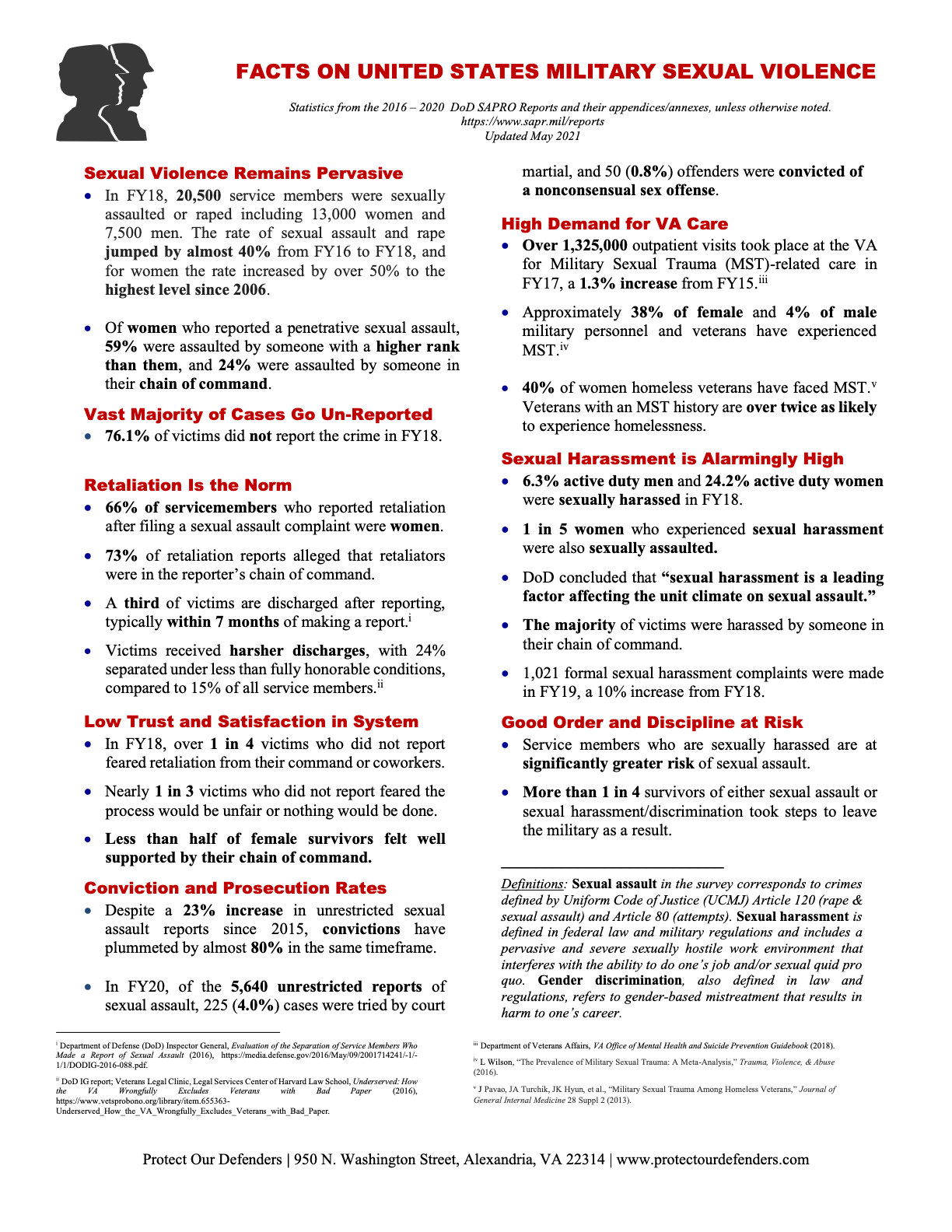
The Pentagon notes that survivors of sexual assault are often reluctant to come forward for a variety of reasons, including a desire to move on, maintain privacy, and avoid feelings of shame. Yet troops say that even when they do speak out, they often face a military culture and command structure that doesn’t take their allegations seriously and a military justice system that provides little accountability. Just 225 of 5,640 eligible cases went to court martial and only 50 of those resulted in convictions for nonconsensual sexual offenses, according to 2020 statistics. That conviction rate represents 0.88 percent of the cases.
This year, President Joe Biden signed an executive order making sexual harassment, for the first time, a crime under U.S. military law.
The effects of poor accountability and shame surrounding sexual assault while on active duty can continue far beyond one’s period of military service. “Despite successes in ensuring access to care for men who experienced MST, ongoing stigma related to experiencing sexual trauma in men also may be a barrier to seeking care,” Randal Noller, a VA spokesperson, told The Intercept. “We are looking at every avenue to help address this concern and inform men who experienced MST that VA believes them, that they are not alone, and we are here to help.”
Last year, in the face of increasing congressional pressure, Austin recommended that decisions to prosecute cases of sexual assault be taken out of the chain of command. In December 2021, Congress passed significant military justice reform that did so, which may prevent retaliation and lead more survivors to report sexual offenses. This year, President Joe Biden also signed an executive order making sexual harassment, for the first time, a crime under U.S. military law.

Justin Rose stands outside of the National Museum of the Marine Corps in Triangle, Va., on Nov. 18, 2022.
Photo: Alyssa Schukar for The Intercept
“Changes Will Happen”
Today, Jase Stanton is incarcerated at the El Dorado Correctional Facility in Kansas. Barring parole board intervention or credit for “good time,” his earliest release date is January 1, 2059 — 53 years to the day that he assaulted Justin Rose.
Stanton did not reply to text messages sent via an app that allows communications with inmates or to a letter sent to him by The Intercept.
“In the years since then, I came to realize that it wasn’t the assault that had the most enduring effect on me,” Rose said. “It was people’s refusal to believe that one man would assault another man. It was the mockery from leaders that I had trusted and the implication that, if it had happened, I must have done something to invite it.”
Rose, now a major in the Army Reserve, still grapples with feelings that, somehow, he remains at fault. “There is guilt on my behalf. I didn’t present a convincing enough case,” he said of his testimony at Stanton’s 2006 court martial. “And these two soldiers down at Fort Riley paid for it. What he did to them was substantially worse than what he did to me, and that’s a shitty feeling — that I didn’t do anything to help them.”
But Bethany Fields, the Riley County prosecutor, credits Rose’s willingness to testify in 2015 as having a major influence on Stanton’s conviction and lengthy prison sentence. “The case got delayed a couple times, so we had to call and tell the earlier victims that the dates had changed, but Justin stuck with me. That was huge,” she said. “In this case, the issue was consent. We had DNA, so there was no question that the act happened. The issue was whether or not the victim consented. Because we had Justin and others come in and say, ‘This happened to me and I didn’t consent,’ ‘I saw him do this and that person didn’t consent’; because we had all these other people who said they had been sleeping or drinking or passed out and didn’t consent, it made for a much stronger case.”
Fields believes that testifying about these traumas will help to hasten change. “The more the word gets out about this type of assault, the more that people are willing to talk about this, the more people speak out,” she said, “the more changes will happen and the less victims we will have in the future.”
Rose said that he’s seen a shift in military culture since his assault at Camp Lemonnier — and that it’s been driven by survivors.
“There was a perception, as a male sexual assault victim, that you wanted it. And if you didn’t, you could have fought back harder. And that creates a culture of silence,” he said. “Today, you see a lot more people being open about their stories. People are willing to come forward. They’re not ashamed of what has happened to them. And because of that, things are changing.”
The post In U.S. Military, Sexual Assault Against Men Is Vastly Underreported appeared first on The Intercept.