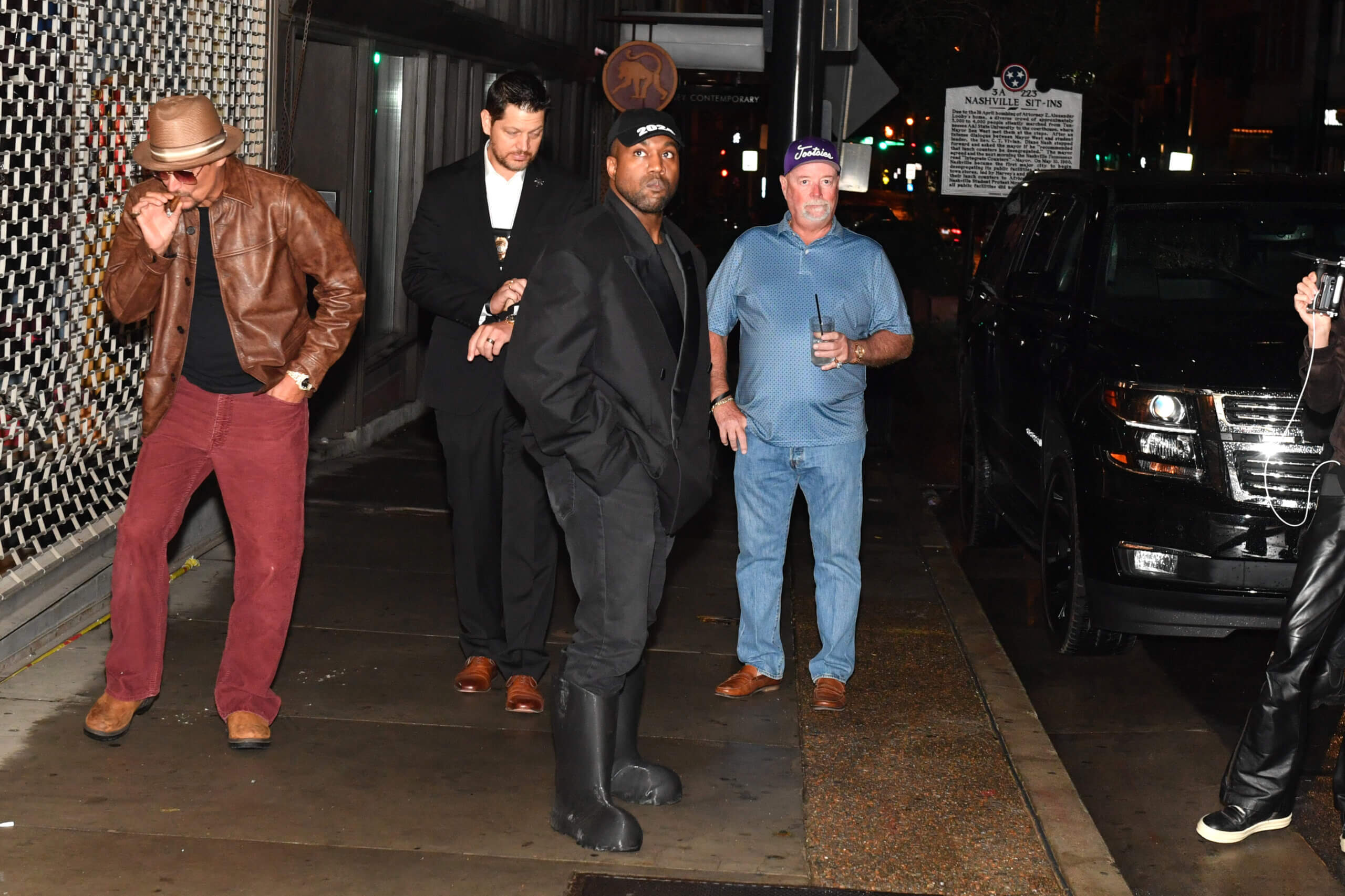
Well before Kanye West publicly praised Hitler (though well after he allegedly did it in private), he was seen out on the town in what looked like a cartoon version of Nazi jackboots.
Ye purports to be an aesthete. He launched a fashion line that included insanely expensive plain white T-shirts and shoes that look like something out of a David Cronenberg film. On an episode of My Next Guest Needs No Introduction with David Letterman, we got a look inside his white, minimalist home (in a widely circulated 2019 video, his ex-wife, Kim Kardashian, showed off its basin-less sinks).
So it’s really no surprise that, if you listen to his Thursday appearance on Alex Jones’ Infowars, the things West was praising Hitler for were, for the most part, aesthetic.
“He had a really cool outfit and stuff, and he was a really good architect,” West, who legally changed his name to Ye, told Jones.
“So you’re in love with the look of it?” Jones asked.
Ye didn’t answer directly. Instead, and somehow this is being glossed over, he replied, “And he didn’t kill 6 million Jews, that’s just, like, factually incorrect.” But it’s pretty clear that, at least as a starting point, the “look” may have been what got him hooked.
A huge part of the Nazi program was killing with looks. Hugo Boss manufactured the SS uniforms. Hitler wasn’t an architect, but one of his closest confidants, Albert Speer, was. Hitler, too, was concerned with appearances, approving an official art style and labeling others degenerate.
Much has been made of West’s erroneous declaration that Hitler invented highways and “invented the very microphone that I use as a musician.”
The last comment isn’t entirely off the mark. The microphone Ye, and many other recording artists, use in the booth is likely the Neumann U87, a descendant of the Neumann CMV3, which became known as the “Hitler Bottle.”
In the 2020 documentary The Meaning of Hitler, microphone expert Klaus Heyne explained how the CMV3, a microphone that allowed for a greater range of movement from a speaker, was used to great effect by the Führer.
“All of a sudden Hitler was able to be more evocative, more animated in his delivery because he wasn’t shackled by the technology,” Heyne says in the film. This allowed for wild gesticulations, wild shifts in volume and tone. The effect of wall-to-wall sound and crescendo, Heyne wagered, was “just the same as when the Beatles performed at Shea Stadium.”
A musician, especially one with a desire to speak to the masses, might find something attractive in this idea.
When Ye says he’s “hot for Hitler,” he may find something appealing in the newsreels of the Nazi leader addressing the Sportpalast. He may like the optics of the “Cathedral of Light,” at the rally grounds, the way Speer made Hitler the focal point — if not the Godhead.
If you look at West’s Sunday Services, he bathes the room in red, magenta or blue light for worship, nominally of God, but, truthfully, of himself and his cult of personality.
Adidas, which West partnered with, and later broke ties with, was founded by members of the Nazi party. Hugo Boss and Coco Chanel (a Gallic collaborator), Volkswagen and Mercedes have all managed to remain relevant without saying nice things about Hitler. They know how to divorce their aesthetics from an ideology.
But West proves that, even 77 years after the collapse of the would-be Thousand-Year Reich, the look and feel of fascism can sell you on its ugly ideas.
The post Nazi aesthetics sold Kanye West on everything else appeared first on The Forward.