Hebrew Israelite groups have been making headlines thanks to Kanye West, Kyrie Irving and their antisemitism controversies. News outlets and advocacy groups like the Anti-Defamation League have published primers describing the groups, which vary widely in their origins, beliefs, and practices. But few of these explainers are shaped by Black scholars who study these movements or by Hebrew Israelites themselves.
That’s why we decided to delve deeply into the subject with two Black experts: Bruce Haynes, a professor of sociology at the University of California Davis, and author of The Soul of Judaism: Jews of African Descent in America; and Walter Isaac, a faculty member at the University of Tennessee Knoxville who has written extensively on Afro-Jewish Studies, including a seminal article in Blackwell’s A Companion to African-American Studies. Isaac is a practicing Hebrew Israelite and was ordained as a universalist rabbi through the online Jewish Spiritual Leaders Institute in 2016.
Below, they answer some critical questions about Israelites’ backgrounds and beliefs, and reflect on public misconceptions.
Robin Washington: There are many myths and misconceptions about Hebrew Israelites. Where do you think they come from?
Bruce Haynes: The media and internet are major sources of confusion and misinformation.
Walter Isaac: They come from the writings of various scholars, most of whom didn’t grow up in an Israelite family or weren’t practicing members of any Israelite community. And so our stories are not the stories they tell. My story is not their story.
What’s wrong with the phrase “Black Hebrew Israelites”?
Haynes: “Black Hebrew Israelite” is a term that conflates many different groups that hold wildly different beliefs and practices. Some adhere to rabbinic practices and some may believe that white-skinned Jews are impostors or say that all Black people are really Jews. Also, not all members are Black. Many are Latinx and some are white.
Isaac: Racializing African Hebrews has a very problematic history. As far back as the late 1600s, Europeans accused our ancestors of heresy, criminality and ritual impurity by labeling us “Black Jews,” “Mulatto Jews,” “Joden kleurlingen” (or “Jews of color”), etc. The “Black Israelite” label shows up at least a century ago, and it’s used by white scholars such as Ruth Landes, Howard Brotz and Israel Gerber, who portrayed nonwhite Jews as psychologically compromised. The stereotype has remained ever since.
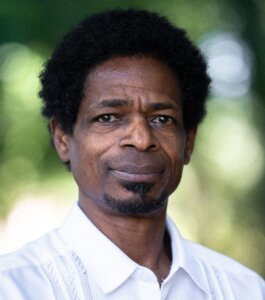 Bruce Haynes Courtesy of Bruce Haynes
Haynes: Also, Black religious bodies generally use geographic places in their names, not race. Examples are the African Methodist Episcopal (A.M.E.) Church, New York’s Abyssinian Baptist Church and Chicago’s Beth Shalom B’nai Zaken Ethiopian Hebrew Congregation, which has Israelite roots.
When were Hebrew Israelite congregations founded?
Haynes: It depends what you mean by “Hebrew Israelite.” Some of the people who today identify as Hebrew Israelite have Jewish roots that date back to slavery in the Caribbean and South America. A few Hebrew Israelites have roots in Ethiopia. Some enslaved Africans who had been converted to Christianity but who strongly identified with Moses and the Exodus story’s promise of redemption from slavery may have also chosen to embrace Hebraic practices.
I’ve read that Hebrew Israelites began with the founding of the Church of God and Saints of Christ in 1896 in Lawrence, Kansas. Is that right?
Isaac: No, not at all. Our communities are diverse and some trace themselves back to African Hebrew communities that are thousands of years old. But if you are asking when the earliest such American communities began, then I would say our communities began the moment African Hebrews arrived in the hemisphere – probably in the 1600s.
Not all members are Black. Many are Latinx and some are white.
How many Hebrew Israelites are there?
Haynes: A recent study that’s been quoted in the media said that 4% of African Americans identify as Hebrew Israelite. However, that study had a margin of error of 3.6%. Looking further back, the 2007 Religious Landscape Study conducted by Pew found that less than .05% of respondents self-identified as members of “Hebrew Israelite” communities. That means more African Americans self-identified as either Mormon, Rastafarian or a part of Conservative Judaism than as Hebrew Israelite.
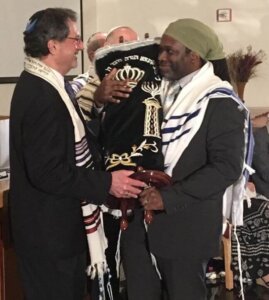 Walter Isaac, holding Torah, is congratulated by Rabbi Monte Sugarman as he becomes the 100th rabbi ordained by the Jewish Spiritual Leadership Institute in 2016. Courtesy of Walter Isaac
Isaac: As for surveys, public admission as a Hebrew Israelite is a poor way to measure our population. In the current environment, I think few people will admit to being Hebrew Israelite if they know others associate it with criminality. Plus, several Israelite denominations headquartered in the United States have many more affiliated congregations in Africa. It’s probably better to count the congregations. I have visited at least 70 or 80, and I am aware of at least 100 more.
Some of the groups around today have Christ in their name, like Israel United in Christ, which staged a march to New York’s Barclays Center recently. How can they be Jewish if they worship Jesus?
Isaac: Not all do, and worship is probably not the right word. Adherents of African American religions often use the same words as Europeans while meaning something different.
There’s a world of difference, for example, between the “Holy Spirit” of European Christianity and the “Holy Ghost” in Afro-Christian congregations. Also, in our communities, the deification of Jesus is usually rejected and “Christ” often means something very different from “Jesus.” The two are not necessarily the same.
To acknowledge that there were Black Jews in Africa in antiquity, or that some Africans became Jewish as a result of the transatlantic slave trade in places like Suriname is not antisemitic.
Why do they call themselves Hebrews instead of Jews?
Isaac: Historically, in the 18th and 19th centuries, the terms “Hebrew” and “Israelite” were more commonly used in reference to Jewish communities in general. Think of the old UAHC acronym for Reform Judaism. It stood for “Union of American Hebrew Congregations.” The term “Jewish” grew in popularity in the 20th century.
Haynes: Clearly at some point people started using biblical language to negotiate race. When Black and interracial congregations formed, they used the nomenclature that was prevalent at the time, and that was the term Hebrew.
So why do they believe that Blacks are the original Jews?
Haynes: First of all, to suggest that among the ancient Hebrews there were Africans is not in itself antisemitic. To acknowledge that there were Black Jews in Africa in antiquity, or that some Africans became Jewish as a result of the transatlantic slave trade in places like Suriname is not antisemitic. The notion that Jewish traders and military garrisons crisscrossed Central, Southern and West Africa, not just Ethiopia, is pretty well-documented. So clearly some of these people are not just fantasizing about Jewish ancestors.
Isaac: I agree. When African Americans say Black people are the original Jews, the only thing we’re doing is reminding everyone of the dangers of whitewashing history. It’s as if to say to the Western world, “Black lives matter even in Jewish history.”
Haynes: Also, if some of this ancestry is over-accentuated, then welcome to the human race. What group or nation doesn’t idealize their heroic forebears?
Why do some claim that white Jews are impostors?
Haynes: Not speaking about all, but when you consider that even the most mainstream of Israelites faced constant rejection by the Askenazi community in the 20th century – the Commandment Keeper’s Rabbi Wentworth Matthew was repeatedly rejected admission to the New York Board of Rabbis – it’s easy to see how bitter seeds may have been sown. And that was a rabbinic-practicing group that was open to dialogue. More radical or Afrocentric groups may have adopted an anti-white stance out of these kinds of bitter experiences, leading to a confirmation bias when their actions led to further rejection.
Isaac: You could ask why do some European Jewish people claim that we are impostors? This tradition of white Jews and Black Jews playing tit-for-tat and “talking smack” to each other goes back at least to the mid-1700s when you start seeing Black synagogues being set up, such as in colonial-era Suriname.
There is an entire area of Jewish law dealing with the treatment of non-Jewish slaves. Our communities started their own congregations because they believed that no real, authentic Judaism could possibly endorse slavery and racial segregation.
Why do some Hebrew Israelites appear so angry?
Isaac: They’re angry at American racism in general and Jewish racism in particular. The street harassment practiced by some Hebrew Israelite men is wrong, abusive and counterproductive. But that’s another reason why the racial stereotype “Black Hebrew Israelites” should be done away with. It feeds the anger, rather than lessening it.
Secular Jewish institutions must pivot by teaching that both those African Americans who embrace their Israelite heritage and European Americans of Jewish ancestry have valid claims, as do Black people who follow the European rabbinic tradition.
Haynes: Mutual respect definitely has to be a part of the conversation moving forward. But I agree with you. Regardless of belief, it’s never appropriate to accost passersby on the street corner and attack their identity. One can believe whatever they want so long as it doesn’t harm others. But it’s usually the most vocal public performers who wind up getting the most attention.
Bruce, you’ve written and spoken about Hatzaad Harishon, the effort by largely white congregations in New York in the 1960s to reach out to Israelite communities. It died in the early 1970s and is often described as a failure. Was it?
Haynes: That depends on how you’re measuring success. If the goal was to convert Israelites to rabbinic Judaism, then maybe it did fall short. But even then, what’s the measure of success? Christian missionaries don’t get anywhere near a 100% conversion rate.
A few of the Israelites from those meetings did choose to convert, some even to Orthodoxy. And relationships were formed following Hatzaad Harishon’s program that took groups of Black kids to Israel, years before Birthright.
OK, so there are many different types of Hebrew Israelites who believe many different things. What do you say to one that is unquestionably antisemitic? Or to someone who denies the Holocaust?
Isaac: Interesting. Few people ask me about how I respond to white Jews who are “unquestionably racist.” But so be it.
I honestly don’t think I would have anything to say to someone so ignorant as to deny the Holocaust, except the following: I am a proud, born-and-raised, lifelong Hebrew Israelite rabbi from a family spanning at least seven generations in North America alone. Some of my extended family survived the Holocaust in Europe. And from their own mouths, they told me that some of my other relatives did not.
Editor’s note: The Forward avoids use of the term “Black Hebrew Israelites” out of concern that it inappropriately conflates hate groups with organizations and individuals who condemn their actions, and to avoid any confusion between these movements and Black Jews generally. It is also important to note that Israelite groups are not exclusively Black.
We will use the specific names of groups whenever possible, such as the African Hebrew Israelites of Jerusalem or Beth Shalom B’nai Zaken Ethiopian Hebrew Congregation. As we do in all our coverage, we will strive to refer to sources and subjects the way they refer to themselves.
The post Hebrew Israelites: Facts, myths and reflections appeared first on The Forward.