
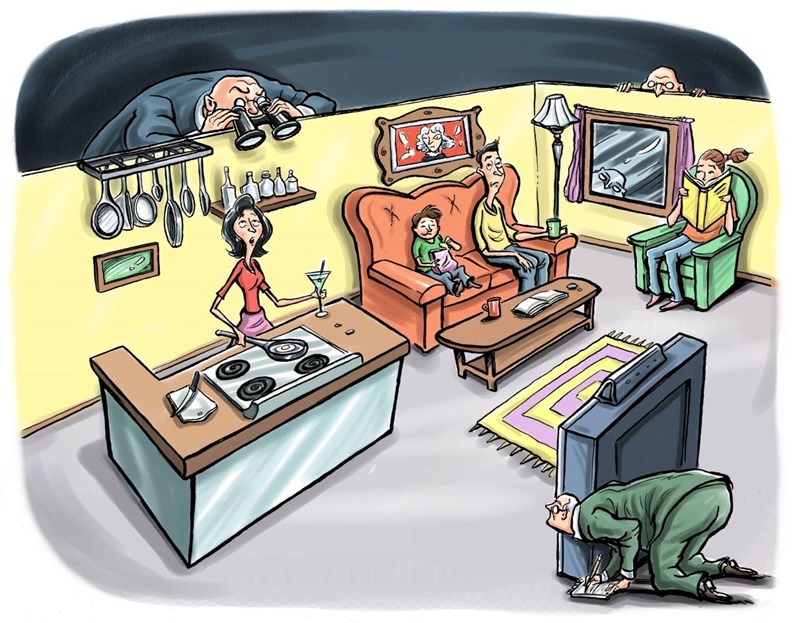
Co-op and condo owners often complain that their board doesn’t do enough, or that the board members aren’t involved as much as they would like in the administration and maintenance of their building. While a disinterested or apathetic board is certainly a problem, going to the other extreme can be just as bad…or maybe even worse.
Board members who let their power go to their heads can be a liability to their building community on many levels, but of particular concern is a board that oversteps its bounds and intrudes on the privacy and agency of individual residents.
Understanding the boundaries and limitations of your power is something that every board member needs to realize or else trouble—including legal problems—can result.
Balancing what is right and what is expected can be tricky for boards — so much so that sometimes, board members and non-board members alike wonder why people bother to serve in the first place.
“I always tell my fellow board members and clients that if you’re going to be on a board, you are basically a sacrificial lamb,” says Luigi Rosabianca, managing partner of the Manhattan-based law firm Rosabianca & Associates PLLC. “You don’t get paid for it, but by doing so you are providing a service to your building. It’s not only a way to protect your investment, but also your quality of life—but [board members] have to learn what being on a board means, and not to overstep their bounds.”
What can a board member really do about an ongoing noise complaint, for example? What sort of majority is needed if a vote in enacted to change something within the condo or co-op? Can a board impose rules regarding security or visitors?
Questions like these can usually be answered by reading the co-op or condo’s official governing documents, says Al Pennisi of the law firm of Pennisi Daniels & Norelli LLP in Rego Park. “The powers are designated in the corporate documents—the certificate of corporation and the bylaws—and some of the additional powers are listed in the offering plan and amended in the offering plan when it’s a co-op conversion. Primarily, it’s the corporate documents and enhanced by case law.”
It’s essential that anyone who is elected to their board read and understand what they can and cannot do as a board member.
“You need to do it with all the knowledge necessary,” Rosabianca says. “The first thing you need to do is read the offering plan or prospectus as well as the bylaws, which very specifically outline what the board’s powers and limitations are.”
In addition to the documents, a new board member can also get advice and instruction from those already involved in the process.
“When someone new comes on, they get instruction from owners, management companies and other board members if they aren’t educated about those sort of things,” says David J. Byrne, a shareholder attorney with the law firm of Stark & Stark, with offices in New York and in New Jersey. “In a practical setting, they don’t always read the documents they should.”
Condos and co-ops have different rules, and their boards have very different powers. Even comparing co-op to co-op or condo to condo will find differences, so just because you served on the board of one building doesn’t mean your current board will operate exactly the same way. Your powers and limitations will be most likely be different on any board you serve.
“The power a board has in a co-op is different than that of a condo,” Pennisi says. “Co-op boards do have more power than condo boards because they control the use of the apartments, they control the sales and leases where in a condo, the unit owner can sell at his or her discretion. Condo boards have less power but both boards can make and enforce rules and regulation pursuant to the documents.”
One of the chief complaints among residents who think their board has overstepped its bounds arises when someone—a super, handyman, or other building staff member—enters their home without permission, usually to check out something like a leak or electrical problem.
“With condos and co-ops you have classic communal living—and with communal living there are certain sacrifices that have to be made,” Rosabianca says. “You are conceding that your neighbors have certain rights to access common elements in the building, and that [building staff] may periodically need to access to your unit.”
Let’s say there is a leak in unit 4F that will affect the owner’s quality of life downstairs in 3F in not taken care of. If the owner in 4F can’t be reached to let building staff into the unit, it is reasonable to expect that the super or repair person will access the apartment to deal with the situation—with or without express permission from the owner of 4F. Upsetting as it might be to think of strangers entering one’s home without permission or supervision, that access is considered reasonable if it’s deemed necessary under the circumstances.
“I always use the ‘reasonableness standard,’” says Rosabianca, “which is vague, but most management companies are really well versed and know what to do and what not to do in situations like these. As a rule of thumb, you should ask, ‘Is this in the best interest of the building?’”
According to Pennisi, co-op documents require you to give the board access to your apartment to make repairs—but that’s not usually the case in condos.
“If there’s a leak in the walls [of your condo,] they just can’t go in and break the door down,” he says. “It has to be a bona fide emergency. If water is leaking under your door and the super or manager has tried calling you and they can’t get in touch with you, they have right to break in and make repairs. I always tell my boards to bring a witness and go in with a camera and take pictures of what the apartment looked like. Don’t go by yourself in case something is stolen and it’s your word against theirs.”
Security in buildings has become a tricky issue in recent years, and since most governing documents were written prior to current concerns about terrorism and other threats, boards sometimes enact security measures that some residents feel may go a bit too far. But does having an especially robust security program in a co-op building ever cross the line from “overzealous” into “invasion of privacy?”
“There could be ‘too much’ security in a practical way or an economical way but not really from a legal point of view,” says Byrne. “The boards probably have a pretty broad discretion to set rules on security, so although it might seem like they are overstepping their power, they aren’t really.”
Some boards feel it’s necessary to have cameras all over their building, a thorough ID check for all visitors, and building access controls that residents may feel are going too far. Some buildings require key code access or card access, and some use cameras to record people coming and going. While it’s fair to say that most residents get a certain peace-of-mind from knowing access to their building is tightly controlled, others find it intrusive, says Pennisi.
“People say, ‘You have no right to take my picture coming and going,’ or they object to having their Social Security number used as an ID” Pennisi continues. “But a number of courts have ruled that [building rules] supercede the individual’s right, because [buildings] have the right to know who’s coming and going. You can’t publish their information or show the videos, however. That would be going too far.”
When it comes to what boards and managers can do with any personal information they collect on building residents, civil rights and privacy laws have the final word. In short, boards and management are prohibited from making any of that information public.
Unfortunately however, “Things happen like that all the time,” says Rosabianca. “People make mistakes …most of the time it’s just errors, rather than fraud. I’m on a couple of boards where they distribute board applications to all board members, and they include a lot of personal details. You’d like to think that your board members are responsible with the information and will shred the information afterwards.”
If materials are being handled properly, Rosabianca continues, one copy of your personal information should be kept under lock and key at the manager’s office—and no one on the board should be distributing that information, or keeping copies for themselves. Some boards are even policing themselves in this respect by blacking out certain information on sensitive documents they see in the course of carrying out their duties to the building.
Though rare, there have been cases where board members have—either through negligence or ignorance—acted improperly with building information or money. Michael Crespo, president of Citadel Property Management Corp. in Manhattan, says he recently dealt with an unscrupulous treasurer.
“We recently had a situation where, in an effort to clear up the books of a building we’d just begun managing, we asked the board’s treasurer if it would be OK to send out two deposit checks that had been collected for [construction] work and move-in fees several years prior,” he says. “The deposits were clearly for a one-time item, and there really was no reason to keep holding on to them—they were just throwing off the balances, and we wanted to clean it up. The board’s treasurer suggested that we do a journal entry and make them ‘disappear.’”
Crespo says that after explaining that these were real deposits that were owed to shareholders, “The treasurer continued to press the issue and explained that he had done this type of thing at his job all the time. In either case, I explained that we know the difference between correcting a journal entry and sweeping someone’s money under the carpet. Needless to say, the shareholders in question (who were also on the board) wanted their money. We ended up cutting them a check.”
While the vast majority of board members take their position in stride and are solely interested in doing what’s best for their building community, some board members do let authority go their head. Most managers and board attorneys have at least one or two stories about boards imposing ridiculous rules on their residents—regardless of whether they actually have the authority to do so.
“Boards do sometimes abuse their power,” Byrne says. “I’ve encountered boards that don’t actually have published rules, yet think they do. There are boards that set unreasonable restrictions on things, or think they have the power to charge residents fines when they don’t.”
Other examples of boards overstepping their bounds and abusing their position include members trying to get family members elected to the board or overseeing applications for people they know, or giving work contracts to friends or family.
“Those are the type of ‘wink-wink’ things you see,” Rosabianca says. “You really want to avoid these types of conflicts. If you are on a board, you should be above the fold. You shouldn’t be soiling your hand.”
Keeping a board in check and on the right side of propriety and the law could be something as simple as pointing out that more rules are not always better.
“We simply like to remind the boards that we deal with that when they implement excessive amounts of rules that infringe upon their neighbors, these rules will often come back to bite the people who created them,” Crespo says. “We’ve seen it time and again: a board puts practices into effect that are very difficult to enforce, and which the very people who implemented them are the ones who end up violating them the most. This is where we like to be the voice of reason. We ask that boards be realistic and use discretion, and ask if they would like these rules enforced upon them.”
Since board members are elected, building residents really have the final say if they think a board member is abusing his or her power. In other cases, a building’s manager or legal council will usually alert the board if board members’ behavior is heading into dangerous territory and the manager or attorney feels they’re abusing their power as a board.
“A board can terminate a person or refuse to allow a sale,” says Pennisi, “but they have to act reasonably and within the corporate documents and if they don’t the courts will strike it. Usually the managing agents and their counsel guide them to not go astray.”
“The best run buildings are those that are the most transparent with nothing to hide,” adds Rosabianca. “I think every unit owner has the responsibility to police their board and if they don’t like what they are doing, vote them out.”
Keith Loria is a freelance writer and a frequent contributor to The Cooperator.