China’s anti-lockdown protests last month were the worst blow yet to the prestige of Xi Jinping. One moment, the Chinese Communist Party’s leader was riding high after securing a third term at the top of the party-state. The next, he was challenged by demonstrators in the streets to “step down,” a sentiment that protestors also chanted against the party itself.
The discontent with the CCP expressed by demonstrators exceeded that of the more massive 1989 protests at Tiananmen Square, albeit this time with much lower numbers: most of the 19 or more cities where protests erupted drew less than 50 people, while the other half in tier one cities with more foreign contact attracted over 50, some in the hundreds.
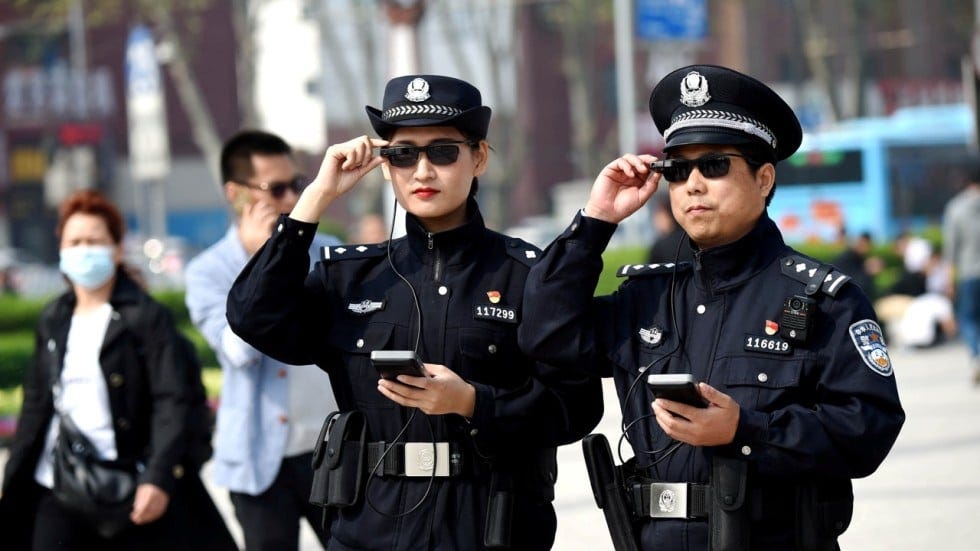
Police officers in Luoyang in Henan province wear sunglasses linked to facial recognition software that can identity fugitives. The devices are just some of the advanced surveillance technology used by police in China. Photo: Reuters via SCMP
Though the numbers were small, it was a notable “political coming out of the closet,” (政治出柜, zhengzhi chugui), much discussed in Chinese social media. But to keep it in perspective, the protests were not thousands of people openly defying authority, as the world now observes in Iran. As far as is known, these were limited actions by small groups in urban centers.
However, the protests in China at the end of November were bold, as those who participated risked arrest or worse. And there is a chance that the demonstrators represented a larger and more cautious percentage of society.
Though the party leadership rapidly (maybe too rapidly) eased the “zero Covid” restrictions that prompted this popular anger, those who spoke up soon learned who was boss.
A rough pattern of police response developed, with some similarity to the way some other protestors have been treated. Mere participants were summoned to police stations to explain themselves and sign statements saying they would never do it again. One demonstrator, perhaps typifying others, had tried to disguise himself with a balaclava and clothing change but was quickly tracked down by police. He was surprised at how easily authorities had picked him out of a large crowd, evidently using his phone data and their urban surveillance system.
Leaders of the protests were treated more harshly. At least one—the man who may have led the first “step down” chants in Shanghai—was apprehended at work and has since disappeared. He, too, thought he might not be identified.
Years ago, well before Xi Jinping’s new era of paranoid surveillance, some citizens have been more clued in than others to the regime’s use of mobiles to keep tabs on users. Chinese citizens secretly working for a foreign intelligence agency were trained to, among other things, separate their phones from any incriminating activity.
Those just living lives removed from international intrigue, but who were tech savvy, also chose different ways to minimize surveillance, according to a Chinese American author who has regularly returned to China for research. They would “put their cell phones in another room when they talk, or take out the SIM cards, use different cell phones to contact different people,” similar to the tactics of protestors in the U.S. to avoid surveillance and police use of data.
Every Move You Make
Another Chinese researcher with a U.S. passport told SpyTalk about his experience of being surveilled during his odyssey around China in 2012-2013, including in Beijing and the Tibetan regions of Sichuan and Qinghai. After conducting his first few interviews, his hosts and those with whom he spoke began receiving menacing calls from people identifying themselves as State Security officers. The agents accused him of being “a member of the Dalai Lama clique,” one of the most poisonous accusations of the time, as it still is today. Even a decade ago, swapping out SIM cards or changing residences at 4:00 am were outdated measures that only drew more attention from authorities.
The researcher interviewed several old Tibetan CCP cadres, including the late Bapa Phüntso Wangye, (Phünwang) whose life is chronicled in the classic 2004 book A Tibetan Revolutionary. As the researcher was about to depart China, State Security officers cornered him at Chinese Customs, initiated the usual thorough search, confiscated his computer hard disk drive, and threatened him with permanent exclusion from the PRC if he published anything.
Compared to now, those were the good old days. “It would be more difficult now,” said the researcher, as authorities “have numerous cameras everywhere, and without a cell phone you really cannot go anywhere or do anything.”
China’s new age of surveillance is in part owed to the maturing capabilities of artificial intelligence (AI) and machine learning (ML), and in part to the ambitions of American companies like Intel, IBM, Seagate, Cisco, and Sun. These firms and others have enabled the CCP to build surveillance systems that retain a massive baseline of data, paired with perhaps the world’s most advanced facial recognition technology. China’s system can save data on every phone user’s movement, activity, preferences, and contacts, even if authorities have not specifically targeted them.
When authorities develop an investigative interest in a person, the system allows Public Security and State Security officers to quickly look deeper and decide on next steps.
Every Breath You Take
Evidence of the conscious and highly profitable role of American companies in helping Beijing perfect its dystopian system abounds: it can be found in books like Surveillance State, a damning essay by Dahlia Peterson in China’s Quest for Foreign Technology, and in a recent comprehensive episode of The Little Red Podcast.
On Nov. 9, two weeks before the anti-lockdown protests erupted in China, Apple took collaboration with Beijing a step farther by rolling out a feature, just in the PRC, restricting use of the Airdrop app. That made it harder for demonstrators to anonymously share protest information with those nearby.
In such an atmosphere, it may seem incredible that anyone in China would fail to recognize that their mobiles were miniature super-informants, especially since all persons seeking to enter a public place or take any form of transport needed to show a green “health code” (健康吗, jiankang ma) on their phone. (Reports indicate that the government scrapped the health code app on December 7. That rollback may be implemented differently in different provinces—and eventually be reversed if covid infections continue to rise).
Are those who did not fully realize the danger of pocketing a phone while protesting now experiencing an epiphany? Could that gum up the system with creative mischief?
Every Bond You Break
Several analysts interviewed for this article were optimistic, at least about heightened awareness. But many in China will just go along to get along, not unlike Americans resigned to the unblinking eye of Silicon Valley surveillance capitalism. Bowing to the inevitable is a human attribute, and many will probably conclude that they have nothing to hide, preferring the convenience and safety of conformity.
In addition, there is a strong cultural reason in China to resign oneself to this situation. Chinese society in the modern era “has always been crowded”, with a population that is “never out of sight” of authority, says Dr. Thomas Fingar of Stanford University, who served as the first deputy director of National Intelligence for analysis and headed the State Department’s Bureau of Intelligence and Research. “In many respects, high-tech tracing is just a variant of long-standing conditions,” he added.
Those long-standing conditions included the baojia (保甲) system of imperial control, stretching back hundreds of years before the CCP’s 1949 victory. Afterward, baojia was abolished and replaced by neighborhood committees of informants controlled by the party and the police.
Yet the masses are uneasy, and so, it seems, is the Chinese Communist Party. Could this lead to more significant opposition to Xi Jinping’s leadership, if not to the CCP itself?
Not as long as the party-state “continues to enjoy technological dominance,” said Nigel Inkster, the former director of operations and intelligence for the British Secret Intelligence Service, now of the International Institute for Strategic Studies in London. But he added that the limited number of citizens involved so far may be encouraged to protest again if they believe that zero covid was rolled back because of the recent protests.
Whether or not there are further demonstrations, at least some Chinese citizens “have resorted to a kind of citizen activism that falls short of subversive or illegal,” added Inkster. At least in part, “they are pushing back against the excesses of local officials.”
Resistance may develop from this segment of society and those who silently sympathize, though the total is likely a minority. They and others in China may realize that a good VPN to “jump the wall“ (翻墙, fan qiang) isn’t enough.
The “Key Political Privacy Guide for Mainlanders to Jump the Firewall” (大陆人翻墙键政隐私指南, Dalu ren fan qiang jian zheng yinsi zhinan), whose authors remain anonymous, was circulated in November on Twitter and is still online here (and accessible even via a VPN location in China). While not necessarily authoritative, it is an example of how the technically adept may be thinking about surviving the CCP’s intrusive surveillance in 2022.
Edited for brevity, the list included these tips:
-
Don’t use domestic mobile phones. Apple is best, followed by Samsung and Google. Don’t install domestic anti-fraud software.
-
Domestic cloud services are untrustworthy, including Apple’s Guizhou servers.
-
Don’t use China social media IDs or variants
-
Don’t use a +86 telephone number (the PRC country code) to register for a U.S. app
-
Don’t sync feeds (photos, texts, videos) between Wechat and other China platforms and those you use overseas.
-
Don’t use domestic email like QQ and 163. Use Protonmail or Gmail
-
Don’t use domestic routers, input methods, browsers, or VPNs.
-
Never expose your face when people take videos.
-
If you think your account has been traced by officials, don’t post anything about your life or habits.
Every Game You Play
As extensive as they are, these steps seem unlikely to overcome the all-seeing eye of the party-state. As outlined in a story from The Intercept, Iran, one of China’s few close allies, runs SIAM, a system to monitor mobiles and the activities of their users. It is highly effective in identifying a phone through the IMEI number, even when the SIM card is changed. SIAM can also slow a phone on a network, thus crippling encryption and making other smartphone features all but unusable.
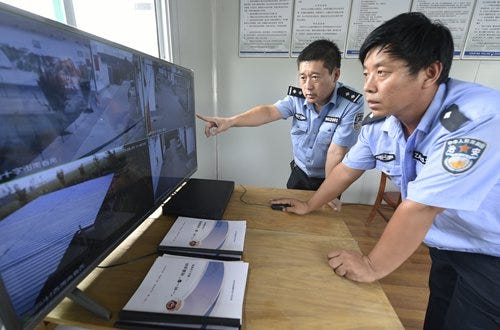
In China, CCTV cameras have sprouted up “like bamboo shoots after a spring rain” in the largest coastal cities where opposition to the regime happens to be the most vocal. But the system is not perfect: the dozens of cameras that can sometimes be seen at one intersection are not necessarily integrated into a single system but separately run by Public Security, State Security, the traffic police, municipal regulatory authorities, and others.
Nonetheless, the CCP’s security apparatus seems technologically far ahead of those who would try to get around it, and Chinese protestors do not have the numbers of their counterparts in Iran. Chances seem slim that Chinese thinking of organizing other protests will be able to escape the observation of authorities unless they can more seriously challenge the CCP’s technical dominance.
Matthew Brazil is co-author of Chinese Communist Espionage: An Intelligence Primer (Naval Institute Press 2019).