
Even for China, where the distance between official narrative and empirical evidence is often a chasm, the last few days have been jarring. On Tuesday, officials announced five deaths from COVID-19—up from two the previous day, which were the first recorded in the country since Dec. 3. On Wednesday, there were officially none. But a glance online tells a different story. Dozens of hearses line up at a Beijing crematorium; bodies wrapped in orange plastic pile in hospitals; patients on ventilators are crammed on a ward floor.
[time-brightcove not-tgx=”true”]
The decision by Chinese Communist Party (CCP) leadership to roll back its stringent zero-COVID policy and allow the virus to proliferate has led to a surge in cases and an immense strain on health services. It’s a quite staggering reversal. On Nov. 10, President Xi Jinping—the self-anointed “commander-in-chief” of a “people’s war” against the virus—instructed his Politburo to stick “resolutely” to “dynamic zero-COVID.” Residents of Shanghai were forcibly detained in quarantine facilities over the summer because of a single case in a neighboring housing block.
Read More: China’s Zero-COVID Trap
But zero-COVID was virtually abandoned on Dec. 7, with China’s top medical adviser now comparing the Omicron variant to “flu.” On Dec. 13, a tracking app that had tyrannized every life in China for the past three years was abruptly taken offline. On Sunday, officials in the central city of Chongqing decreed that mild or asymptomatic COVID-19 cases could “go to work as normal.”
The screeching U-turn underlines the fickle nature of strongman rule but also the immense paranoia of the CCP when faced with public discontent, such as the protests that erupted in late November across several Chinese cities. The catalyst was the deaths of at least 10 people in an apartment block fire in China’s western city of Urumqi that observers blamed on draconian pandemic controls keeping residents locked in their homes. (Officials deny this.) It spurred a wave of protests, with scores of people gathering on streets and university campuses across the country, shouting “we want freedom, not PCR tests,” and even “down with Xi Jinping.”
Read More: Detained Zero-COVID Protesters in China Share Their Stories
The sudden rollback of restrictions that followed “could be seen as a victory for people power,” says Yanzhong Huang, a senior fellow for global health at the Council on Foreign Relations.
Still, the policy climbdown is surprising. China’s security services were swift to track down and detain demonstrators, who were never close to forming a political opposition. “They never quite galvanized into a single, unified, politically actionable message,” says Wen-Ti Sung, a scholar specializing in Chinese elite politics at the Australian National University. But what likely spooked Xi was the breadth of discontent that zero-COVID engendered. Affluent Shanghainese, embattled students facing bleak job prospects, and migrant workers in southern factories all railed against its privations and related economic blowback in distinct but analogous acts of rebellion. Their concerns were well-founded; models suggest zero-COVID may have cost the Chinese economy $384 billion and reduced GDP growth by 2.2 percentage points.
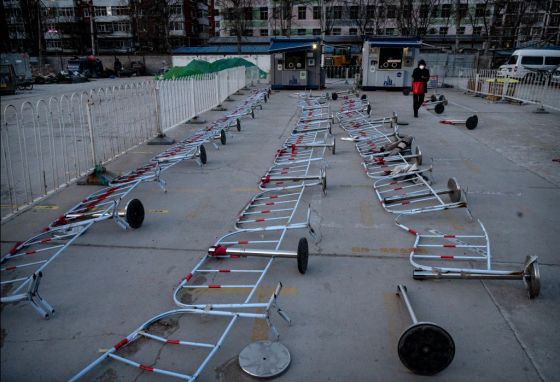
Kevin Frayer—Getty ImagesA woman walks by barricades as they are seen scattered on the ground at a testing site for COVID-19, on Dec. 19, 2022 in Beijing, China.
It’s perhaps unsurprising that a CCP spawned from popular revolution should fear the wrath of the masses most of all. In truth, however, over two-thirds of the 303 autocrats ousted from power worldwide between 1946 and 2008 were unseated by elite coups, with only a small minority bested by popular uprisings. The lesson being that rather than fear a mob over the horizon, leaders like Xi should be looking over their shoulder. It’s clear that he does the latter too, of course; by assuming a protocol-breaking third leadership term in November, while stocking his inner circle with loyalists and lackeys, Xi has doggedly insulated himself from potential rivals.
Herein may lie the problem. The fear was always that this new leadership’s homogeneity would undermine the quality of its policy-making. “That it has been having a hard time facing its first major test—smooth transition out of zero-COVID—has not been helpful in dispelling those concerns,” says Sung. The government saw the economic pain of zero-COVID and wanted to make adjustments. But local officials who for the past three years have been judged first and foremost on stamping out the virus were naturally hesitant. So the central leadership had to take bolder steps to force their arm such as dismantling the nationwide tracking apparatus. Cue the lurch from one extreme to another. Today, China is caught between Xi’s two festering paranoias—fear of the people, and of challenges within the party.
The consequences may be dire. With virtually no community exposure to the virus, and only low efficacy domestic vaccines, the surge in cases will no doubt result in many deaths—some models predict over 1 million—despite official denials. Zhang Wenhong, a prominent Chinese doctor often likened to America’s Dr. Anthony Fauci, has warned that China’s medical institutions will face their “darkest hour” by next month.
Instead, a new propaganda campaign has taken over. Previously, pandemic chaos in the West was painted as evidence of liberal democracy’s failings. Meanwhile, China’s success in banishing the virus was proof of a superior political system. But on Dec. 12, the CCP mouthpiece People’s Daily newspaper instead framed zero-COVID as a necessary stopgap to buy time while the virus’s severity waned and effective treatments were developed. Its dismantling, so it went, was always in the works. “Be the first person responsible for your own health,” it wrote.
The problems with this account are myriad and glaring. If this opening up was long-planned, then surely more efforts should have been made to vaccinate the elderly. Currently, only 42% of over-80s have had three doses of the vaccines, according to government figures. Today, people seeking boosters are being turned away from clinics due to a lack of supply. The most vulnerable could have been given more effective foreign vaccines. (On Tuesday, the U.S. offered China mRNA vaccines, though nobody expects the nationalistic CCP to accept.) In addition, effective antivirals like Paxlovid should have been stockpiled; one Chinese website sold out its supply in half-an-hour.
Public health experts also struggle with the logic of opening up some six months after most Chinese have had their last jab, given the rapidly decreasing efficacy of vaccines over time. Not to mention there’s just weeks before China’s Spring Festival—humanity’s largest annual migration, when some 200 million Chinese cram into buses and trains for long journeys to ancestral villages where medical facilities are rudimental at best.
“Even healthcare workers were caught off-guard [by the reversal],” says Huang.
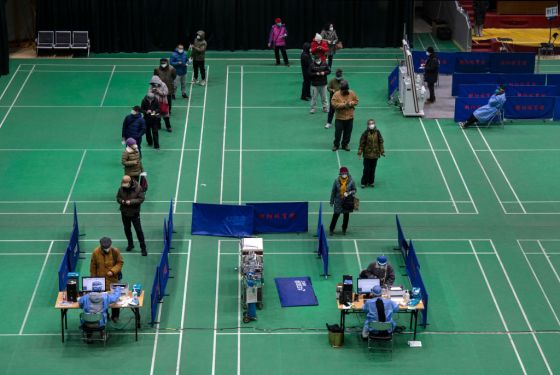
Kevin Frayer—Getty ImagesPeople wait in line to see a health worker at a temporary fever clinic set up by a hospital to treat potential COVID-19 patients in a sports centre on Dec. 18, 2022 in Beijing, China.
Yet the CCP’s account is already written. On Dec. 14, authorities stopped reporting infections deemed “asymptomatic,” which in China is often stringently defined as those not confirmed with a chest scan. Then, on Dec. 20, officials said that they would only include on its official COVID-19 death tally those who had tested positive for the virus and died of respiratory failure or pneumonia—excluding anyone with complicating conditions, as is frequently the case with elderly patients. The aim is to push home the message that China suffered the lowest COVID-19 toll of any major power.
Many Chinese will no doubt buy the propaganda. But a large number have had their eyes opened by the bungling of zero-COVID, the lives lost to suicides and treatable ailments that worsened in an ultimately futile attempt to stamp out the virus. The protests only serve to show that the party is, in fact, fallible and responsive to public anger, that the people have more power than anyone thought. “This will be very encouraging for Chinese civil society, which has had very little space to work in for years,” says Sung. The irony is, of course, that so far they have only nudged the CCP from suffocating control to callous inaction.
“I don’t know how anybody can have confidence in China anymore,” says one Shanghai resident, speaking to TIME on condition of anonymity for fear of official reprisals. “Disruption and unexpected things is one thing, but a government pulling the rug under your feet is quite another.”