
Empress Elisabeth of Austria, whose reign lasted from her marriage to Emperor Franz Josef in 1854 and ended with her assassination in 1898, was a European rock star of her time. She was a doyenne of fashion who outfitted herself in the latest tasteful ruffles, with hair that reached nearly to her ankles. Something of an eccentric for her day, she devoted herself to a gymnastics regime to keep trim and healthy. She spoke fluent English and French, and learned modern Greek in the long hours it took for her hairdresser to arrange her majestic tresses. And her status as a royal brought pressures that any modern-day superstar would recognize: At age 40, fearing that her beauty was beginning to fade, she sought to control her image by refusing to be painted or photographed. Even her death was weird and grimly glamorous: She was killed at 60 when, on a visit to Switzerland, an Italian anarchist stabbed her in the heart with long, slender industrial file.
[time-brightcove not-tgx=”true”]
With Corsage, Austrian writer-director Marie Kreutzer gives Empress Elisabeth—often referred to, with casual affection, as Sisi—the sympathetic, imaginative and offbeat dream biography she deserves. The picture has a kind of tattered rock’n’roll elegance; it’s rendered in gorgeously muted cream-to-powder colors, from gentle lavenders to silvery greens to summer-evening beiges. (The cinematographer is Judith Kaufmann.) And its Sisi, Vicky Krieps—who made her first splash as a couturier’s muse in Paul Thomas Anderson’s Phantom Thread, and who has also appeared in another of Kreutzer’s films, We Used to Be Cool—gives a performance perched on the edge of haughtiness and despair. Her Sisi is a woman of quietly intense sexual appetites, though what turns her on most is being looked at adoringly. She suffers from what we would, with our modern insight, call an eating disorder: her dinner plate might contain one petal-thin sliver of beef, or two slices of orange. Krieps plays Sisi with both imperious grandeur and a sense of humor, a fine line to walk, even on slender, regal ankles.
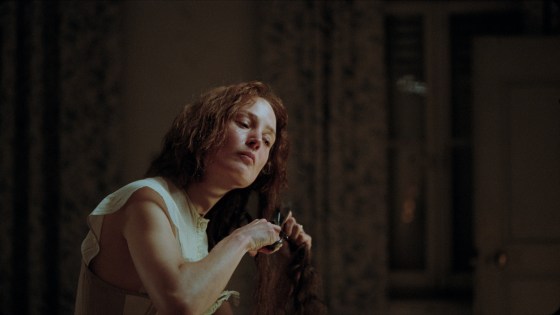
Courtesy IFC Films Vicky Krieps as Empress Elisabeth
Corsage takes place during one pivotal year in the empress’ life, 1878. In the waning days of 1877, she turns 40, an event she marks with wan apprehension—little wonder, given that the attendees at her birthday dinner serenade her with a song whose lyrics include the words, “Long may she live, beautiful may she remain.” Her husband, played by Austrian actor Florian Teichtmeister—his resemblance to the real-life Franz Josef is so remarkable, he’s like a painting come to life—senses her unhappiness and is beginning to lose patience. (At one point, immediately following a dull state affair, he visits her in her chambers and wastes no time peeling off his artificial mutton chops, apparently stuck on with spirit gum just for show—a servant stands by with a little box, ready to store these tiny wiglets for future use.) Elisabeth essentially rolls her eyes at him, without literally doing so. Despite her ennui and encroaching sadness, she still takes pleasure in her hounds, who are usually seen whisking along at her feet. She loves her children, including a young daughter, Valerie (Rosa Hajjaj), whose princessy propriety is at odds with her mother’s irreverence, and a young adult son, Rudolf (Aaron Friesz), who’s sympathetic to his mother’s idiosyncrasies but also hopes to protect her from gossip. There’s a haunting heartbreak in her past, too, the loss of her first child, whose baby portrait hangs solemnly in a closed-off room.
Sisi tries to solve her intense but unnameable problems by leaving Austria, to visit old lovers (like her sexy English riding instructor, played by Colin Morgan) and a crazy cousin she adores (Manuel Rubey in a glorious turn as kooky-elegant Ludwig II, King of Bavaria). But mostly, she’s alone, confiding—barely—in one of her ladies-in-waiting, Marie (Katharina Lorenz), the closest thing she has to a girlfriend.
Read More: 12 International Movies to Watch This Awards Season
Together, Kreutzer and Krieps explore the idea of female loneliness, a state that isn’t necessarily caused by men, but one that even so shuts them out of a woman’s world. Elisabeth is controlled by the strictures of her status and her time: the movie’s title refers not to a small bouquet of flowers, but to an older use of the word, describing a tightly laced bodice. Even if the metaphor is obvious, the movie is too well-rounded, and too pleasurable, to be reduced to easy symbolism. As a story that deals with the way royal expectations can crush a woman, Corsage is a far better film than Pablo Larrain’s garish, overreaching Spencer; it’s more on par with Sofia Coppola’s marvelous 2006 Marie Antoinette, which is motivated by a similarly vibrant spirit. (Kreutzer, like Coppola, has some fun with obvious anachronisms, including the vision of a dreamy youth plucking out a version of “Help Me Make It Through the Night” on a violin.) And while Corsage doesn’t dramatize, or even mention, Sisi’s eventual assassination, it ends with an imagined leap of freedom, the happiest possible escape for an unhappy empress. Long may she live, beautiful may she remain! That’s the gift Corsage gives to poor Sisi.