
Witchcraft rules the world in Anne Rice’s Mayfair Witches, but the show is most electrifying when it immerses us in the everyday magic of New Orleans. In one mesmerizing scene, a young neurosurgeon named Rowan Mayfair (Alexandra Daddario) is wandering the nighttime streets during her first visit to the city when she nearly collides with a horse-drawn hearse bearing the photo of a smiling, white-haired man. Musicians and stilt walkers dressed as skeletons trail behind. Mourning has never looked so cathartic.
“No one is ever gone,” a stranger tells Rowan. “Only separated for a minute.” Reluctantly, Rowan drinks the test tube of unidentified liquid the woman buys her off a sidewalk shot girl. The Second Line is a ghostly blur as they join the revelers in the graveyard. This spectral wake weaves its way through the series’ third episode the way a procession might weave through the city. All of it serves to initiate Rowan—who flies in from San Francisco after losing her adoptive mother, discovering that she can kill people with her mind, and deciding to search for her biological relatives, New Orleans’ powerful Mayfair clan—into a city and a family where there is no bright line between human and supernatural. “I will never forget that night of shooting,” says showrunner Esta Spalding. “You enter the land of the dead in this cemetery in the middle of the Garden District, right near Anne Rice’s house where she wrote The Witching Hour,” the first novel in the trilogy from which AMC’s Mayfair Witches was adapted. “That was the one where I was like, ‘We’re doing this. We’re making this thing.’”
[time-brightcove not-tgx=”true”]
The thing Spalding and co-creator Michelle Ashford have made is a multilayered drama of ideas hiding under the umbrella of streaming-era TV’s favorite format: the genre franchise. The second title, after last fall’s acclaimed Interview with the Vampire, in what AMC is calling its Anne Rice Immortal Universe, Mayfair Witches is a fantasy-horror series based on valuable intellectual property; each of Rice’s Lives of the Mayfair Witches books spent months on the New York Times best-sellers list in the 1990s. Yet the show is so meticulously constructed around complex characters and thematically rich scripts that you’d never confuse it with expensive but halfhearted IP fare like The Book of Boba Fett, Netflix’s The Witcher universe, or the diminishing returns of AMC’s own The Walking Dead franchise. Just as Interview expanded upon themes of sexuality, race, and family, Spalding and Ashford dig into Rice’s ideas about women’s free will and self-definition, yielding something more ambivalent than the standard female-empowerment narrative. Where many genre franchises hinge on simplistic notions of good vs. evil, the ARIU thrives in the shades of gray.
It’s a canny approach for AMC—which faced a daunting 16% year-over-year revenue drop in the third quarter of 2022—to take in an oversaturated TV landscape where franchise-friendly IP is king and the transition to subscription-based streaming has yet to compensate for earnings lost during a mass exodus from cable. The network made its name with sophisticated, late-2000s linear dramas like Mad Men and Breaking Bad, and its parent company AMC Networks prides itself on making shows for adults across its portfolio of cable channels and boutique streamers including IFC, Acorn, and Shudder. Dan McDermott, the company’s President of Entertainment & AMC Studios, envisions the franchise growing to up to seven titles.
For a relatively small player in an industry controlled by giants like Disney and Netflix, this is a big bet. But beyond the business implications, it offers hope to grownup viewers looking for something artfully made to watch now that Better Call Saul is over, and to audiences who fear that the IP takeover that has crowded out original films on the big screen is threatening to do the same to the small one. The ARIU is a crucial test of whether it’s possible to build a better TV franchise.
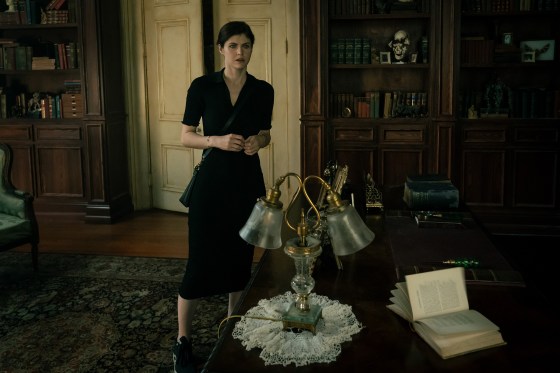
Courtesy AMCAlexandra Daddario as Dr. Rowan Fielding in AMC’s Mayfair Witches.
Like so many paradigm shifts, the franchising of TV happened slowly, then all at once. Television is, of course, a business, and businesses thrive by building on lucrative products—hence the enduring popularity of spin-offs. When All in the Family became a generation-defining smash, CBS would’ve been foolish not to spin off The Jeffersons, Maude, and more. And so, by the mid-1970s, a stand-alone family sitcom became a sort of Norman Lear Extended Universe.
Until the streaming era, this is the way most TV franchises took root. Individual spin-offs could, like Cheers sequel Frasier, become big hits but didn’t quite signify the creation of a franchise as we know them today—with all the merchandising, fandom, and multi-title longevity that designation implies. The major franchises of the 2000s—which co-existed with dramas like The Sopranos, The Wire, and Friday Night Lights that made the decade one of television’s most celebrated eras—were broadcast procedurals and reality fare. Why not expand the hugely popular Las Vegas–based CSI to Miami, New York and D.C.? The same logic applied to Bravo’s Real Housewives universe.
The predominant TV franchise of today is something different, born of a hybrid broadcast, cable, and streaming ecosystem that produces thousands of titles each year. With so many products fighting to break through the noise, McDermott explains, it’s a challenge to get viewers to tune in, “even if you find your audience and say: ‘Hey, guess what, we have this show up here, come watch it.’” A franchise offers platforms the opportunity to hold fans’ attention once they’ve done the hard work of attracting it—particularly crucial for subscription-based streamers.
And so the contemporary franchise tends to be genre-forward and based on IP with widespread name recognition or salacious true stories. It’s Ryan Murphy’s American Horror Story, American Crime Story, and soon American Sports Story and American Love Story. It’s The Walking Dead and all its zombie spin-offs. Disney’s entrance into the streaming market in 2019 intensified the trend; now Marvel, Star Wars, Lord of the Rings, and other blockbuster factories pump out as much, if not more, content for the living room as the cinema. Star Trek has been a multi-platform franchise since the ’70s, but it has produced as many series in the past five years, on CBS All Access and then Paramount+, as it did in its first five decades.
Read more: Welcome to TV’s Era of Peak Redundacy
The Anne Rice project, which began when AMC bought the rights to 18 of the author’s books in 2020, is a product of the same industry stressors. Yet its makers have taken on what is in many ways a bigger challenge than Marvel and DC’s dozens of TV offerings, which often seem sanitized or dumbed down to maximize viewership. Led by Breaking Bad, Better Call Saul, and Halt and Catch Fire executive producer Mark Johnson, they are consciously trying to make what McDermott calls TV that “says something about the world we live in.” For Spalding, that comes down to telling stories where “the characters are broken, sophisticated adults with psychology”—a Rowan Mayfair, for example, who’s every bit as enigmatic as Don Draper.
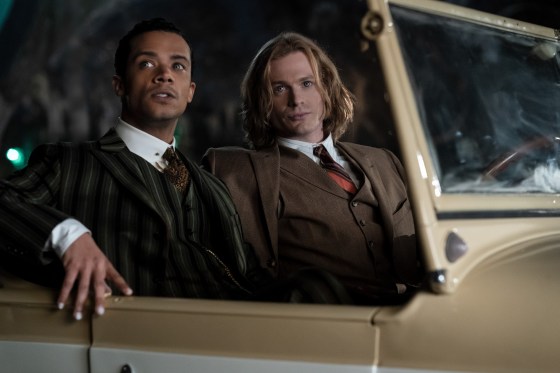
Courtesy AMCJacob Anderson, left, as Louis De Point Du Lac and Sam Reid as Lestat De Lioncourt in AMC’s Interview with the Vampire.
This is the kind of talk that makes critics like me swoon. In truth, we can’t know this early in their runs whether any ARIU show will achieve such lofty aims. But in their debut seasons, Mayfair (whose Jan. 8 premiere will air on all five of AMC Networks’ linear channels; I’ve seen five out of eight episodes) and Interview strike the right balance between grounded characters, thought-provoking themes, and supernatural thrills. And they do it largely by de-prioritizing typical genre-franchise preoccupations like canon and combat, in favor of the more elemental aspects of great audiovisual storytelling—writing, acting, directing, production design, music.
While there are certainly excellent creators within the genre space (Ronald D. Moore of Battlestar Galactica, Outlander, and For All Mankind, for one), none of the core ARIU team comes from that kind of background. Spalding was the showrunner of Showtime’s capitalism-critiquing multilevel marketing dramedy, On Becoming a God in Central Florida; she and Ashford previously worked together on historical drama Masters of Sex. Interview creator Rolin Jones made his name as a writer on Weeds, Friday Night Lights, and Boardwalk Empire. (“I still think the bloodsucking is weird,” he admits.) “At first blush, none of us is the obvious person to be involved in an Anne Rice adaptation,” says Johnson. But as they read the books, each found the inspiration they sought.
For Jones, the baroque Interview was a chance “to make something big and bold and grand” and “to get into my inner Clockwork Orange, Deadwood—write some language.” Once you get beyond the blood feasts, he notes, Rice’s “book is talking about the thing that winds everyone’s clock: mortality. We do everything because we’re going to die.” Spalding recalls that she’d already been turning to the horror genre, “partly because the world has gotten so strange and horrifying that horror is a response to it that I understand.” Mayfair, with its particular focus on women’s bodily autonomy and witches as not just monsters, but healers, “seemed like a way to respond to the experience of being a woman right now in America.”
Yet, in an era of endless circular discourse about the politics of representation, neither show is precious about its characters who are underestimated, if not outright oppressed, because of their identity. Medicine may be Rowan’s calling, but she has to placate the field’s many male gatekeepers daily. The discovery that her lineage might unlock supernatural abilities that shift the balance of power in her favor is obviously compelling to her. It was this moral ambiguity that drew Daddario to the role. “She’s really delighted by some things she shouldn’t be delighted by,” the White Lotus alum notes. A heroine susceptible to temptation is more fascinating, to play and watch, than a righteous Strong Female Superhero. Likewise, only actors with the chemistry of Jacob Anderson and Sam Reid, who play Interview’s central couple, could make the passion between immortal lovers feuding over the ethics of bloodsucking feel real enough to invest in.
Authenticity, insofar as it’s possible for supernatural stories, is also paramount to the look and feel of the ARIU. Mayfair boasts century-spanning costumes from Mad Men designer Janie Bryant; Interview is soundtracked by The Green Knight composer Daniel Hart’s elegant, ominous score. But the key ingredient in the franchise’s mise-en-scène is Rice’s beloved hometown itself, with its singular Creole architecture, vibrant cultural life, and local crew members who cherished the author’s work. “I don’t think there was any question that we had to shoot in New Orleans,” says Johnson. “The city is imbued with all of those ineffable things that impact on what something looks and sounds like.” Such attention to the texture of real places has become increasingly rare in genre franchises, which often shoot against computer-generated backdrops in virtual production studios like Disney’s Infinity Stage.
Read more: The 10 Best TV Shows of 2022
While Mayfair was in production, Spalding often walked the eight blocks from where she was staying to the house where Rice, who died in December 2021, lived. “There were all these crows that were always landing at twilight on the branches and the wires around the house,” she recalls. “I’d be like, ‘I hope we’re doing OK by you. If it’s all right, crows, please take the message.’ And then, of course, crows slowly crept into the show.”

Courtesy AMCThe Mayfair Witches crew on location in New Orleans.
Mayfair and Interview are triumphs of talent and care. But quality doesn’t guarantee longevity on TV; for every Saul, there’s a wonderfully odd Lodge 49, cut short because of low ratings. AMC Networks has a lot riding on the ARIU, which McDermott has called “the biggest venture we’ve ever embarked upon from the ground up.” It’s a transitional moment for AMC, which recently lost two flagship shows, Saul and The Walking Dead, and is in the midst of executive turnover with layoffs and budget cuts on the horizon. “AMC Networks is the walking dead,” an industry analyst told the New York Times in December.
Last year was brutal for the streaming wars in general, as platforms’ massive content spends threw balance sheets further into the red and drove leadership shake-ups, from Netflix to Disney to Warner Bros. Discovery. It’s the kind of environment that sends executives scrambling to find new formulas. The nontraditional—or, if you must, prestige—franchise is one such idea, with the potential to please creatives, viewers, and bean counters alike. And it’s starting to catch on. Less ambitious in its storytelling than its antecedent but also more popular than Interview, House of the Dragon put ur-prestige fantasy brand Game of Thrones on the franchise track. Starz, which is also home to the thriving crime drama franchise Power, recently renewed The Serpent Queen, an irreverent take on Catherine de’ Medici that extends its historical-queens-and-princesses franchise. Amazon is pouring its biggest budgets this side of Rings of Power into the troubled production of Citadel, meant to fuel multilingual spin-offs.
The ARIU is not alone in its quest to remake franchise TV, but I’ve never seen a TV franchise come out of the gate quite as strong, delivering two thoroughly well-made shows in three months. It’s not just critics cheering, either. The hashtag #interviewwiththevampire has more than 270 million views on TikTok; on video chat, Jones shows me an office wall plastered with the kind of fan art that’s still circulating on social media two months after the Season 1 finale. And early audience metrics bode well. AMC reported that Interview had the most-watched debut in the history of its AMC+ streaming service, by a factor of three. Johnson says that three more ARIU titles are in development.
If Mayfair finds its audience—and based in part on the sleeper-hit success of AMC Networks’ British import A Discovery of Witches, there’s reason to believe it will—then the Anne Rice franchise could become a shining example of how to make top-tier television in a suboptimal market. Of course, even the best IP-based genre franchise can’t obviate the need for great stories that are original to the TV medium. “I don’t want to live in a world where we can’t discover the next Matthew Weiner or Vince Gilligan,” McDermott says. There’s no downside to a business model in which a reliably popular, high-quality franchise subsidizes riskier projects. And as a certain surgeon awakening to her power as a witch discovers, the necessary work of adapting in order to survive can bring unexpected pleasures.