When documents bearing classification markings were apparently packed into boxes by White House staffers at the end of the Trump administration and shipped to unsecure locations, a violation of the Executive Order governing the classification and declassification of national security information clearly occurred. (It likely also violated federal statutes not discussed here, including the Presidential Records Act, and, depending on the facts, criminal statutes). Even if the documents in question had been declassified as asserted by the former president, at a minimum the governing Order, to which staff within the Executive Office of the President are clearly required to adhere, mandated that the records be appropriately marked to reflect their declassified status once they were removed from the control of the federal government. When a number of documents with classification markings where removed from then Vice President Biden’s office at the end of the Obama administration and stored at unsecure locations, violations of that same governing Order did not necessarily occur, at least according to the most recent position of the Department of Justice dating back to the administration of George W. Bush – that’s because the specific status of the Vice President and his staff under the Order is murky. I know this because I sought an interpretation of the Order’s application to the Office of the Vice President (OVP) when I was responsible for overseeing the executive branch’s compliance with the rules regarding safeguarding classified national security information as the Director of the Information Security Oversight Office during the Bush administration. As such, a 2006-07 dispute between my office and the OVP under Dick Cheney over reports dealing with the classification and declassification of information by that office highlighted a constitutional anomaly which has not been addressed even to this date and which has potential implications for the recently announced special counsel investigation into the handling of classified documents by then Vice President Biden and his staff. Specifically (and notwithstanding common understanding), considering constitutional language, historical precedent and assertions by a recent Vice President and his staff, is the Vice President and his office subject to executive orders?
My dispute with Vice President Cheney’s office first came to public light in 2006. In May of that year, the Chicago Tribune published an article based on the annual report my office prepared on the executive branch’s implementation of the Executive Order governing the safeguarding of classified national security information. While I was required to submit this annual report to the president, I also viewed the report as a means to provide the public with insight into the state of government secrecy. The Tribune picked up on a deliberate but obscure footnote included in the report which indicated that the classification statistics therein did not include the OVP. When queried by the Tribune, Cheney’s spokesperson replied that the OVP was not an “agency” under the Order and that the matter had “been thoroughly reviewed and it’s been determined that the reporting requirement does not apply to [the OVP] which has both legislative and executive functions.” In essence, the Vice President and his staff were claiming that with respect to the rules governing the safeguarding of classified national security information he was not a part of the executive branch and thus not beholden to the reporting requirements of the Executive Order.
I found this response to be remarkable, not only because the governing Order’s extraordinarily broad definition of an “agency” included “any other entity [emphasis added] that comes into possession of classified information,” but especially in view of the OVP’s track record for handling classified national security information under Vice President Cheney. At that time, senior OVP aid I. Lewis “Scooter” Libby had been criminally charged (and subsequently convicted) of selectively leaking classified information and OVP staffer Leandro Aragoncillo had been charged (and subsequently convicted) of taking top secret documents from the Vice President’s office and passing them to opposition figures in the Philippines. Henry Waxman, then chair of the House Committee on Oversight and Government Reform, eventually wrote to Cheney that “[y]our office may have the worst record in the executive branch for safeguarding classified information” and “[g]iven this record, serious questions can be raised about both the legality and advisability of exempting your office from the rules that apply to all other executive branch officials.” Thus, in response to a complaint I received from Steve Aftergood, a public interest advocate who wrote a blog on government secrecy for the Federation of American Scientists, I wrote a letter to David Addington, the Vice President’s then Chief of Staff, outlining my concerns.
Specifically, I wrote that OVP’s interpretation of the Order as reported was fairly recent, since up until 2002 that office, including under then Vice President Cheney, did conduct itself as if it was subject to the Order. Furthermore, I indicated that if the OVP was not to be considered an entity within the executive branch, I was concerned that this could possibly impede access to classified information by OVP staff, since such access would be considered a disclosure outside the executive branch. While I recognized that OVP staff personnel may, at times, be supporting the Vice President’s performance of legislative duties, I believed it was fair to state that most, if not all, disclosures of classified information to OVP staff by other agencies and entities within the executive branch have been regarded by those agencies as disclosures within the executive branch, since they occur in support of the Vice President’s performance of executive duties (including as a statutory member of the National Security Council).
I was never furnished a direct reply from the OVP. Absent a common understanding as to how the Order applies to the OVP, I directly requested then Attorney General Alberto Gonzales to render an interpretation as to whether the OVP was an “entity within the executive branch” for purposes of the Order and thus subject to its requirements. At about the same time, David Addington attempted to abolish my office by drafting an amendment to the president’s executive order. Concomitantly, Henry Waxman subpoenaed all my office’s correspondence with the OVP and thus became involved in the controversy. Moreover, the Financial Services Appropriations Bill then under consideration in the Senate Appropriations Committee restricted the Vice President’s use of otherwise available funds unless the Vice President submitted to oversight by my office with respect to complying with the governing Order.
Along with these rapidly evolving events, what should have been a one-day, Washington-centric story soon became fodder for late night comedy shows such as those of Jon Stewart and Stephen Colbert, primarily because of the White House’s shifting rationale for the Vice President’s position. The litany of rationales included: the Vice President’s unique role as a member of both the legislative and executive branches exempted him; the Order did not apply to the Vice President because his office was not an “entity within the executive branch;” and the Vice President’s constitutional status was unclear and an “interesting constitutional question” to be explored. In a response to an inquiry from then-Senator John Kerry, David Addington finally settled on the rationale that, as a textual matter, the Order distinguished the Vice President and the President from executive agencies, which, while textually true, did not address the issue at hand – i.e., whether the Vice President and his staff were subject to the requirements of the Order overall despite explicit carve-outs from a few of its provisions.
Specifically, there were only three sections of the Order that treated the President and Vice President on equal terms. One of these sections exempted the Vice President and his staff from the mandatory declassification review provisions of the Order which were applicable to all other government agencies. As I had consistently pointed out to the Attorney General and others, “[t]his sole explicit reference for the purpose of exempting the OVP from a provision of the Order supports an interpretation that the rest of the Order does apply, to include the Order’s definition of an ‘agency,’ otherwise there would be no need for an exemption” from the declassification review provisions.
What was especially noteworthy and remains unchallenged to this day, in his letter to Kerry Addington went on to state that
constitutional issues in government are generally best left for discussion when unavoidable disputes arise in a specific context instead of in theoretical discussions. Given that the executive order treats the Vice President like the President rather than as an “agency,” it is not necessary in these circumstances to address the subject of any alternative reasoning, based on the law and history of the legislative functions of the vice presidency and the more modern executive functions of the vice presidency, to reach the same conclusion that the vice presidency is not an “agency” with respect to which ISOO [the Information Security Oversight Office] has a role.
Addington was not backing off from his initial position that since the Vice President had both executive and legislative functions, OVP was not bound by the reporting requirements of the executive order. Rather, he was instead simply stating that my office had no role with respect to his based on his baseless assertion that since three limited sections of the Order treated the President and Vice President alike, then the entire Order had to be viewed in a similar vein.
In view of the Senate’s attempt to defund the Vice President’s office and not withstanding a plain text reading of the Order, White House Counsel Fred Fielding wrote to then Senator Sam Brownback, ranking member of the Senate Appropriations Committee, that “[t]he President has asked me to confirm to you that … the Office of the Vice President … is not an ‘agency’ for purposes of the Order.” While I had no basis to dispute the then President or his White House Counsel’s intent, it must be noted that it would have been very easy for the President to amend his executive order to make this reading explicit, which never occurred. For example, the Presidential Records Act expressly states “Vice-Presidential records shall be subject to the provisions of this chapter in the same manner as Presidential records.” Clear language to this effect was absent from the Order governing classified national security information and continues to be to this day.
It should be noted that historically there was some merit to Addington’s arguments on behalf of Vice President Cheney. Former President Harry Truman himself wrote in his memoirs that the Vice President “is not an officer of the executive branch.” Until Lyndon Johnson got an office on the White House grounds in the Executive Office Building, the only official office for use by the Vice President was in the Capitol building, and it was not until Walter Mondale that the Vice President had an office in the West Wing of the White House. To this day, the Vice President’s salary is included in the budget of the Senate (although most of his staff’s budget is included in the executive’s appropriation). Nonetheless, Dick Cheney himself exemplifies the modern Vice President wielding unprecedented executive power in all matters of policy, even laying claim to the protections of executive privilege himself multiple times.
It was not until a full year after I had initially raised the issue of the Vice President’s obligations under the executive order governing classified national security information that I received a reply to my appeal to the Attorney General. Writing on behalf of the Attorney General, Steven Bradbury, the Principal Deputy Assistant Attorney General wrote to me referring to the earlier White House Counsel letter to Senator Brownback. Bradbury asserted that Fielding’s letter on behalf of the President directly resolved the question I posed to the Attorney General, “[t]herefore, the Department of Justice will not be providing an opinion addressing this question.”
And there is where this issue remains to this day. The last time questions arose with respect to how a Vice President and his staff handled classified national security information, a chief of staff on behalf of a sitting Vice President asserted that the Vice President and his staff are not subject to the same rules as are every other member of the executive branch. Given an opportunity to refute that position, the Department of Justice refused to do so. As such, it would be wise for the new special counsel appointed to investigate the handling of classified information by then Vice President Biden and his staff to recommend that the Attorney General clarify once and for all exactly what rules apply to the OVP. Moreover, Congress can and should exert its responsibility to counter assertions of unchecked authority, be it by a president or vice-president, when it comes to protecting classified national security information.
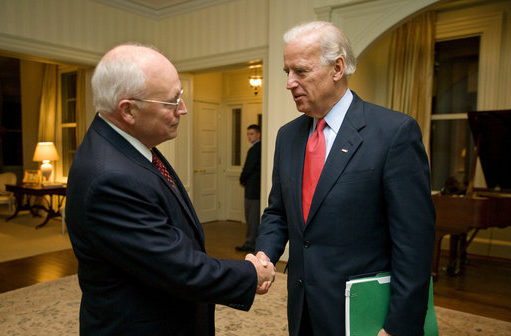
IMAGE: Vice President Dick Cheney bids farewell to Vice President-elect Joe Biden Thursday, November 13, 2008, following their nearly hour-long visit at the Vice President’s Residence at the U.S. Naval Observatory in Washington D.C. (White House photo by David Bohrer)
The post Vice Presidents and Rules Governing Classified National Security Information appeared first on Just Security.