Lyndon B. Johnson, the 36th President of the United States and the architect of some of the most significant federal social welfare programs like Medicare and Medicaid, died fifty years ago on Jan. 22, 1973, from a blood clot in his heart. He was buried in his native Texas.
Johnson rose from Vice President to President in 1963 following the assassination of President John F. Kennedy on Nov. 22, 1963. A TIME White House correspondent in the 1960s described the way he brought the nation together after that traumatic moment as a “near miracle in a storm center of anguish.”
[time-brightcove not-tgx=”true”]
Serving until 1969, he presided over one of the most tumultuous periods of social unrest in American history fueled by protests for civil rights and the Vietnam War. The programs he signed into law to combat his “war on poverty”—like the early childhood education and nutrition initiative Head Start—”will shape American life for years to come,” TIME said in its 1973 obituary of the politician. “Much of the legislation passed under his leadership was too hastily conceived—the product of good will more than of good planning,” the obituary said. “Overshadowing all of Johnson’s good works, moreover, was the ‘brushfire’ war [in Vietnam] he inherited, which soon began to breed revolt on the campuses and riots that scarred America’s cities.”
He was also known for brusque manner, dishing out eccentric words of wisdom like, “Never trust a man whose eyes are too close to his nose,” or when asked why he kept J.Edgar Hoover in his role as FBI Director, saying, “I’d rather have him inside the tent pissing out than outside pissing in.”
For the 50th anniversary of his death, TIME talked about his legacy to two of the nation’s foremost experts on Lyndon B. Johnson: Mark Updegrove, former President of TIME Canada and president & CEO of the LBJ Foundation, and Mark Lawrence, Director of the LBJ Presidential Library and Museum in Austin, Texas. In the below conversation, they discuss how his legacy holds up today and some under-appreciated moments of his presidency.
TIME: Where can we see LBJ’s accomplishments in the news today?
Updegrove: If you look at the full flower of LBJ’s legislative accomplishments, voting rights stood at the top for him because he believed there was nothing more important than every American having unfettered access to the ballot box.
And we’re still talking about immigration all these years later. Remarkably, we’re probably more xenophobic now than we were when LBJ signed the Immigration Act of 1965, which is the most radical immigration reform in the history of our country.

Boris ChaliapinThe Aug. 6, 1965, cover of TIME
Lawrence: Americans these days are very much wrestling with the question of how much influence the United States can still exert globally at a time when it’s suffered through not one but two very, very challenging wars that have diminished the expectations that many ordinary Americans hold of what their country can achieve in the world—and I think that, too, traces back to the period of the Vietnam War. LBJ was really in many ways the first Cold War president who had to reckon with limitations on American power and trying to figure out how, nevertheless, to continue to try to exert American influence internationally.
Scholars like Elizabeth Hinton have noted that it was Johnson who shaped President Nixon’s “Law and Order” rhetoric when he invested in policing over social welfare programs.
Updegrove: That’s a part of his legacy. In the latter part of his presidency, there was a great deal of concern about crime, and LBJ felt like he had to address it in some fashion. By that point, we were seeing riots in Watts [Los Angeles] in 1965, and then in other urban centers throughout the course of the decade. So I think that compromised LBJ’s ability to do more in the Great Society, and I think compelled him to enact some crime bills which flowed into the Nixon Administration as well.
Lawrence: Johnson attached a lot of importance to “law and order,” in part, because he understood that it was an emerging political issue that could be used effectively against him and against the Democratic Party.
What are the flaws or failures of LBJ as a person or as a president?
Lawrence: LBJ, for all of his creativity in thinking about domestic policy, was fairly conventional in his thinking about foreign policy. Though he recognized the problems that the United States would likely confront in Vietnam, he nevertheless carried out the major escalation, transforming a relatively minor problem into a major war that would ultimately send 58,000 Americans to their deaths.
Updegrove: As the war evolved, there were compelling reasons to get out, which LBJ never quite fully embraced or understood, perhaps, and I think he should be faulted for that. That’s the downside of the LBJ legacy.

TIMEThe Apr. 12, 1968, cover of TIME
Lawrence: He was such a formidable presence in one-on-one or maybe small group interactions, but he wasn’t great at reading the public mood. He was a man of Washington and not of the nation. And I don’t mean that in a way that disparages LBJ. He was comfortable in the halls of power, but especially as the 1960s advanced, he had a really hard time understanding social protest and the ways in which American society was changing so dramatically.
Updegrove: As society changed, and LBJ became more insulated in Washington, he did lose touch to a certain degree with the American public and couldn’t read them as readily as he might have.
Are there underrated moments in the LBJ presidency?
Updegrove: It’s March 9, 1965, and LBJ is calling [Vice President Hubert] Humphrey because he needs to get through the Elementary and Secondary Education Act, which is a profusion of federal aid to education for the first time—and fundamentally, in so many respects, a civil rights bill. And at one point, he says, “I want Black voters to support Republicans. We need a strong two party system.” And I think he would lament the decline of the Republican Party [today].
Speaking of education issues: In the last year, Texas enacted laws to limit the teaching of critical race theory that some teachers say will restrict how they teach about the full history of America. What LBJ would have thought of such actions in his native Texas?
Updegrove: It would be doubly offensive to LBJ. Number one because he was a teacher himself. And one of the most formative experiences—if not the most formative experience of his young life—was teaching Mexican American school kids in Cotulla, Texas, close to the Mexico border and seeing through the eyes of these young children, what poverty and bigotry and racial injustice looked like. And he took that I think had a searing effect on his consciousness.
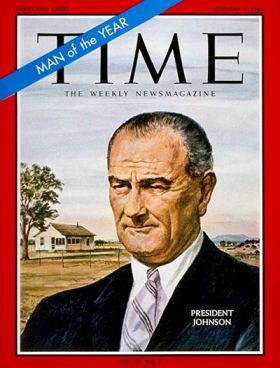
Peter HurdThe Jan. 1, 1965, cover of TIME
What are some unheralded accomplishments of LBJ?
Lawrence: The Nuclear Non-Proliferation Treaty [of 1968] is arguably the most important international agreement that comes from the Cold War era that still has impact in the world today. It’s not uniquely LBJ’s creation but it really got momentum during the LBJ period.
Updegrove: Johnson even suggests the notion of opening up China, preceding the Nixon Administration.
What are myths or misconceptions about LBJ that you often find yourselves debunking or setting the record straight on?
Lawrence: There is a myth that circulates around LBJ that he was gung-ho about war, that he was a war monger. We now know with near certainty that he actually was really anguished about the decisions he had to make in connection with the war.
Updegrove: The telephone tapes—the crown jewel of the LBJ Presidential Library archives—really do show the anguish that LBJ had around the war and his profound ambivalence about it, and the fact that he wanted to pull out but really didn’t see a way to do so. This is the last president we’ve had who had family members who were fighting on the front lines; two sons in law were fighting in Vietnam throughout the course of 1968.
And we’d be remiss if we didn’t say there is no proof whatsoever that LBJ was behind President Kennedy’s assassination. There would be no reason for LBJ to do that. He lamented being an accidental president.