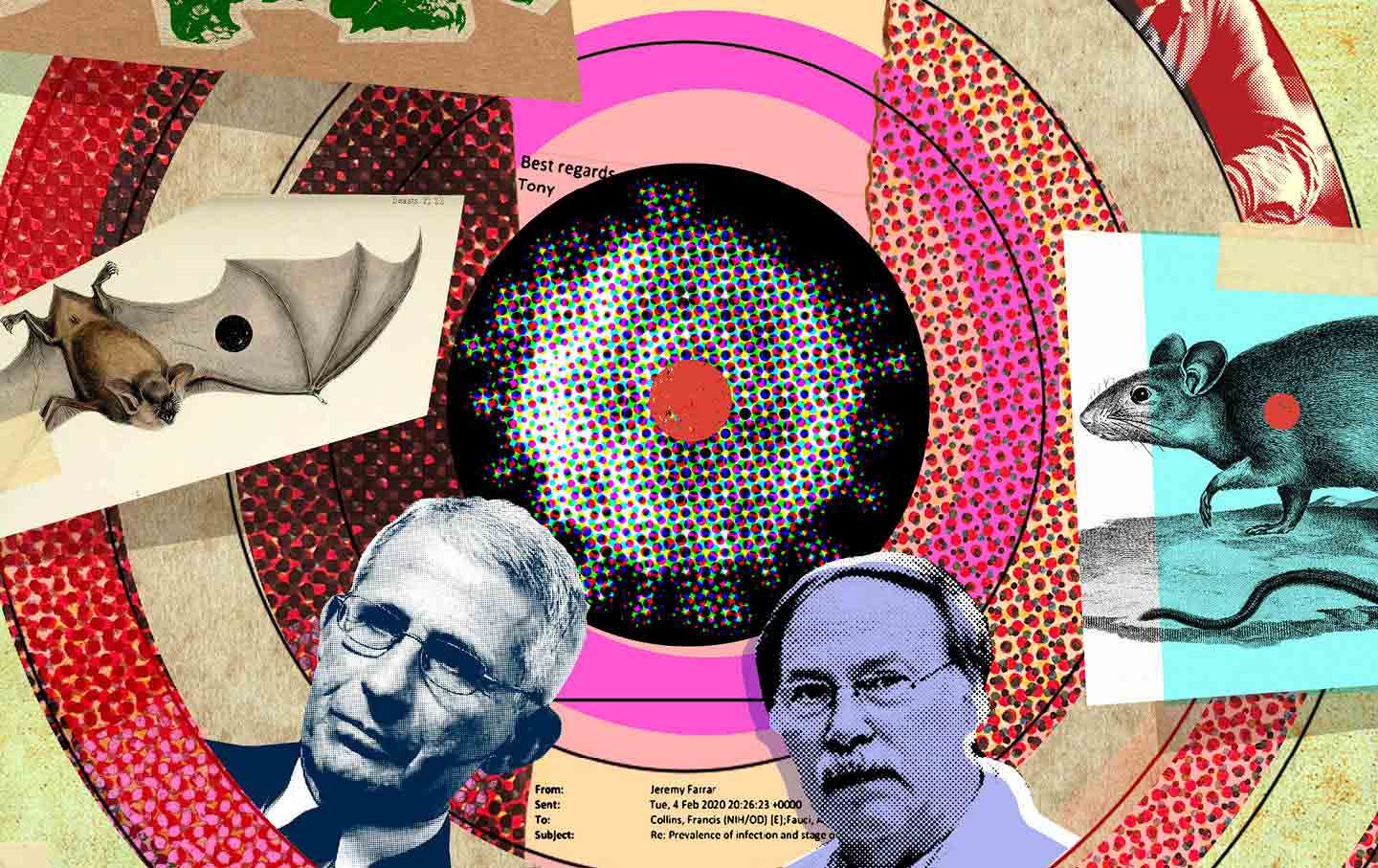
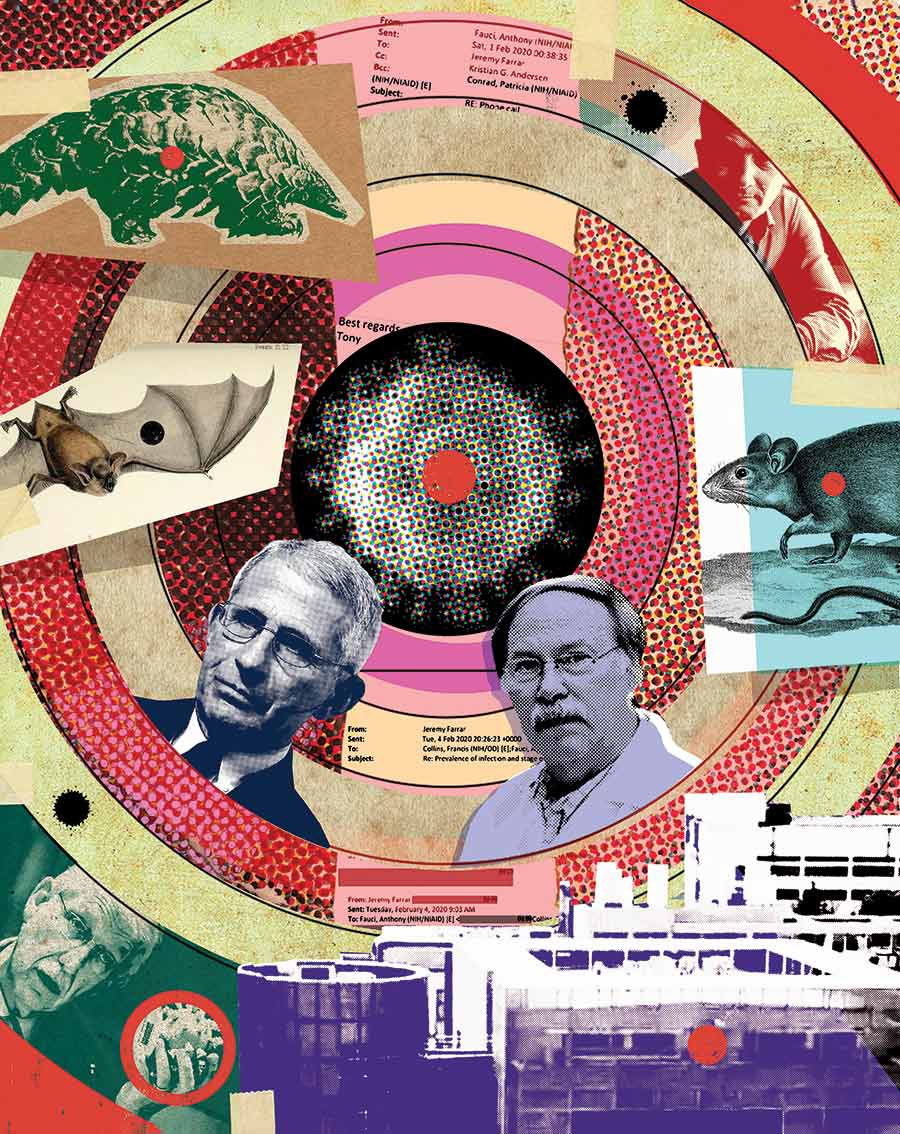
Illustration by Tim Robinson.
As Covid-19 was spreading fear and spurring lockdowns across the United States in March 2020, the scientific journal Nature Medicine published a paper titled “The proximal origin of SARS-CoV-2.” Written by five renowned academic scientists, it played an important early role in shaping the debate about a fiercely controversial topic: the origin of the virus that has killed millions since it emerged in Wuhan, China, in late 2019. Did it spill from animals to humans in nature, on a farm, in a market? Or did it leak from a lab like the Wuhan Institute of Virology, a leading center of coronavirus research in China? Drawing on “comparative analysis of genomic data,” the paper’s authors wrote that “our analyses clearly show that SARS-CoV-2 is not a laboratory construct or a purposefully manipulated construct.” Toward the end of the paper, they added, “We do not believe that any type of laboratory-based scenario is plausible” in explaining the origin of the virus. Instead, the scientists strongly favored a natural origin, arguing that the virus likely spilled from bats into humans, possibly by way of an intermediate animal host.
This article was produced in partnership with The Intercept.
The peer-reviewed paper proved to be hugely influential. Dr. Francis Collins, then the director of the National Institutes of Health (NIH), announced its findings in a post on the agency’s website in late March 2020. When asked during an April 17 press conference at the White House about concerns that SARS-CoV-2 had come out of a lab in China, Dr. Anthony Fauci, who recently stepped down as head of the National Institute of Allergy and Infectious Diseases, referenced the paper, describing its conclusions and calling its authors “a group of highly qualified evolutionary virologists.” The paper has been accessed online more than 5.7 million times and has been cited by more than 2,000 media outlets. ABC News, for instance, ran an article on March 27 titled “Sorry, Conspiracy Theorists. Study Concludes Covid-19 ‘Is Not a Laboratory Construct.’” In that article, one of the paper’s authors, Robert Garry, is quoted saying, “There’s a lot of speculation and conspiracy theories that went to a pretty high level, so we felt it was important to get a team together to examine evidence of this new coronavirus to determine what we could about the origin.”
What that quote didn’t quite convey was that Garry and several of the paper’s other coauthors were themselves initially suspicious that SARS-CoV-2 may have emerged from a lab. They communicated their suspicions to Fauci, Collins and others in late January and early February 2020, and what ensued was a period of intense and confidential deliberation about the origin of the virus.
Unredacted records obtained by The Nation and The Intercept offer detailed insights into those confidential deliberations. The documents show that in the early days of the pandemic, Fauci and Collins took part in a series of e-mail exchanges and telephone calls in which several leading virologists expressed concern that SARS-CoV-2 looked potentially “engineered.” The participants also contemplated the possibility that laboratory activities had inadvertently led to the creation and release of the virus. The conversations convey a sense of anxious urgency and included speculation about the specific types of laboratory techniques that might have caused the virus’s emergence. After roughly a week of debate and data collection, one of the key figures involved in the deliberations characterized the focus of the group’s work as follows: “to disprove any type of lab theory.” Several of the scientists on the calls and e-mails then went on to write and publish “Proximal Origin.” It became one of the best-read papers in the history of science.
The records presented here were made public by the NIH in response to a Freedom of Information Act (FOIA) lawsuit filed by this reporter. Their release in late November came as Fauci prepared to leave the agency after decades of service, and as Republicans in Congress, in anticipation of their imminent control of the House, geared up to launch oversight investigations into the origin of Covid-19.
Many of the documents analyzed in this article were first obtained in 2021, in heavily redacted form, by the journalist Jason Leopold. Some of them were later presented to Congress, where staffers were allowed to look at them and take notes but could not keep full copies. It was only after more than a year of litigation that the NIH released these documents without redactions. Their contents have been met with widely divergent interpretations by the participants in the often vitriolic debate about the origins of Covid-19. What most people seem to agree on, however, is that the documents are a valuable record of the early days of the pandemic and belong in the public domain.
“These documents are important, and they should have been available earlier. The public has a right to know,” says Lawrence Gostin, a professor of global health law at Georgetown University, who favors a natural origin explanation for SARS-CoV-2 but doesn’t rule out the possibility of a lab origin. “All the world has suffered from Covid-19, and we deserve to have all information open and transparent, with a rigorous evaluation of what the cause was.”
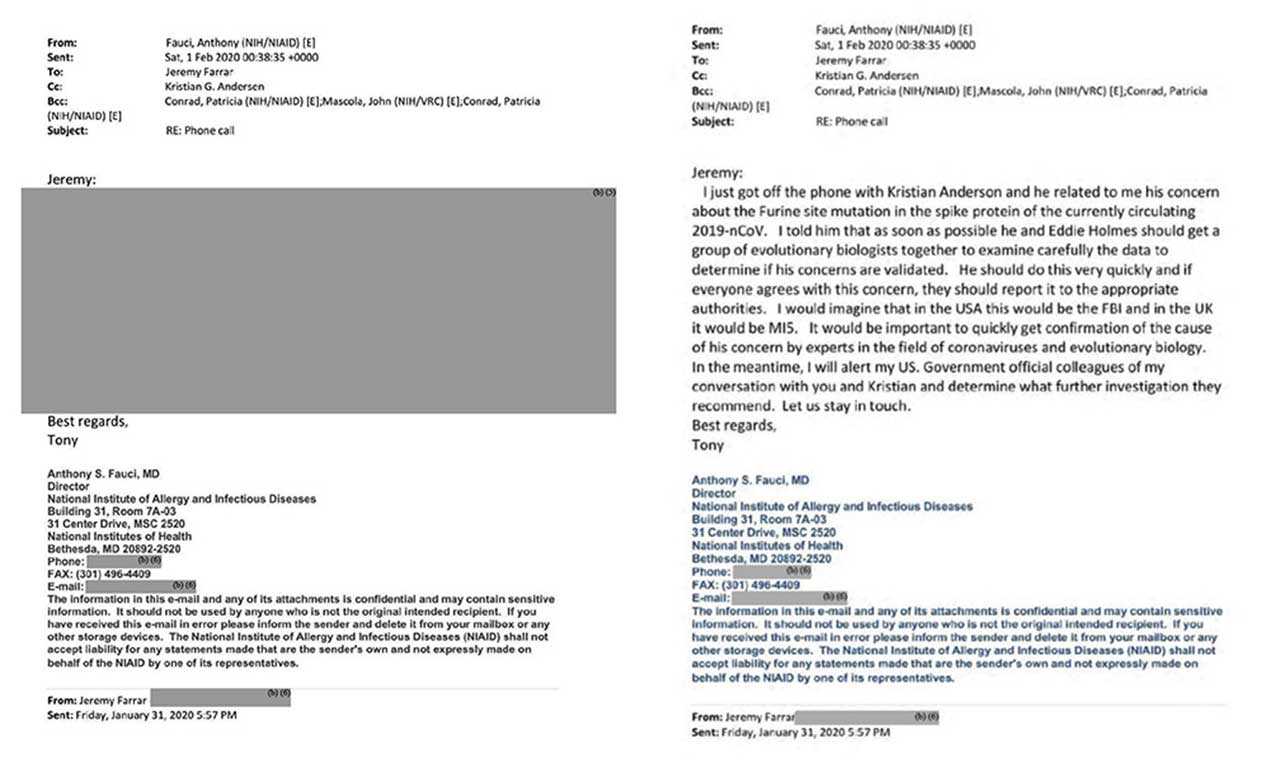
Redacted and unredacted versions of the email that set off the effort to determine if concerns about the origins of the novel coronavirus were valid.
On January 31, 2020, Anthony Fauci received an e-mail from Jeremy Farrar, the director of the Wellcome Trust, an influential health research foundation based in the UK. “Tony, really would like to speak with you this evening,” he wrote.
“Will call shortly,” came an e-mailed response from Fauci’s assistant.
Farrar then wrote to Fauci: “Thanks Tony. Can you phone Kristian Anderson… He is expecting your call now. The people involved are: Kristian Anderson[,] Bob Garry[, and] Eddie Holmes.” Kristian Andersen of Scripps Research, Robert Garry of Tulane University, and Edward Holmes of the University of Sydney are all eminent biologists and virologists, and all three would go on to be coauthors of “Proximal Origin.” Garry and Andersen have both been recipients of large grants from NIH in recent years, as has another “Proximal Origin” author, W. Ian Lipkin of Columbia University.
Fauci had his phone call with Andersen that night, and what he heard clearly disturbed him. In an e-mail to Farrar after the call, he wrote the following: “I told [Andersen] that as soon as possible he and Eddie Holmes should get a group of evolutionary biologists together to examine carefully the data to determine if his concerns are validated. He should do this very quickly and if everyone agrees with this concern, they should report it to the appropriate authorities. I would imagine that in the USA this would be the FBI and in the UK it would be MI5.”
What were Andersen’s concerns? And why were they so dire they might merit a call to the FBI?
Andersen laid them out plainly in an e-mail to Fauci that same evening. “The unusual features of the virus make up a really small part of the genome (<0.1%) so one has to look really closely at all the sequences to see that some of the features (potentially) look engineered,” Andersen wrote in the e-mail. “I should mention,” he added, “that after discussions earlier today, Eddie, Bob, Mike and myself all find the genome inconsistent with expectations from evolutionary theory. But we have to look at this much more closely and there are still further analyses to be done, so those opinions could still change.”
Thus began a scramble to probe in private the origin of SARS-CoV-2. The following day, Saturday, February 1, Farrar organized a conference call with Fauci, Andersen, Holmes, Garry, and several other scientists, including Andrew Rambaut of the University of Edinburgh and Ron Fouchier, a prominent Dutch virologist whose work experimenting with the H5N1 influenza virus has sparked controversy in the past. Also invited on the call were Patrick Vallance, the chief scientific adviser to the UK government, and Collins. This “close knit group,” as Farrar later described it, was to treat their discussion “in total confidence.”
Fauci spent part of the morning before the 2 pm est conference call brushing up on what sorts of grants and collaborations his agency was involved in with research institutions in China. In an e-mail to his deputy Hugh Auchincloss, he wrote: “It is essential that we speak this AM. Keep your cell phone on…. You will have tasks today that must be done.”
In a recent deposition, Fauci said he e-mailed Auchincloss before that afternoon’s conference call because he “wanted to be briefed on the scope of what our collaborations were and the kind of work that we were funding in China. I wanted to know what the nature of that work was.”
In the deposition, Fauci was asked if he was concerned that the work he had funded in China “might have led to the creation of the coronavirus.”
“I wasn’t concerned that it might have,” he responded, “but I didn’t like the fact that I was completely in the dark about the totality of the work that [was] being done, and I was going into a phone call with a larger group of established scientists and I wanted to have at my fingertips just what we were and were not doing.”
If he wasn’t aware of the details already, Fauci may have learned that morning that the NIH, via a US nonprofit called the EcoHealth Alliance, had provided money to the Wuhan Institute of Virology. Among other things, the NIH helped fund experiments at WIV that infected genetically engineered mice with “chimeric” hybrids of SARS-related bat coronaviruses in what some scientists have described as unacceptably risky research. As The Intercept has reported, these particular experiments could not have sparked the pandemic—the viruses described in the research are too different from SARS-CoV-2—but it does raise questions about what other kinds of experiments were going on in Wuhan and haven’t been disclosed. Key details of these US-funded experiments were made public only after The Intercept filed a FOIA lawsuit.
When the conference call kicked off later that day, it provided a forum, according to Farrar, to “listen to the work Eddie, Bob[,] and Kristian have done. Question it and think through next steps.” The specific contents of the conference call are unknown, but e-mails sent among the participants during and after help fill in the picture.
On February 2, for instance, the scientists and health officials sent a series of e-mails explaining their views on the virus’s features and its possible origin. The possibility that the virus emerged from a lab release was top of mind for some of the scientists. In one e-mail to Fauci, Collins, and another NIH official, Farrar wrote, “On a spectrum if 0 is nature and 100 is release—I am honestly at 50!”
Farrar then summarized the perspectives of several other scientists, including Michael Farzan, of UF Scripps Institute. Farzan, Farrar wrote, was particularly puzzled by the presence in the virus’s genome of a furin cleavage site, which is a feature that has not been found in other SARS-related coronaviruses. The furin cleavage site plays an important role in helping the virus infect human airway cells. Farzan was “bothered by the furin site and has a hard time explaining that as an event outside the lab (though, there are possible ways in nature, but highly unlikely).” On the question of whether the virus had a natural origin or came from some sort of accidental lab release, Farrar reported that Farzan was “70:30” or “60:40” in favor of an “accidental-release” explanation and that “Bob”—an apparent reference to Robert Garry—was also surprised by the presence of a furin cleavage site in this virus. Farrar quoted Bob saying: “I just can’t figure out how this gets accomplished in nature…. [I]t’s stunning.”
Several other scientists, including the Dutch virologist Ron Fouchier, offered very different perspectives. In a lengthy February 2 e-mail, Fouchier wrote, “It is my opinion that a non-natural origin of [the virus] is highly unlikely at present. Any conspiracy theory can be approached with factual information. I have written down some of the counter-arguments.” Among other things, he explained that a “natural origin of the furin site is certainly not impossible.” He also warned his colleagues that further debate about the “accusation” that SARS-CoV-2 may have been engineered and released into the environment by humans “would unnecessarily distract top researchers from their active duties and do unnecessary harm to science in general and science in China in particular.” He expressed doubt that a follow-up discussion about the origin question “needs to be done on very short term,” given other pressing issues.
Throughout these exchanges, the scientists and health officials showed keen awareness of the growing public interest in and social media discussion about the question of Covid-19’s origin.
“I agree that we really cannot take Ron’s suggestion about waiting,” Fauci wrote on February 2. “Like all of us, I do not know how this evolved, but given the concerns of so many people and the threat of further distortions on social media, it is essential that we move quickly.”
“Hopefully we can get [the World Health Organization] to convene,” he added. Fauci, Farrar, and Collins had decided to alert top WHO brass to the concerns about the origin of the virus and ask the organization to convene a group to explore the matter. The WHO apparently declined to do so at the time.
“Critical that responsible, respected scientists and agencies get ahead of the science and the narrative of this and are not reacting to reports which could be very damaging,” Farrar wrote that same day.
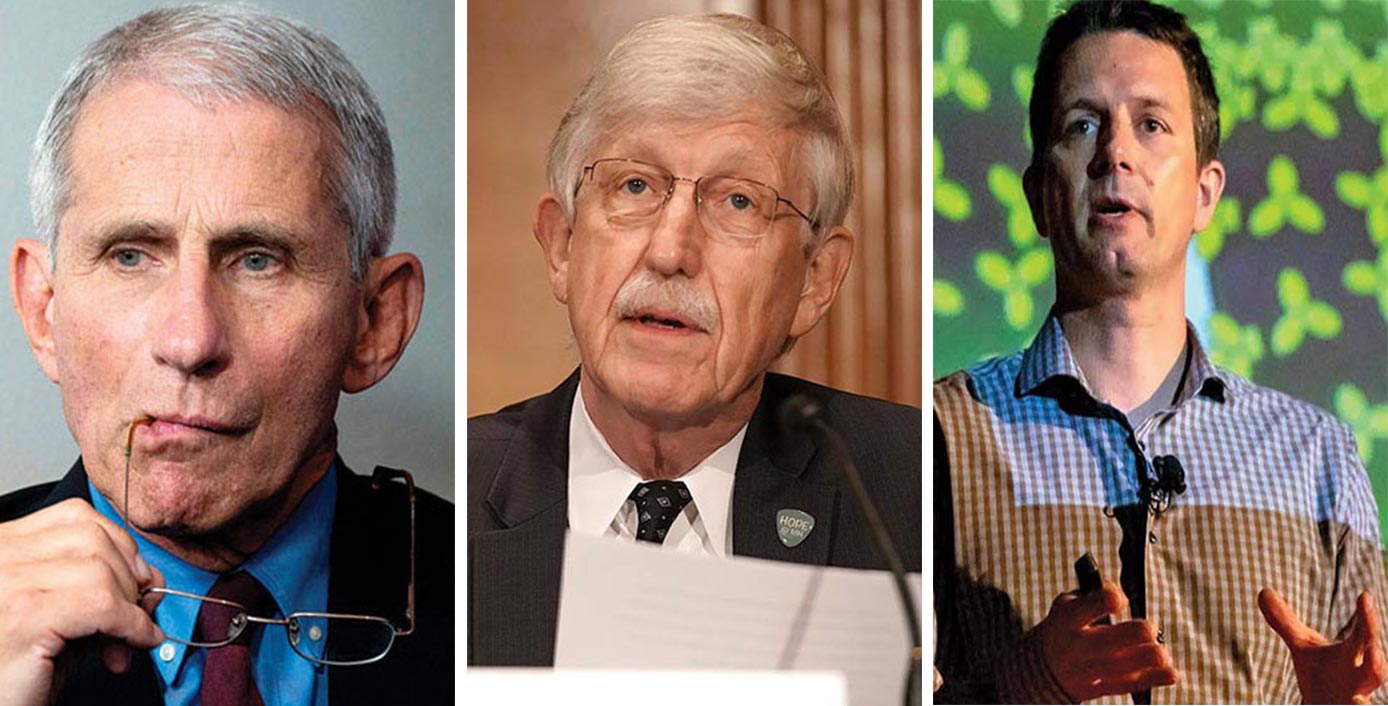
(From left:) Anthony Fauci, Francis Collins, Kristian Andersen. (Jim Watson / AFP via Getty Images; Greg Nash / Getty Images; Scripps Research)
By February 4, after a brief period of debate and data collection, Edward Holmes and some of the other scientists involved in the calls and e-mails had written up a rough summary of their deliberations. “It’s fundamental science and completely neutral as written,” he explained in an e-mail. “Did not mention other anomalies as this will make us look like loons.”
In contrast to the scientists’ concerns a few days prior that the virus looked potentially engineered, the summary definitively stated that the “deliberate engineering” of the virus could be ruled out with a “high degree of confidence as the data is inconsistent with this scenario.” Instead, it laid out two main hypotheses for the virus’s emergence: that it evolved via natural selection in an animal host or that it emerged accidentally from a laboratory practice known as “selection during passage.” “It is currently impossible to prove or disprove either,” the summary stated, “and it is unclear whether future data or analyses will help resolve this issue.”
Holmes sent the summary to Farrar, who forwarded it to Fauci and Collins. It sparked a speculative discussion among the three men about the kind of laboratory work that could have inadvertently created the virus. Their speculations centered on “serial passage” or “repeated tissue culture passage,” a practice in which a virus is evolved in a lab by repeatedly passaging it through mice, other lab animals, or cell culture. In some cases, this technique involves passing viruses through the bodies of mice that have been genetically altered to express certain human proteins. The technique can also make it possible for scientists to “fairly rapidly select for more pathogenic variants [of a virus] in the laboratory,” as Garry would note in a later e-mail.
After reviewing the summary document from Holmes and his team, Collins wrote: “Very thoughtful analysis. I note that Eddie is now arguing against the idea that this is the product of intentional human engineering. But repeated tissue culture passage is still an option—though it doesn’t explain the O-linked glycans,” another feature of the virus that the scientists scrutinized.
Farrar replied in an early-morning e-mail: “Being very careful in the morning wording. ‘Engineered’ probably not. Remains very real possibility of accidental lab passage in animals to give glycans.” The scientists seem by this point to have made a sharp distinction between a scenario in which the virus was deliberately engineered in a lab and a scenario in which the virus was generated during serial passage experiments in a lab.
“Eddie would be 60:40 lab side,” Farrar added. “I remain 50:50.”
“Yes, I’d be interested in the proposal of accidental lab passage in animals (which ones?),” Collins wrote.
“?? Serial passage in ACE2-transgenic mice,” Fauci responded.
“Exactly!” Farrar replied.
“Surely that wouldn’t be done in a BSL-2 lab?” wrote Collins, referring to Biosafety Level 2 labs, which do not have the most stringent safety protocols.
“Wild West…” was Farrar’s response, an apparent reference to lab practices in China or possibly to the Wuhan Institute of Virology itself.
In the above exchange, the health officials seem to be contemplating the possibility that the repeated passage of a coronavirus through genetically modified mice in an insufficiently secure lab could have resulted in the accidental emergence and release of SARS-CoV-2. In a later e-mail exchange, Farrar, quoting Garry, noted that serial passage in animals had been proved to result in the appearance of furin cleavage sites in other viruses, specifically the H5N1 flu virus. “There are a couple passage of H5N1 in chicken papers—the furin site appears in steps.”
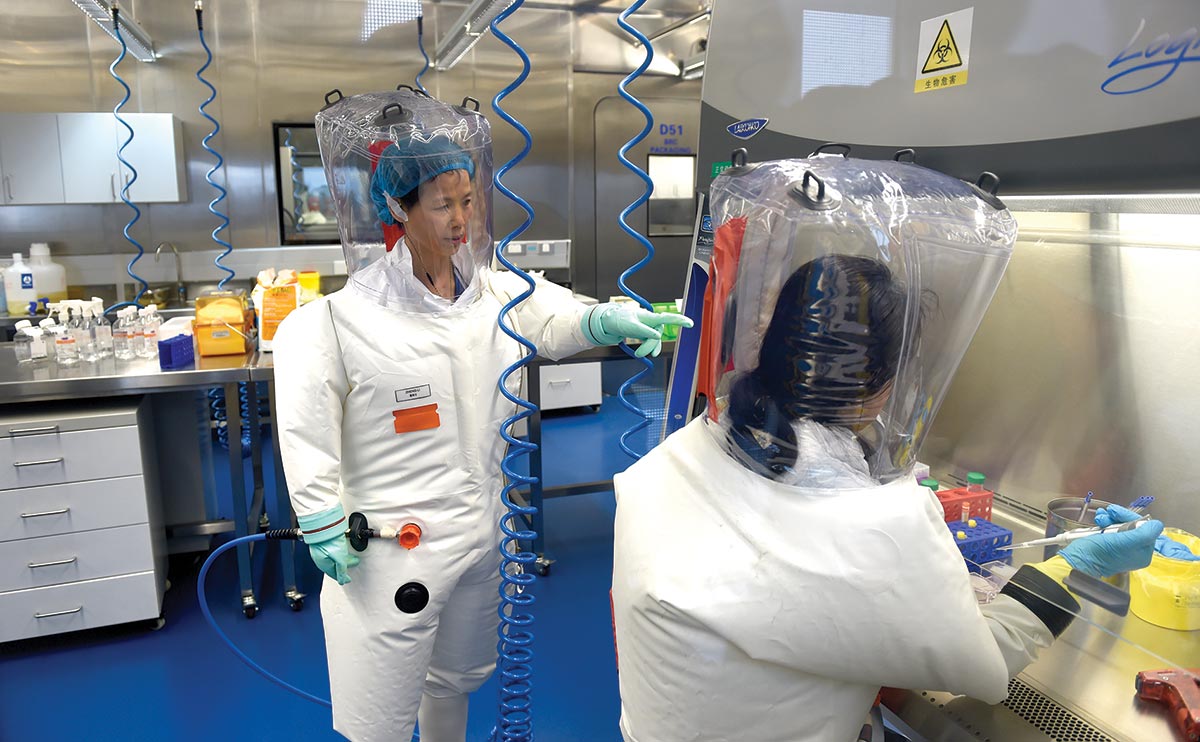
Studying viruses: Virologist Shi Zheng-li, left, at work with a colleague in a lab at the Wuhan Institute of Virology in 2017. (Feature China / Future Publishing via Getty Images)
In the days after February 4, the summary document written by Holmes and his colleagues continued to circulate among the scientists and health officials, including Collins and Fauci, as it was revised and reworked. The scientists were now contemplating three main hypotheses for the virus’s origin—two involving a natural spillover event and one involving a lab origin. They hypothesized that it jumped from its original host, likely a bat, directly into humans, where it evolved its pandemic potential; that it spilled from its original host into some intermediate animal host before jumping into humans; or that it was the result of some sort of lab accident involving serial passage. The scientists wrote that “current data are consistent with all three” scenarios.
On February 7, Farrar notified Fauci and Collins that new preliminary data had come in from China concerning coronaviruses found in pangolins, one of the world’s most heavily trafficked mammals. It seemed to excite the scientists: “Reports coming out overnight that Chinese group have pangolin viruses that are 99% similar,” Farrar wrote. “This would be a crucially important finding and if true could be the ‘missing link’ and explain a natural evolutionary link.”
“That will be VERY interesting,” Collins responded. “Does it have the furin cleavage site?”
The pangolin data, it turned out, did not provide an explanation for the scientists’ central concerns about the furin cleavage site, and the viruses isolated from some pangolins were not 99 percent similar to SARS-CoV-2, but the data did show that coronaviruses circulating in pangolins shared other key features with the pandemic virus. This seems to have played an important role in shifting the scientists’ thinking away from the lab hypothesis.
Holmes, who had been described in an earlier e-mail as being “60:40 lab side,” wrote, “Personally, with the pangolin virus possessing 6/6 key sites in the receptor binding domain, I am in favour of the natural evolution theory.”
The scientists and health officials began debating whether to publish their work and how to address the issue of a possible lab origin. On February 8, Farrar wrote to several of the scientists asking for their views on the revised summary document and seeking their advice on potential publication.
Christian Drosten, a scientist from Germany, responded. Among other things, he wrote: “Can someone help me with one question: didn’t we congregate to challenge a certain theory, and if we could, drop it?”
“Who came up with this story in the beginning?” he added. “Are we working on debunking our own conspiracy theory?”
Holmes replied, in part: “Ever since this outbreak started there have been suggestions that the virus escaped from the Wuhan lab, if only because of the coincidence of where the outbreak occurred and the location of the lab. I do a lot of work in China and I can [sic] you that a lot of people there believe this and believe they are being lied to.”
Kristian Andersen, who would end up being the lead author of “Proximal Origin,” also weighed in on February 8. “The fact that Wuhan became the epicenter of the ongoing epidemic caused by nCoV [novel coronavirus] is likely an unfortunate coincidence, but it raises questions that would be wrong to dismiss out of hand,” he wrote. “Our main work over the last couple of weeks has been focused on trying to disprove any type of lab theory, but we are at a crossroad where the scientific evidence isn’t conclusive enough to say that we have high confidence in any of the three main theories considered.”
“As to publishing this document in a journal,” he added, “I am currently not in favor of doing so. I believe that publishing something that is open-ended could backfire at this stage.” Andersen suggested that the scientists wait and collect more evidence so they could publish some “strong conclusive statements that are based on the best data we have access to. I don’t think we are there yet.”
Though it is unclear from the documents what convinced them to do so, the scientists decided to publish the final paper the following month. On March 6, Andersen wrote to Farrar, Fauci, Collins and others announcing that “Proximal Origin” had been accepted for publication. “Thank you for your advice and leadership as we have been working through the SARS-CoV-2 ‘origins’ paper,” he wrote. “We’re happy to say that the paper was just accepted by Nature Medicine and should be published shortly (not quite sure when).”
“Thanks for your note,” Fauci replied. “Nice job on the paper.”
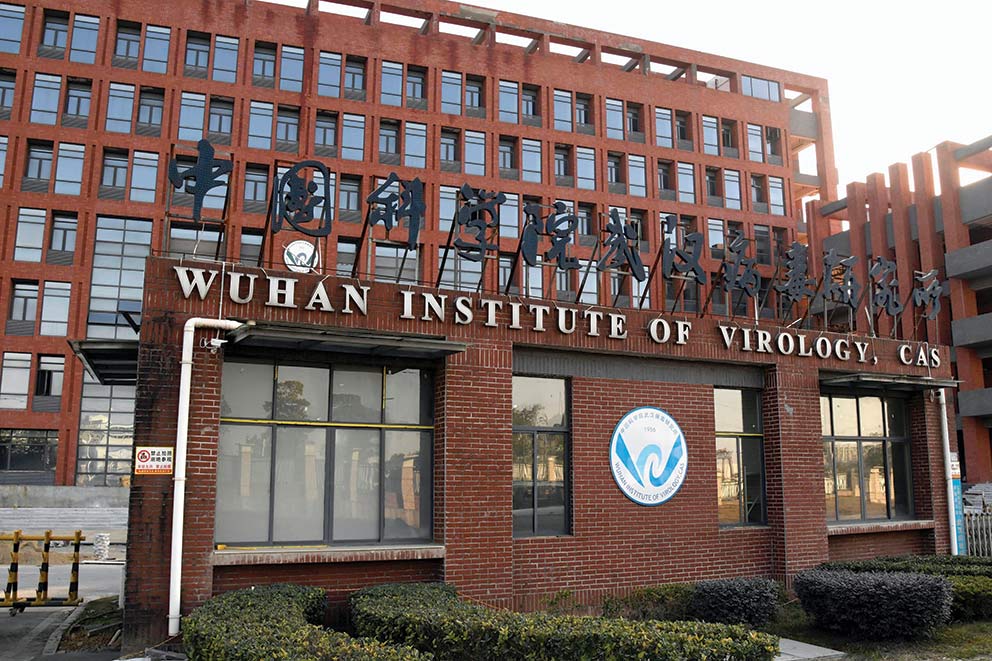
From the outside: The Wuhan Institute of Virology, a leading center of coronavirus research. (Kyodo via AP)
“The Proximal Origin of SARS-CoV-2” was published on March 17, and its findings were much more conclusive than those of the earlier summaries circulated among the scientists. The summaries had not taken a strong stand on whether the virus had emerged from a natural spillover or was the result of selection during passage in a laboratory. The final version explicitly favored a natural origin: “Although the evidence shows that SARS-CoV-2 is not a purposefully manipulated virus, it is currently impossible to prove or disprove the other theories of its origin described here. However, since we observed all notable SARS-CoV-2 features…in related coronaviruses in nature, we do not believe that any type of laboratory-based scenario is plausible.” The earlier summaries had also included a direct reference in the text to labs in Wuhan: “Basic research involving passage of bat SARS-like [coronaviruses] in cell culture and/or animal models have been ongoing in BSL-2 for many years across the world, including in Wuhan.” The reference to Wuhan was cut from this sentence in the final paper, among other changes.
Edward Holmes would later describe the evolution of the paper as the scientific process at work: “I’ve absolutely no problem with people knowing that my views on this issue have evolved as more data have appeared. That’s science,” he wrote in a document obtained via FOIA request. “Indeed, I’ve told this to many people: the way [sic] see it is that we set-up an hypothesis and then tested it. As far [sic] I can tell we are only ‘guilty’ of following the proper scientific method.”
Scientists interviewed for this story had varied interpretations of what the unredacted documents show. Stephen Goldstein, a postdoctoral research associate and evolutionary virologist at the University of Utah, called them a “valuable addition to the body of knowledge surrounding these discussions.”
“In these e-mails we can see science in action—while initially alarmed by certain genomic features, the authors of The Proximal Origin of SARS-CoV-2 consult with accomplished experts in coronavirus biology, which substantially improves their analysis of the viral genome,” he wrote.
“That said these e-mails also clearly reveal just a fraction of the work that would have gone into producing ‘Proximal Origin,’” he added, noting that many of the conversations that informed the paper are likely not captured in the recent FOIA release.
“I think they did what was reasonable given the information they had at the time and given the pace they were moving at here,” said Michael Imperiale, a virologist at the University of Michigan. “This is the way the scientific process works—we make conclusions based on what we know and modify as we learn more.”
Others, however, have a less sanguine view about what these unredacted e-mails contain. Sergei Pond is a computational virologist at Temple University who is “agnostic” on the question of the virus’s origin. He described reading this new batch of e-mails as a “revelatory experience” and likened it to watching the TV show Breaking Bad, in which the main character, through a series of small, understandable decisions, ends up in a bad place. He sees in the e-mails a desire to downplay the deep concern about the possibility of a lab origin.
“It started out being a fairly careful discussion, with anomalies being aired out and people saying multiple times that there is simply not enough data to resolve this,” he said in a recent interview. “But at some point, I think there was such strong pressure that they went from ‘Let’s just wait to get more data’ to ‘Let’s publish something that has a very strong opinion favoring one explanation over another without acquiring any new data.’”
“The big question,” he said, “is why did this happen?”
Pond added that there was no definitive data then, and there is no data now, that would definitively indicate that a lab origin like the one contemplated in “Proximal Origin” is not at least plausible.
Dr. David Relman, a professor of microbiology, immunology and medicine at Stanford University, also has critical words for the paper, arguing that it rests on “flawed assumptions and opinion” and doesn’t fairly contend with the possibility of a lab-associated origin, which he believes is as plausible as a natural origin.
“When I first saw it in March 2020, the paper read to me as a conclusion in search of an argument,” he said. “Among its many problems, it failed to consider in a serious fashion the possibility of an unwitting and unrecognized accidental leak during aggressive efforts to grow coronaviruses from bat and other field samples. It also assumed that researchers in Wuhan have told the world about every virus and every sequence that was in their laboratories in 2019. But these [unredacted e-mails] actually provide evidence that the authors considered a few additional lab-associated scenarios, early in their discussions. But then they rushed to judgement and the lab scenarios fell out of favor.”
“It appears as if a combination of a scant amount of data and an unspoken bias against the [lab origin] scenario diminished the idea in their minds,” he added.
Several academic scientists who were asked to comment for this article expressed their gratitude that these documents are now public but declined to speak on the record given the rancor surrounding this subject. Others, including all five authors of “Proximal Origin” as well as Fouchier and Farzan, declined to comment, did not respond to queries, or were otherwise unavailable. The NIH did not respond to repeated requests for comment. The Wellcome Trust declined to make Jeremy Farrar available. This past December, the WHO announced that Farrar would be its new chief scientist. Also that month, Republican members of the House Committee on Oversight and Reform sent letters to Andersen, Garry, Fauci, Collins, and others seeking documents and testimony concerning the origin of SARS-CoV-2.
As the search for that origin continues, both in Congress and in the scientific community, it is unclear whether dispositive evidence to support either the lab or natural origin theory will ever emerge. Georgetown’s Lawrence Gostin, for his part, is not optimistic, noting that the Chinese government has foreclosed the possibility of a rigorous, transparent, and independent investigation into the emergence of the virus in Wuhan.
“I think it is extraordinarily sad for humankind that we probably will never know for sure,” he said. “But I lay much of that in the hands of China.”