
(JTA) — Mordechi Rosenfeld, the Jewish comedian, insists that the recent Variety article in which he reveals he is married to a man is not a “coming out” piece.
“This article is showing that I’m a veteran comedian and I’m married to a man,” said Rosenfeld, who is known to his friends and fans by the nickname Modi. “This is it. It doesn’t feel like a coming-out piece to me because I’ve been out.”
Anyone who has listened closely to Rosenfeld’s podcast in the last year would know that he and his husband have been married since 2020. The pair talk about living and traveling together, and in a recent episode revealed they would be vacationing on Fire Island, which has a famous gay scene, with prominent gay Jewish cookbook author Jake Cohen.
But the news could easily have come as more of a surprise for one swath of Rosenfeld’s core audience: Orthodox Jews from communities like the one where he grew up, where LGBTQ inclusion remains an unfamiliar and often frowned-upon frontier. Rosenfeld has delivered his signature blend of highly informed Jewish comedy, which often digs into the technical details of Jewish law, on kosher Passover cruises; at benefits for Orthodox organizations including yeshivas, Young Israel chapters and Hatzalah, the Orthodox ambulance service; and on the annual Chabad-Lubavitch movement telethon. But until recently, his routine has contained little whiff of his personal life — in fact, some of his jokes suggested to his fans that he had a wife named Stacy.
“Stacy” is in fact his manager and husband, Leo Veiga, a millennial raised Catholic in South Florida whom the 52-year-old Israel-born, Long Island-raised comedian met on the New York City subway in 2015. The split content has reflected Rosenfeld’s long-espoused belief that the only way comedy can work is to tailor the set to the crowd.
“Even though some religious organization has brought me in and people are coming to see me, I understand I’m under the umbrella of a certain demographic that I need to respect and know the audience,” Rosenfeld told the Jewish Telegraphic Agency. “If you put me in front of an audience, I give them what they need. And they don’t need gay material — they need the material for this audience.”
“But when I’m on the road doing my material, I can do whatever I want,” he added. “They came to see me.”
The Variety article was born of Rosenfeld’s deepening belief that it’s possible to merge his Orthodox and gay identities more publicly — something that he has long done as a congregant and sometimes-cantor at the Modern Orthodox synagogue he attends in the East Village.
“The prayers are done in an Orthodox way. And somehow, gays have been attracted to come to this synagogue,” he said. “We have a whole group of gay people and we have a whole group of trans people welcome.”
“The rabbi’s thing is no one should ever feel bullied, no one should ever feel excluded,” Rosenfeld said. “Be you. Be a proud Jew and be you.”
Rosenfeld’s “not a coming out piece” is significant and part of a broader recent pattern, according to Rabbi Steve Greenberg, the founding director of Eshel, an advocacy organization for LGBTQ Orthodox Jews and their families.
“You used to leave. Coming out meant [you] had to go. Because you could either stay and be silent, or speak up and leave,” Greenberg said. “What has begun to change the story is people insisting on not choosing between their religious identities and their queer identities and insisting on staying in Orthodox communities.”
The Variety piece comes at a time of tension around LGBTQ inclusion in Modern Orthodoxy. Yeshiva University — where Rosenfeld studied at the Belz Cantorial School of Music — has made headlines for fighting for the right not to recognize an LGBTQ student club. This month, a synagogue affiliated with the Modern Orthodox flagship also made news for its treatment of a transgender congregant; Yeshiva’s top Jewish law authority said she could no longer pray there.
The episode ignited strong feelings for Rosenfeld.
“To torture someone like that, somebody who’s religious, who’s keeping the mitzvahs, who’s teaching, who’s doing that, and to open that up and to do what they did is so terrible,” Rosenfeld said. “It’s so, so terrible. That’s the only thing I can tell you.”
For Rosenfeld, there’s no tension between Jewish observance and being gay — although his articulation of why reveals an awareness of the pain that others might feel in trying.
“Being gay, you can keep Shabbos, you can keep kosher, you can keep anything you want to do,” he said. “You can learn Talmud, you can learn Torah, the only thing you can’t do is kill yourself. You can’t commit suicide. That’s not even on the table as an option.”
When Rosenfeld shared the Variety article on his Instagram page, the vast majority of the nearly 800 comments left by fans and friends showed support for his public embrace of his gay identity.
“It’s amazing that you announce that you are gay,” one fan wrote. “You are an example to all the Jews struggling with their gayness. You are a role model to me. Cheers.”
“I think it’s great you can be out with so many of your orthodox fans,” wrote Peter Fox, a freelance writer and Jewish community advocate. “What a wonderful gift of visibility.”
But a few commenters said they would boycott his work in the future, some citing interpretations of Jewish law.
“I can’t believe you are gay,” wrote one person. “What a giant Hillul HaShem [desecration of the name of God]. I lost all respect for you. Unfollowing now. And good luck to you when it’s time to be judged by The Almighty.”
Rosenfeld doesn’t anticipate that the Variety article will lose him any gigs. If anything, he says, it might actually increase his audience. Since he has started adding gay material to his repertoire, his audiences have been increasingly LGBTQ, like at some of the “Holidazed” shows he performed in December at Sony Hall in New York.
Still, he noted, “onstage, I’m more Jewish than I am gay.”
Rosenfeld began to dabble in comedy while working on Wall Street early in his career, when his colleagues realized he was good at impressions. In the last several years, he has emerged as a leader in a wave of comedians focusing on their Jewish identities, even playing himself on an episode of HBO’s “Crashing.” Five years ago, New York City’s then-mayor, Bill de Blasio, declared June 26 as “Mordechi Modi Rosenfeld Day” in honor of his contributions to the artistic community, and last August, Rosenfeld co-hosted the first-ever Chosen Comedy Festival on Coney Island with his frequent comedy partner Elon Gold to a crowd of 4,000. The Jewish comedy show has since gone on to an audience in Miami and will head to Los Angeles in February.
Meanwhile, Rosenfeld has embarked on a steady stream of sold-out shows on multiple continents himself, while enjoying several viral moments. In one bit that was shared thousands of times last year, he pilloried the practice of taking people who have made antisemitic comments to Holocaust museums, joking, “It just gives them ideas.”
Since comedy clubs reopened after their pandemic closures, Rosenfeld has worked on new material at New York’s iconic Comedy Cellar, where patrons’ phones are kept in sealed envelopes and filming is prohibited. The absence of phones gives comedians the freedom to workshop new material — and a lot of that new material, for Rosenfeld, has been focused on living with a millennial husband.
Rosenfeld and Veiga’s story is a classic New York City meet-cute: The comedian was riding the 6 train when he felt a tap on his shoulder. It was Veiga, then an intern at CAA, the talent agency, introducing himself.
“And then we went on a date,” Rosenfeld told JTA. “I picked him up and I brought him to the Comedy Cellar, where I was performing. And he didn’t know that.”
After his 15-minute set, Rosenfeld returned to the comedians’ table, where he had nabbed Veiga a seat, to gauge his date’s reaction. “I said, ‘So I’m a comedian.’ And then we had dinner, we had two more dates, and then he moved in.”
In the eight years they have been together, Rosenfeld credits Veiga with facilitating the evolution of his career as both his husband and manager. During the COVID lockdown, as comedians everywhere found themselves unable to perform in their usual crowded clubs, Rosenfeld says he thought he was getting a break from work — but it was Veiga who suggested a pivot to video. That’s when Rosenfeld grew his online presence and developed his now-beloved characters, like the Israeli know-it-all “Nir, not far” (married to the fictitious, off-camera Stacy) and the Hasidic Yoely, who reviews quarantine-era TV shows and runs for president.
While Yoely is a character, Rosenfeld, too, is religiously observant. He wraps tefillin in the morning, even while touring, and he and Veiga keep a kosher home. Though Veiga is not Jewish — the couple had a civil wedding — he attends synagogue with Rosenfeld, his Hebrew and Yiddish pronunciation is excellent, and he is extremely well-versed in Jewish ideas and lingo. That has occasionally enabled him to stand up for their relationship when encountering people who believe it is forbidden: In one anecdote on the podcast, Rosenfeld shared that at a Shabbat retreat at a yacht club in notoriously conservative Orange County, California, a man at the couple’s table told them that the Bible says two men should not live together. Veiga retorted that the Bible says people should not mix wool and linen — implying that not all strictures are always followed, and leaving the man dumbfounded, according to Rosenfeld’s account.
Veiga has been part of Rosenfeld’s podcast behind the scenes since it began in August 2021, and began appearing on-screen in the taped recordings in December of that year. (In a sign of how deeply Jewish content is woven into his own life, he once wore a kitschy shirt referring to “muktzeh,” the prohibition of touching or moving certain objects on Shabbat.) Rosenfeld co-hosts the podcast with Jewish comedian Periel Aschenbrand, where guests include a mix of mostly comedians with the occasional rabbi (one time, Alan Dershowitz made an appearance).
In the December episode with Jake Cohen, Rosenfeld and Veiga recounted their experience at the Republican Jewish Coalition meeting in Las Vegas. The couple, who admitted to following RuPaul’s Drag Race more closely than American politics, learned what causes Republican Jews were almost universally excited by (Israel and antisemitism on college campuses) and what causes they were lukewarm on (abortion) solely based on the volume of applause in the room. They also said they were surprised by how welcomed they felt as a gay couple at a Republican event, and remarked on how many of the political figures and donors they met were excited to show them pictures of all the other gay couples they knew.
Veiga said in the episode that he didn’t learn until after they agreed to the gig that the conference lineup included Florida Gov. Ron DeSantis and former Vice President Mike Pence, whom Rosenfeld said he found “a little creepy.” Both men have advanced policies and ideas that are anti-LGBTQ.
Rosenfeld said he had no principled objection to performing for Republicans, or anyone else.
“If the Democrats want to invite me, I will go there,” Rosenfeld said. “If Al-Qaeda wants to invite me, we’re there. A check and a microphone, and I’m there. It’s simple.”
The aside came as Rosenfeld, Veiga and Cohen discussed one of Rosenfeld’s favorite ideas — what he calls “moshiach energy.”
“Moshiach energy,” as Rosenfeld puts it, is akin to the Jewish principle of loving your neighbor as yourself and then putting that energy into the universe in order to bring about the coming of the Messiah. The idea is inspired by the last leader of the Chabad-Lubavitch Orthodox movement, Rabbi Menachem Mendel Schneerson — a major source of inspiration for Rosenfeld, who studied at a Lubavitch yeshiva.
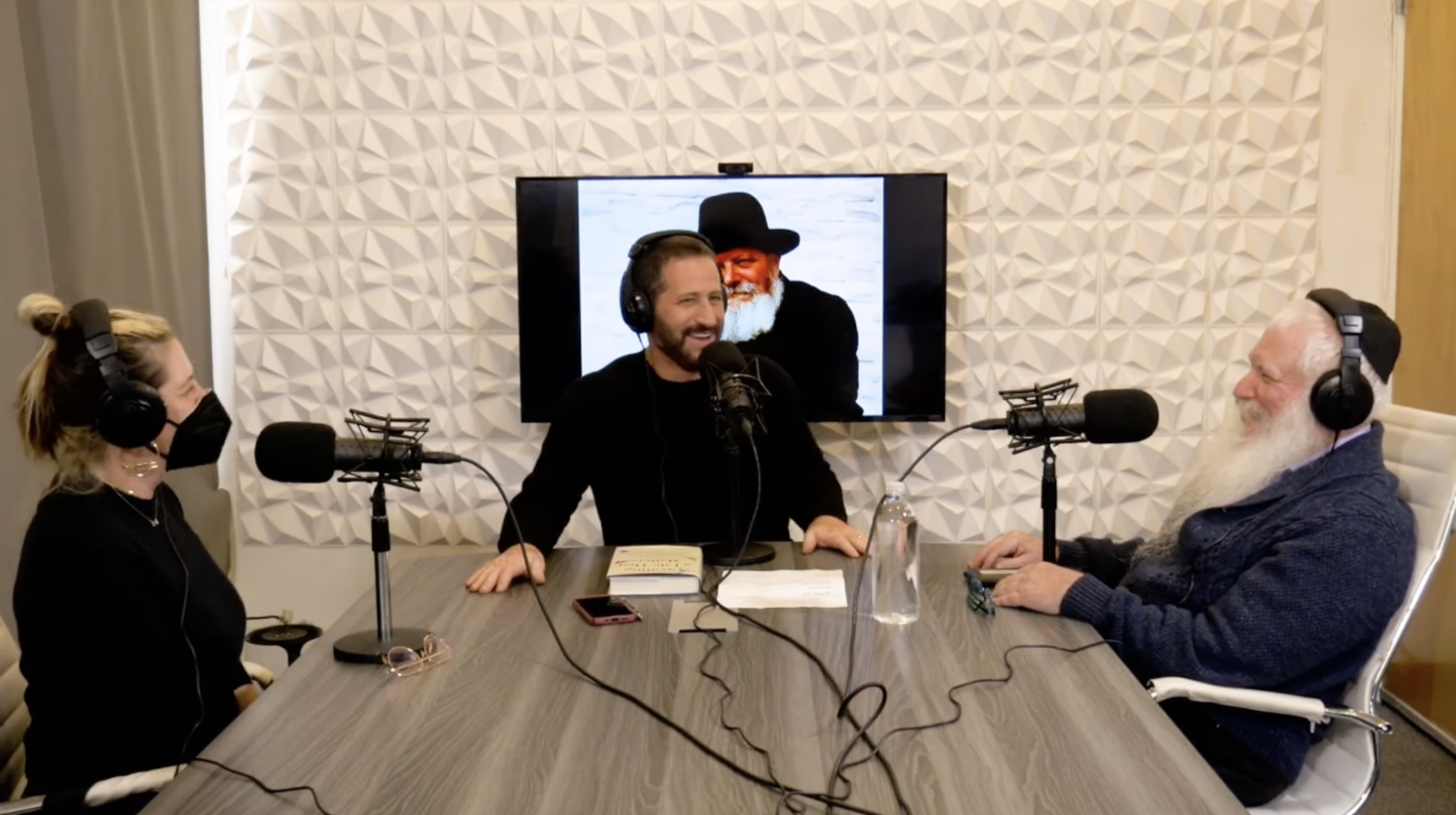 Comedian Modi Rosenfeld Rosenfeld speaks with Rabbi Manis Friedman, right, and comedian Periel Aschendbrand on his podcast in November 2021. A portrait of Rabbi Menachem Mendel Schneerson, the last rebbe of the Chabad Orthodox movement, is behind Rosenfeld. (Screenshot via YouTube) Image by
It’s an attitude that he says is embodied by his synagogue, which he has attended since it opened in the 1990s.
“I am so fortunate to belong to a synagogue, Sixth Street Community Synagogue, where when you put moshiach energy out, it comes right back at you,” he said.
Schneerson considered homosexuality a sin and advocated for Jews to choose not to yield to homosexual urges. Last year, on his podcast, Rosenfeld hosted a Chabad rabbi, Manis Friedman, the former translator for the Rebbe, who espouses the same view; he said he finds Friedman inspiring even though he may not agree with all of Friedman’s views. It’s one of many instances where Rosenfeld has been able to square his identities in ways that have proved challenging for others.
Greenberg, the executive director of Eshel, agreed with Rosenfeld’s hypothesis that the Variety article would have little effect on the comedian’s ability to book gigs — and he said Rosenfeld’s commitment to Orthodox ideas and practices could work in his favor.
“Maybe some of those organizations that have hired him before will actually think this is an even more important reason to have him,” Greenberg postulated. “Some people will see this as a kind of affirmative step that you don’t have to abandon your religious identity because you’re gay.”
It’s an idea that is central to one of Rosenfeld’s signature jokes. For him, being Jewish means praying with tefillin every day, eating kosher food and observing Shabbat — while also being married to his husband.
“I always say: the Jewish people — we’re not the chosen people, we’re the choosing people,” Rosenfeld said. “Being Jewish is a lifestyle — like Equinox.”
This article originally appeared on JTA.org.
The post Comedian Modi Rosenfeld is a mainstay for Orthodox audiences. He’s also gay. So what? appeared first on The Forward.