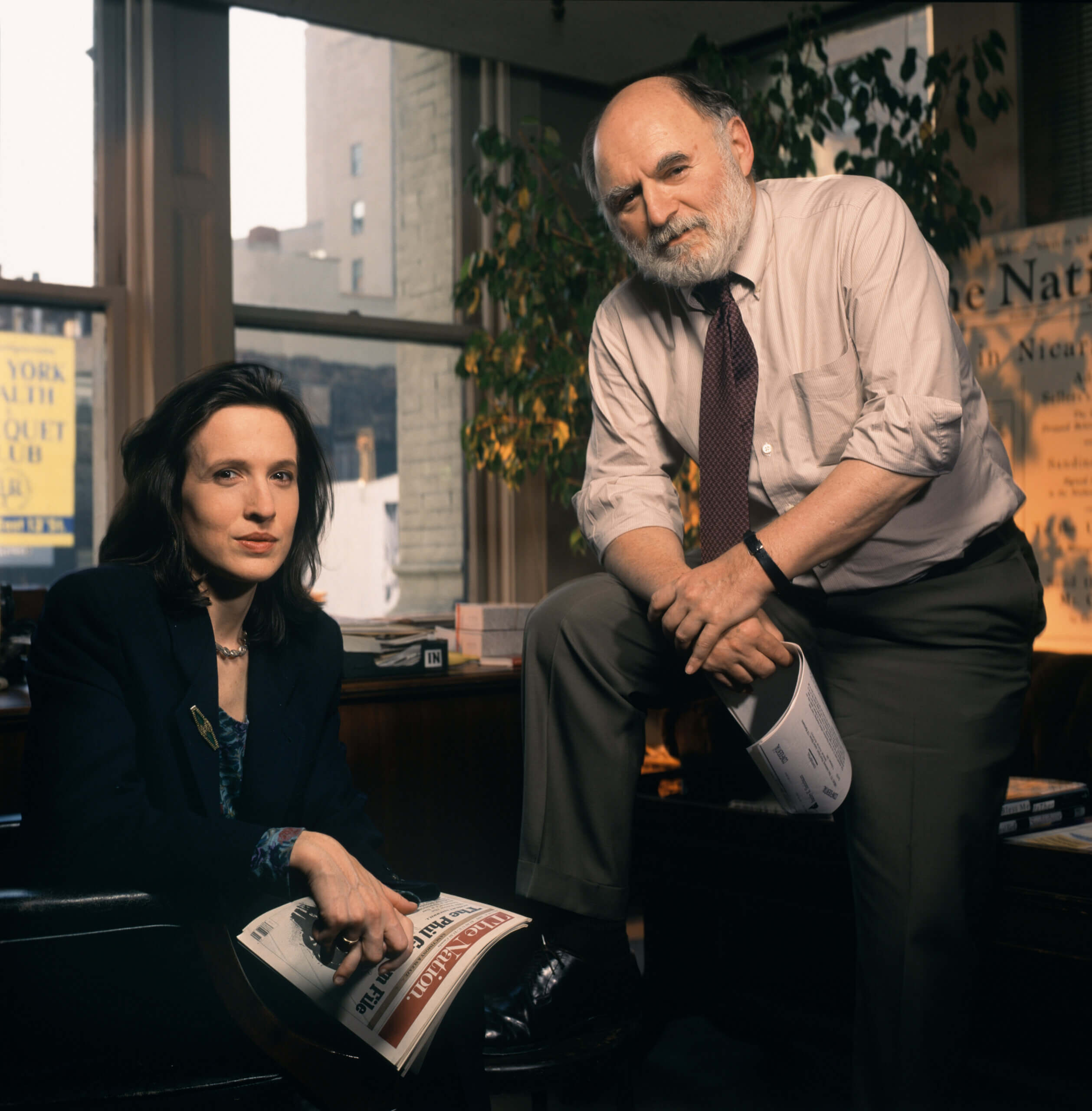
As former longtime editor, publisher and editorial director of The Nation, Victor Saul Navasky, who died on Jan.23 at age 90, famously announced in 1966 that “rumors to the contrary notwithstanding, you don’t have to be Jewish to be an intellectual.”
Nevertheless, Navasky’s long career was marked by loyalty to Jewish brainiacs which was fully reciprocated. Navasky’s Manhattan home was adorned by a caricature by one such confidant, Edward Sorel (born Schwartz), who adapted a notorious Soviet poster paying tribute to a dictator with a slogan by the poet Vladimir Mayakovsky, “Lenin Lived, Lenin Lives, Lenin Will Live Forever!” to read instead: “Navasky Lived, Navasky Lives, Navasky Will Live Forever!”
This mock-immortality was likely due in part to Navasky’s persistent faith in the friends and colleagues he admired. Asked in 1982 about which of today’s journalists was writing like George Seldes, a then-nonagenarian investigative journalist of Russian Jewish ancestry, Navasky stated that the only contemporary “writing like George Seldes is George Seldes.”
Related
Even an acidulous review of one of Navasky’s later books in the September 2005 issue of Commentary, a periodical that deemed his ideology anathema, had to admit that Navasky was “certainly among the most cheerful men in the world and may just be the most satisfied.” Or as the English Jewish polemicist Christopher Hitchens once claimed, Navasky preferred “being furry to being spiky.”
Part of this bonhomie was due to possessing, at least outwardly, the carapace of an armadillo and assuming that everyone else should too. This inner toughness led Navasky to be less than sympathetic in 2007 in Daedalus when Jewish students at the University of California Irvine were traumatized by Muslim Students Association lecture announcements with titles expressing what Navasky pooh-poohed as “dubious taste” such as Israel: The 4th Reich and Zionism Hijacking Judaism. Navasky felt that “most of the ‘oppressed,’ including the Jewish community, can take care of themselves.”
This imperturbably strong stomach made it possible for Navasky to appear in 1980 on William Buckley’s chat show Firing Line alongside the supervillain Roy Cohn, who opposed Navasky’s viewpoint on McCarthyism and the Hollywood blacklist, to put it mildly. Likewise, in 2008 in the Columbia Journalism Review, Navasky regretted the demise of the New York Sun, distributed in its print version from 2002 to 2008, stating: “I couldn’t abide its right-wing politics … and while I didn’t mind its obsession with Israel and the Jews, …let me quickly add that I subscribed to The Sun, I loved The Sun, and although it published its last issue today, I already miss it.”
Perhaps Navasky saw ideological opponents as indispensable elements for affirming his own opinions. In the same article, he congratulated The Sun for reporting “systematic harassment of Columbia University’s Jewish students by anti-Zionist and antisemitic professors” although he trivialized this reportage with the opinion that “these allegations had little or no basis in fact.”
Some of this stouthearted taking-care-of-himself attitude might have been learned from Navasky’s father Macy, a Garment District hondler. The elder Navasky’s small-scale wheeling and dealing possibly offered a prototype for his son, who even attended Harvard Business School at one point to hone his entrepreneurial skills.
Navasky’s first exposure to Jewish fundraising was in 1946, when as a teenager he was paid $2 per hour to solicit donations for the Irgun at performance of Ben Hecht’s play, A Flag is Born, which advocated for a Jewish state.
Not all such efforts would succeed. Time reported in 1964 that when Navasky asked the playwright George Axelrod, of Russian Jewish origin, to sponsor a satirical quarterly, Axelrod refused because “satirists should starve.” Navasky never quite starved, nor did his regular writers who were able to supplement The Nation’s low wages with more lucrative gigs.
Among them was Marvin Kitman, still thriving at age 93, who jokingly ran for president against the Arizona Republican Barry Goldwater. Kitman spoofed Goldwater’s paternal Jewish roots by boasting: “I am twice as Jewish as Goldwater.” Kitman and Navasky would collaborate on The Red Chinese Air Force Exercise, Diet, and Sex Book (1967) presented as “translated by William Randolph Hirsch,” a Judaicized version of the name of the media tycoon Hearst.
Another loyal ally was the American Jewish humorist Calvin Trillin, long identified as the most frequent contributor to The Nation. Trillin joked about Navasky’s modest pay rates, but had to admit that he was paid the same $100 per item of doggerel about current events, even if it consisted of a mere rhyming couplet.
Still another sustained friendship was with E.L. (Edgar Lawrence) Doctorow, the U.S. novelist of Russian Jewish origin. These and many other friendships were of capital importance to a sustained editorial career.
Indeed, Navasky’s Naming Names (1980) analyzed the investigation of Hollywood radicals by the House Committee on Un-American Activities from a moral, rather than political, standpoint of violated friendships. Navasky told the Jewish interviewer and historian Studs Terkel in 1980 that according to Jewish tradition, “You have your tongue cut out if you inform on a fellow Jew to the Gentiles.” And Navasky cited the actor Zero Mostel, who refused to cooperate with the committee by rationalizing: “I can’t be an informer because under Jewish tradition an informer can’t be buried on sacred ground.”
Although The Nation was regularly castigated for purportedly antisemitic articles by Gore Vidal, Edward Said, Alexander Cockburn and others, Navasky remained amused by details of Yiddishkeit, as he observed in a November 2005 issue. Navasky was tickled when his subscription copy of Jewish Currents arrived with an editorial apology for a mishap at the bindery: “If your copy was ongepatshket (messed up) please contact our offices.”
Navasky’s definition was debatable for the Yiddish term more often transliterated as ongepotchket, since it most often refers to something needlessly complicated or slapped together senselessly. Yet as usual with Navasky, he gave a plausible impression of having his heart in the right place.
He was a fan of political cartoons and proud of having printed a controversial 1984 David Levine caricature of Henry Kissinger shtupping a female personification of the world with her head replaced by a terrestrial globe. Navasky’s predilection for caricature may have been partly due to the fact that he was an ideal subject: Many devoted friends commented on the ideally spherical shape of his head.
Yet his 2013 study Art of Controversy may have been a trifle close to the subject to allow for proper perspective, since it assumes that once-famed, but now unfortunately overlooked, Herblock, the pseudonym of the editorial cartoonist Herbert Lawrence Block, was still a household name. In a parallel way, Navasky’s bon enfant style of loving his enemies might have led him to soft-pedal offenses by insidious political opportunists like perennial American Communist Party candidate Gus Hall, just as he soft-pedaled Stalinist propaganda efforts in Hollywood.
As a result, Susan Sontag may have been justified when she asserted at a Town Hall gathering in 1982 that Reader’s Digest was more accurate in depicting European Communism as “fascism with a human face” than Navasky’s Nation had been. Even so, Victor Navasky surely left a legacy of rare civility and amiability, inspired by Jewish moral standards.
The post How the consummate Jewish intellectual remained ‘one of the most cheerful Jewish men in the word’ appeared first on The Forward.