
Washington is bracing for the impact of the new House Select Subcommittee on the Weaponization of the Federal Government which is to be led by Rep. Jim Jordan, the incoming chairman of the Judiciary Committee and a politician deeply aligned with former President Donald Trump and his MAGA movement. Republicans and conservative media are comparing the new group to the 1970’s era Democratic-led Church Committee that investigated Executive Branch intelligence abuse and spurred the congressional oversight process for the U.S. intelligence community that exists today.
According to Jordan and GOP organizers, the purpose of the committee is to investigate how the executive branch allegedly gathered information on citizens and worked across both the government and the private sector “to facilitate action against American citizens” in silencing conservatives “at all levels.” Their premise is that U.S. government institutions, principally law enforcement and the intelligence community, have been “weaponized” by Democrats to repress legitimate, conservative political agendas.
I served for more than 34 years in the CIA’s Clandestine Service and made multiple journeys to Capitol Hill to brief oversight members on the most sensitive aspects of agency operations. I detailed the CIA’s successes, as well as its failures. The experiences were time-consuming and not always pleasant, but I firmly believe that congressional oversight is a necessary and essential component of a functioning democracy. The process facilitates public trust and provides for appropriate accountability and reforms, as needed, for a secret organization like the CIA as it operates in an open and democratic society.
But that’s oversight, a bipartisan endeavor conducted in the interest of all Americans, regardless of political affiliation. The oversight structure that came from the Church Committee investigations adopted legal and sensible rules of the road and protections for all stakeholders. Such supervision is conducted in controlled settings, shielded from public exposure, in a way that promotes candor and trust among both the auditors and the audited, facilitating transparency.
That’s not to say it’s perfect. I’ve seen lawmakers’ bias for or against various programs unrelated to partisan politics cloud their judgment. One example was the largely bipartisan seduction of members of Congress by the Predator armed drone program, which dazzled with extraordinarily slick videos featuring the bells and whistles of precision strikes that often supplanted important conversations about targeting methodology and strategic effectiveness. Or members’ fascination with a tool or tradecraft methodology they funded, despite CIA disinterest that impeded rather than facilitated mission success.
Still, up until my 2019 retirement, with few exceptions, I found that oversight members acted responsibly, at least behind the closed doors of our engagements. Similarly, and again with a few exceptions, members were unlikely to leak or make political fodder from what they came to learn, good or bad. The CIA took its deserved lumps when appropriate, but also came away at times with even more support than had been requested for critical initiatives.
Not Oversight
Jordan’s committee will not be oversight. Rather, it promises to be the very politicized weapon it claims interest in exposing. The body’s spectacle and powers pose dangerous implications for the ability of the U.S. intelligence and law enforcement communities to effectively conduct their mission.
The CIA strives to adhere to the mandate that it does not operate as a policymaking institution, though there have been unfortunate exceptions. The CIA’s misguided endorsement of the George W. Bush White House’s contention that deposed Iraqi leader Saddam Hussein retained weapons of mass destruction is one famous example. And arguably, former CIA Director Gina Haspel’s deflection of Havana Syndrome concerns and reported interference with reporting that cast Russian leader Vladimir Putin in a bad light so as not to provoke President Donald Trump is another.
But it’s a requirement that CIA officers embrace and that Director William Burns affirmed in a rare December 2022 PBS interview. “We are an apolitical organization,” Burns observed. “Our job is to provide the best intelligence that we can collect and analyze to the president, to policymakers, to discuss that with our Oversight Committees in the Congress as well, and to do that without any policy agenda, any whiff of politics.”
The reality is that the CIA generally does not offer recommended courses of action or suggest a right or wrong approach to policymakers. CIA officers are so conditioned to refrain from policy prescriptive prose that my own transition to writing publicly on national security matters has frustrated no small number of editors. CIA officers are trained to tell it like it is, warts and all, and ideally, have the courage to speak truth to power, even as uncomfortable as it could be before Congress. It’s literally written in stone at our entrance: “And ye shall know the truth and the truth shall make you free.”
Intelligence officers are trained to see the world without absolutes, judgment, political bias, or even in the context of their own religious beliefs and personal values. Whether raw reporting from field agents or finished intelligence products, their language is clinical, without passion, and excludes even mention of U.S. policy, let alone criticism. That’s not a moral issue, but rather a requirement for objectivity in getting things right. Absolutes, judgment, and the like are filters that undermine one’s ability to see the world as it is, rather than how we would like it to be. Emotion and qualifiers convey imperative and can come across as a policy prescriptive. These characteristics are unfortunately more prevalent among policymakers, on both sides of the political aisle.
The Intelligence Community-Policymaker Tension
Herein lies the ultimate tension between intelligence professionals and the decision-makers they support. For the most part, national-level leaders, even autocrats, are politicians who see the world through ideological prisms aligned with their supporters and constituencies (though it’s sometimes unclear who is following whom). They represent platforms and ideology, coming into their jobs with predetermined judgments and, in democracies, campaign promises that limit maneuvering room. The enlightenment of even reliable intelligence does not necessarily always sway their thinking.
As a CIA case officer whose career required befriending and recruiting sources with moral standings that varied from selfless patriot to mercenary opportunist, my world was a no-judgment zone; my mission was to carry out lawful direction. Clinically, there was no absolute right and wrong, nor good versus evil, even among our enemies, but instead, we were forced to operate within the context of political realities. Not situational ethics per se, but rather a mindset concerning the need to mitigate risk and protect national security.
Nurturing this mindset among intelligence professionals is key to avoiding the political deep state Jordan’s new committee contends it seeks to investigate and reform, but risks creating instead. One need look no further than how Russia’s systemic intelligence failures contributed to Putin’s calamitous decisions in Ukraine. Putin’s intelligence agencies may have validated the Russian dictator’s predetermined judgment that the war would be a short and largely uncontested affair. Putin appears to have been certain that Ukrainians would greet Russian forces as liberators or otherwise acquiesce, and that the United States and the world’s liberal democracies would lack the backbone to do more than protest and impose further toothless sanctions.
In Russia’s organized kleptocracy, where survival, let alone advancement, is secured by fealty, corruption, and personal networks, who is going to disagree with the party line, tell Putin that he’s wrong, speak truth to power, and tell it like it is? Putin’s intelligence echo chamber is systemically cultivated, from leadership to those in the trenches, resulting in skewed strategic assessments based on sloppy tradecraft and politicized analysis to fit the answers he and his cronies expect to hear.
Wasteful Durham Probe
During Trump’s tenure, then-Attorney General William Barr appointed U.S. Attorney John Durham as special counsel to investigate potential misconduct against the president or his associates in the Trump-Russia probe. Beginning in 2019, Durham was expected to reveal the deep state Trump claimed had created “the hoax” of Russia’s election interference and enmity toward the United States. The Durham investigation had cost at least $6.5 million through the end of 2022 but resulted in the conviction of only a single low-level FBI lawyer, who avoided jail by pleading guilty to doctoring a 2017 email that the FBI used to justify the surveillance of a former Trump campaign aide.
Durham had complete access to all of the intelligence, operational information, and personnel involved in the intelligence community and to law enforcement assessments and products, details including the nation’s most sensitive secrets and capabilities. Moreover, then Director of National Intelligence John Ratcliffe, in an effort to assist Trump’s 2020 campaign, declassified nearly 1,000 pages of intelligence material for Durham’s use. He did so over CIA Director Gina Haspel’s objection, an action that given the scale and the topic, Russia, put sources at risk and jeopardized the cooperation of agents and the CIA’s foreign government partners. Still, as the New York Times just reported, “after almost four years — far longer than the Russia investigation itself — Mr. Durham’s work is coming to an end without uncovering anything like the deep state plot alleged by Mr. Trump and suspected by Mr. Barr.”
In addition to taking intelligence and law enforcement personnel offline from their work to answer questions, Durham’s inquiry struck fear among underpaid, junior-level intelligence and law enforcement professionals who had worked on the investigations, collection operations, and ensuing assessments that his probe targeted.
Civil servants, some of whom struggle just to make ends meet, suddenly had to concern themselves with the cost of expensive legal counsel and the threat of professional consequences for work that diverged from the president’s narrative. “Go back to school,” Trump angrily exclaimed, when the U.S. Intelligence Community’s 2019 Worldwide Threat Assessment challenged many of his claims.
It’s hard to imagine Jordan’s new committee finding evidence of politically motivated malfeasance in the U.S. Intelligence Community that eluded a determined, experienced, well-trained, and well-staffed Durham, who operated with the sitting president’s support, unrestricted access, and essentially unlimited resources. But that doesn’t mean the committee won’t cause havoc, at minimum posing a worrisome distraction and consuming time and resources the intelligence and law enforcement communities could better use to protect the country.
The greatest danger, though, is the impact on these communities’ protection from political pressure. Professionals dedicated to national service will have to assess the risks of telling it like it is and speaking truth to power. Even those at the bottom of the professional ladder might find themselves having to lawyer up and consider the prospect of subsequent purges depending on who is in office. It also doesn’t make for good buzz among the talented Americans these agencies are trying to recruit into their ranks who might think twice about signing up.
The GOP and the American people need to reflect on what type of national security institutions they want: Russia’s failed system or a cadre of professionals committed to country rather than party and guided by the Constitution and their oaths. The wrong choice will ultimately be borne by us all in blood and treasure.
(Editor’s note: Readers may also be interested in this article on the new select subcommittee by Noah Bookbinder, “Decoding the “Select Subcommittee on Weaponization of the Federal Government.”)
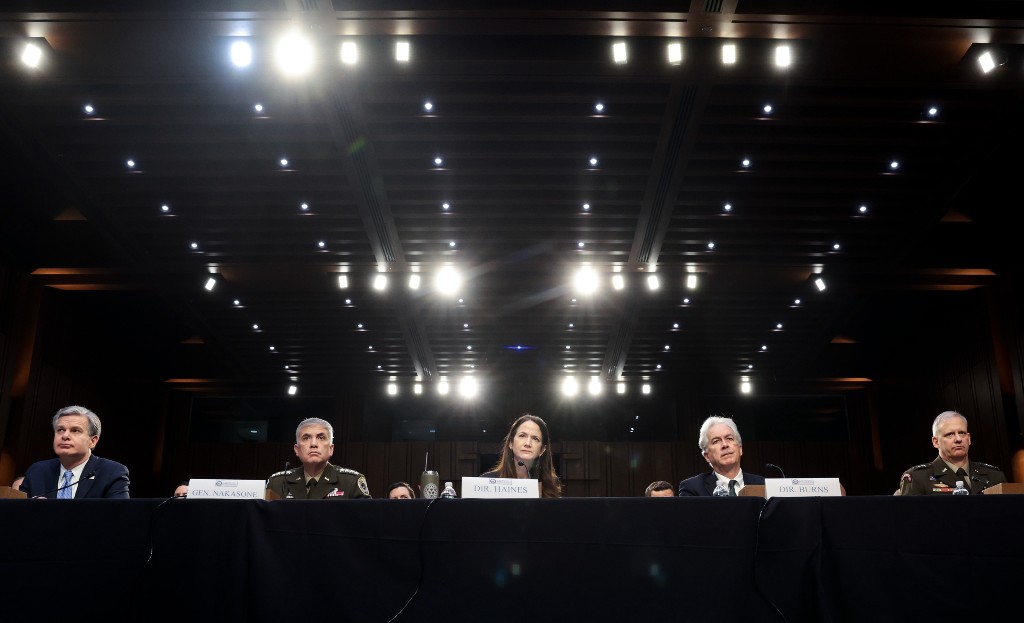
IMAGE: (L-R) Federal Bureau of Investigation (FBI) Director Christopher Wray, National Security Agency (NSA) Director Gen. Paul Nakasone, Director of National Intelligence (DNI) Avril Haines, Central Intelligence Agency (CIA) Director William Burns, and Defense Intelligence Agency (DIA) Director Lt. General Scott Berrier testify before the Senate Intelligence Committee on March 10, 2022 in Washington, DC. The committee held a hearing on worldwide threats. (Photo by Kevin Dietsch/Getty Images)
The post Rep. Jordan’s Dangerous New Panel is Nothing Like the Church Committee appeared first on Just Security.