
The murder rate rose nearly 8 per cent last year and is 20 per cent higher than in 2014, according to the Federal Bureau of Investigation, which on Monday released its annual compilation of national crime statistics.
“The worrying violent crime increase that began in 2015 after many years of decline was not an isolated incident,” the bureau said.
The FBI also adjusted upward its 2015 data, saying that the violent crime rate that year had increased by 3.3 per cent rather than the originally reported 3.1 per cent.
“For the sake of all Americans, we must confront and turn back the rising tide of violent crime . . . and send a strong message to criminals that we will not surrender our communities to lawlessness and violence,” Mr Sessions said.
A crackdown on violent crime has been a centrepiece of Mr Sessions’ rocky tenure as attorney-general. He has rewritten guidance for federal prosecutors, requiring them to charge suspects with the most serious offences and thus secure longer prison terms. He also has backed urban police departments that he says have been “unfairly maligned” for heavy-handed and racially discriminatory policing.
Despite the recent increase, the national rate of violent crime remains near a generational low and is roughly one-half of 1991’s modern peak. Last year, there were 386.3 crimes such as murder, rape, robbery and aggravated assault per every 100,000 Americans, up from 373.7 in 2015, but far below the 758.1 rate reported in 1991.
The national murder rate of 5.2 per 100,000 people also is roughly equal to where it stood in 2008. “We’re still nowhere near what these rates were in the 1990s,” said Ames Grawert, a former prosecutor now with the Brennan Center for Justice at New York University.
The rate of property crimes such as burglary, car theft and arson also fell in 2016 for the 15th consecutive year, a fact that the FBI did not highlight. The reason for the continuing decline is not clear, but modern policing tactics, video surveillance and security systems may be combining for better property crime prevention, Mr Grawert suggested.
Two cities — Chicago and Baltimore — accounted for 15 per cent of the two-year murder increase from 2014 to 2016, Jeff Asher, a crime data analyst in New Orleans, said on Twitter. But of the cities that reported 20 or more murders in 2014, 70 per cent saw an increase over the two years, he said.
______________________
fbi statistics | fbi statistics 2017 – Google Search
_______________
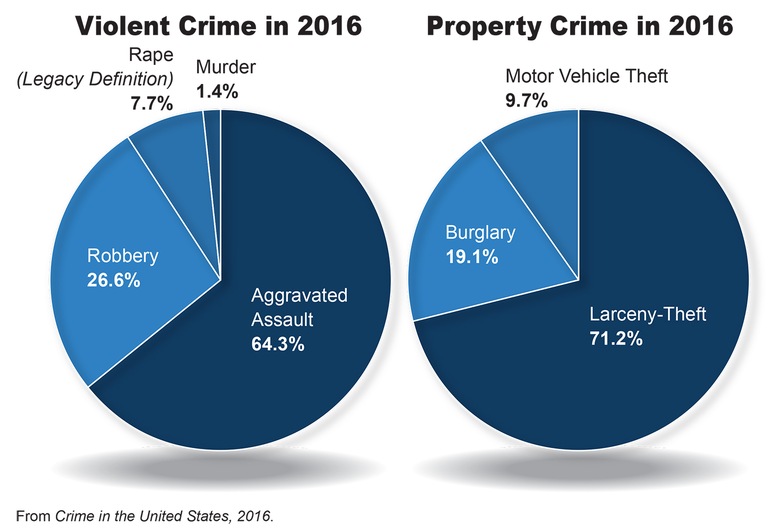
Additional statistics from Crime in the United States, 2016 include:
- Last year’s data shows there were 95,730 rapes reported to law enforcement, based on the UCR’s legacy definition. (Learn more about the updated rape definition.)
- Of the violent crimes reported to police in 2016, aggravated assault made up 64.3 percent, while robbery was 26.6 percent. Rape (legacy definition) accounted for 7.7 percent of the violent crimes reported last year, and murder made up 1.4 percent.
- About 7.9 million property crimes were reported to the UCR, with losses (excluding arson) of about $15.6 billion.
- The report estimates that law enforcement agencies made about 10.7 million arrests in 2016 (excluding arrests for traffic violations).
The 2016 report has been streamlined from 81 information tables to 29, but it still includes key data on major categories—such as known offenses and number of arrests—that researchers, law enforcement, and the public expect. Crime in the United States, 2016 also includes the additional publications Federal Crime Data, Human Trafficking, and Cargo Theft.
In his message accompanying the report, FBI Director Christopher Wray called on law enforcement agencies to continue transitioning to the more informative National Incident-Based Reporting System (NIBRS). Use of NIBRS data, which will be the national standard for crime reporting by 2021, will provide additional transparency. Wray called for the country to “get beyond anecdotal evidence and collect more comprehensive data so that we have a clearer and more complete picture of crime in the United States.” He also noted the creation of the FBI’s database to collect law enforcement use-of-force statistics to facilitate an informed dialogue within communities.
“The more complete the data, the better we can inform, educate, and strengthen all of our communities,” Wray said.
FBI, This Week: 2016 Crime in the United States Report Released
September 25, 2017
Audio Player

The FBI’s 2016 Crime in the United States report shows violent crime jumped 4.1 percent and property crime decreased 1.3 percent when compared to the year before.
Audio Transcript
Mollie Halpern: The FBI’s 2016 Crime in the United States report shows violent crime jumped 4.1 percent when compared to the year before.
The report shows increases compared to 2015 in all four offenses in the violent crime category: murder, rape, robbery, and aggravated assault. Murder has the largest growth at 8.6 percent.
2016 was the second year in a row for an increase in violent crime, but Assistant Director of the Criminal Justice Information Services Division Douglas Lindquist says numbers for property crimes went in the opposite direction.
Douglas Lindquist: Property crimes decreased now for the 14th year in a row and have shown a 1.3 percent decrease over the 2015 numbers.
Halpern: This year’s annual report has been streamlined.
Lindquist: We’re trying to give the public, the press, Congress, everybody out there—and the law enforcement agencies—the information that they need and put it at their fingertips without them having to do unnecessary searches.
Halpern: About 16,700 local, state, tribal, college, and federal law enforcement agencies submitted the crime data to the FBI for the report. Read the report at <a href=”http://www.fbi.gov” rel=”nofollow”>www.fbi.gov</a>. With FBI, This Week, I’m Mollie Halpern of the Bureau.
Audio Download
fbi statistics 2017 – Google Search


Fox News |
Deadly Tennessee church shooting: Sudanese immigrant arrested, FBI launches civil rights investigation
Fox News “The Memphis FBI Field Office’s Nashville Resident Agency, the Civil Rights Division, and the US Attorney’s Office for the Middle District of Tennessee have opened a civil rights investigation into the shooting at the Burnette Chapel Church of Christ … FBI opens civil rights investigation into deadly Tennessee church shootingCBS News Department of Justice, FBI open federal civil rights investigation into deadly Antioch church shootingwhnt.com Gunman opens fire in Nashville church: One killed, seven injured, FBI launches civil rights probeFirstpost The Tennessean all 322 news articles » |

New York Magazine |
We Know a Lot About What Robert Mueller Is Doing. We Also Know Nothing at All.
New York Magazine There’s a temptation to treat every revelation about Robert Mueller’s investigation into Russian meddling in the presidential election, every breadcrumb about its progress, as the missing piece bringing us closer to the undoing of the Trump administration. The Latest On Mueller’s Russia InvestigationWBUR 7 signs Robert Mueller’s Russia investigation is getting seriousWashington Examiner Robert Mueller Special Counsel Investigation: Manafort Under …National Review GQ Magazine –Slate Magazine –Vanity Fair –CNN all 65 news articles » |
CBS News |
FBI opens civil rights investigation into deadly Tennessee church shooting
CBS News The FBI has opened a civil rights investigation into the church shooting that left one woman killed and several others injured in Tennessee, the agency said in a statement Sunday. “The MemphisFBI Field Office’s Nashville Resident Agency, the Civil … Department of Justice, FBI open federal civil rights investigation into deadly Antioch church shootingwhnt.com Deadly Tennessee church shooting: Sudanese immigrant arrested, FBI launches civil rights investigationFox News A Gunman Opened Fire and Killed One at a Tennessee Church SundaySlate Magazine (blog) Aljazeera.com –The Tennessean all 412 news articles » |
WBUR |
The Latest On Mueller’s Russia Investigation
WBUR Special counsel Bob Mueller bears down on Paul Manafort, as the Trump-Russia investigation escalates. We’re on it. In this photo taken July 17, 2016, Paul Manafort talks to reporters on the floor of the Republican National Convention at Quicken Loans … Mueller Scorches the EarthNational Review 7 signs Robert Mueller’s Russia investigation is getting seriousWashington Examiner Robert Mueller Has Requested Air Force One Phone Records in the Russia InvestigationGQ Magazine Slate Magazine –Vanity Fair –Power Line (blog) –CNN all 66 news articles » |
|
National crime isn’t the epidemic the FBI would have us believe
R Street Preliminary reports suggest the FBI’s annual crime report, expected to come out at the end of the month, will show an uptick in violent crimes for the second year in a row. Before various law-and-order pundits have a collective panic attack and declare … |

President Trump and Attorney General Jeff Sessions have said repeatedly that the nation is in the grip of a crime wave that requires more arrests and harsher penalties, including for nonviolent crimes like drug possession.
Mr. Trump, in his Inaugural Address in January, spoke of “American carnage” to describe the nation’s rate of killings, and Mr. Sessions has directed prosecutors to more aggressively charge those arrested, while blaming illegal immigration for much of the rise in violence. Criminologists, police officials and others who study crime say that is untrue.
The Trump administration’s tough-on-crime strategy comes after more than a decade of criminal justice reforms at the federal, state and local levels that have proved popular with both liberals and conservatives.
Critics of the administration’s criminal justice policies point out that despite the recent increases in violent crime, since 1971 there have been only five years with lower violent crime rates than 2016.
“There are pockets of increased violence across the country that demand an increased response from all levels of government,” said Adam Gelb, director of the public safety project at The Pew Charitable Trusts. “But there is no indication that we’re in the midst of a crime wave, and no justification to return to the failed policies of the past.”
He added: “What’s going on? No one really knows. And if someone says they do know, you ought to be deeply suspicious. It’s too early to tell anything.”
Among the reasons cited for the increase are a profusion of handguns, poverty and social isolation, warring gangs involved in the drug trade, and police officers who are questioning fewer people and making fewer arrests for fear of being criticized by superiors and civil rights groups.
Each hypothesis has its detractors. But one theory that has gained traction of late is that violence has increased as police legitimacy has been questioned after the fatal police shootings of unarmed African-Americans. The shootings, many of which have been captured on video over the last three years, have been widely disseminated via the news media and on the internet.
Proponents of the theory maintain that in cities where police departments treat citizens with disrespect and engage in brutality, residents will eventually stop cooperating with the police, which will diminish officers’ ability to solve crimes. The result, according to the argument, is that the most violence-prone people in a particular area will be free to continue committing crimes with little fear of arrest.
“The question really is, what is different now from 15 years ago in terms of why crime has increased?” said John K. Roman, a criminologist at the University of Chicago. “And the only thing that has changed is the distrust between heavily policed communities and local police. It’s not a coincidence that cities that have crime increases have also had problems between communities and the police.”
Among the cities that have experienced recent upticks in murder coupled with questionable police shootings that prompted rioting or other civil disturbances are Chicago, Baltimore, Charlotte, St. Louis and Milwaukee. But other cities where there have been significant increases in homicides in recent years, including Las Vegas and Memphis, have been largely free of public anger in response to fatal police shootings.
In 2016, Chicago again led the nation in murders with 765 — more than double the 335 people killed in New York, which has more than 5.8 million more people than Chicago.
In Chicago and elsewhere, murder victims, as well as those arrested on murder charges, were disproportionately young, African-American and male, according to the F.B.I. records and data from local law enforcement agencies. The overwhelming weapon of choice was a firearm, responsible for four of five killings in 2016.
And although large cities — those with populations of more than a million people — saw homicides rise by 20.3 percent, and all violent crime increase by 7.2 percent in 2016, the trend toward greater violence was felt in cities and towns of all sizes. In towns with populations of fewer than 10,000 people, for instance, murders rose by 8.4 percent, according to the F.B.I. data.
Current data suggests, however, that violence may be tailing off in 2017, at least moderately.
In an analysis of the nation’s largest cities, the Brennan Center for Justice at the New York University School of Law projected that violent crime would drop this year by 0.6 percent and that the overall crime rate would fall by 1.8 percent.
Federal Bureau of Investigation (press release) (blog) |
2016 Crime Statistics Released
Federal Bureau of Investigation (press release) (blog) Violent crime increased for the second consecutive year, while property crime decreased for the 14th straight year, according to the FBI’s annual report on national crime statistics released today. There were an estimated 17,250 murders in the U.S …and more » |
Washington Post |
FBI Releases 2016 Crime Statistics
Federal Bureau of Investigation (press release) (blog) The estimated number of violent crimes in the nation increased for the second straight year, rising 4.1 percent in 2016 when compared with 2015 data, according to FBI figures released today. Property crimes dropped 1.3 percent, marking the 14th … Violent crime increased in 2016 for a second consecutive year, FBI saysWashington Post Violent crime rising throughout US, FBI saysFox News The US Murder Rate Is Up But Still Far Below Its 1980 PeakFiveThirtyEightall 7 news articles » |
Newsweek |
Facebook Warned FBI About Russian Interference Before 2016 Election: Report
Newsweek Facebook detected activity by Kremlin-linked hackers suspected of U.S. election interference on its platform during the presidential election and informed the FBI, according to a Washington Post report. In the months that followed, Facebook and the U.S …and more » |
USA TODAY |
FBI: Violent crime increases for second straight year
USA TODAY WASHINGTON – Violent crime in the U.S. ticked up in 2016 for the second consecutive year – the first time a two-year increase was recorded in more than a decade, according to the FBI. Overall violent crime was up 4.1% last year, while murder increased … |

However, it found no solid proof of Russian disinformation and turned over everything it found to the US government. Reportedly, neither US law enforcement nor national security personnel met with Facebook to share or discuss the information.
After Obama pulled Zuckerberg aside, Facebook starting taking the problem more seriously, but again failed to find clear links to Russian operatives, the WaPo says. On July 20th this year, Facebook actually told CNN that “we have seen no evidence that Russian actors bought ads on Facebook in connection with theh election.”
It finally uncovered proof of suspicious activity after tracking a firm called the Internet Research Agency, a known Russian hacking operation. By working backwards, it discovered over 3,000 ads around social and political issues it had posted between 2015 and 2017.
Right now they are operating in an arena where they have some, but very few, legal responsibilities. We are going to keep seeing examples of this kind, and at some point the jig is going to be up and the regulators are going to act.
Putin-backed Russian groups paid up to $100,000 to buy the ads, and boosted anti-immigrant rallies in Idaho, among other activities. Facebook recently turned over the ads to the US Intelligence Committee and congressional investigators, who say the findings are likely just “the tip of the iceberg.” Facebook executives will also testify before a Senate Intelligence committee.
While it appears that Facebook turned over any evidence to US law enforcement as soon as it found it, ads and fake news are filtered mostly by algorithms. Facebook’s human content gatekeepers, often contractors, are mostly on the watch for violent or sexually explicit materials, not foreign propaganda.
In response the latest report, a company spokesman says that “we believe in the power of democracy, which is why we’re taking this work on elections integrity so seriously, and have come forward at every opportunity to share what we’ve found.”
However, many observers think that Facebook can’t be trusted on the problem. “It’s rooted in their overconfidence that they know best, their naivete about how the world works, their extensive effort to avoid oversight and their business model of having very few employees so that no one is minding the store,” Professor Zeynep Tufekci from UNC Chapel Hill told the Post.
Other critics believe that Facebook is going to need much more oversight. “Right now they are operating in an arena where they have some, but very few, legal responsibilities,” Stanford Law School scholar Morgan Weiland told The Atlantic earlier this month. “We are going to keep seeing examples of this kind, and at some point the jig is going to be up and the regulators are going to act.”

New Zealand Herald |
Here’s Another Man Who’d Like to Tell You Why Hillary Lost
Esquire.com “I think that she wasn’t particularly good at articulating the things that she wanted to do, and unfortunately we live at a time right now where articulating what you want to do is more potent in the electorate than the other way around, obviously … George Clooney bashes Hillary Clinton over 2016 electionPage Six Hillary Clinton blames many things for her loss. George Clooney blames her ‘frustrating’ speeches.Washington Post George Clooney talks politics and opens up about what Hillary Clinton did wrongMarie Claire UKall 29 news articles » |

Fox News |
Anthony Weiner scandals: From politics to sexting cases
Fox News From his start as a politician and marrying political staffer Huma Abedin, to the first reports of his “sexting” scandal, here’s a look at Weiner’s time in the spotlight. July 2010: Weiner and Abedin, who met in 2001, got married in New York. Former … Anthony Weiner arrives at sentencing hoping to get off with probation in teen sexting scandalNew York Daily News Anthony Weiner to be sentenced in sexting caseABC News Anthony Weiner, Once a Congressman, Faces Jail As a Sex OffenderNBCNews.com 10TV –New York Post –FOX 61 all 41 news articles » |

Engadget |
Facebook knew about Russian meddling well before the US election
Engadget Despite once saying that it was “crazy” to believe Russians influenced the 2016 election, Facebook knew about a possible operation as early as June, 2016, the Washington Post reports. It only started taking it seriously after President Obama met … Maureen Dowd: Prospect of President Zuckerberg is very scaryIrish Times Focus on Facebook’s Russian Ads May Reflect on Major News Outlets’ Russian DealsThe Epoch Timesall 155 news articles » |

The Guardian |
US murder rate rose in 2016 but this year’s numbers suggest decline ahead
The Guardian Murders in the US rose by 8.6% in 2016 following a more than 10% increase the year before, according to new FBI statistics. The violent crime rate increased by 3.4% while property crimes dropped. … With a president and an attorney general who have … |
Readers compare this coverage with their dwindling bank balances and crumbling infrastructure and feel disconnected and disenfranchised, and latch onto something — anything — that speaks to them. That might be President Trump’s tweets. Or dubious “news” from an extreme right- or left-wing site might ring true. Or they might turn to Russian disinformation, which exploits this trust gap.
All is not lost. Disinformation can be defeated without the establishment of a shiny new initiative cased in the language of Cold War 2.0. Instead of “rapid information operations,” the United States should work to systematically rebuild analytical skills across the American population and invest in the media to ensure that it is driven by truth, not clicks.
The fight starts in people’s minds, and the molding of them. In K-12 curriculums, states should encourage a widespread refocusing on critical reading and analysis skills for the digital age. Introductory seminars at universities should include a crash course in sourcing and emotional manipulation in the media. Similar courses could be created as professional development for adults, beginning with state employees. Large corporations could be offered government incentives to participate, too.
Training like this has a proven track record. In Ukraine, IREX, a nongovernmental organization, trained 15,000 people in critical thinking, source evaluation and emotional manipulation. As a result, IREX measured a 29 percent increase in participants who double check the news they consume. Another neighbor of Russia, Finland, has been resistant to Russian influence in part because of its media education program, which begins in childhood.
The American government should also work to level the information playing field, increasing its investment in public broadcasters and demanding a hefty financial commitment from companies like Facebook and Twitter — the unwitting agents of Russia’s information war — to support the proliferation of local, citizen-focused journalism. If social networks are unwilling to be the arbiters of truth (despite 45 percent of American adults’ getting news from Facebook), they should at the very least provide grants to reporters who cover the local issues that most immediately affect people’s lives and donate advertising to small outlets that cannot compete with national media giants.
Finally, under no circumstances should the United States attempt to restrict freedom of the media. The United States might label RT or Sputnik a foreign agent, but it should never ban them. It also need not reinvent the wheel by creating an American version of RT. These would be grave mistakes that would erode America’s position as a beacon of free speech. They would contribute to the crisis of trust that makes Russian disinformation successful in the first place.
Russia has very deftly exploited America’s weaknesses — but these are weaknesses of our own making. Until policy makers start putting people at the heart of their fight against disinformation, they will continue to be easy targets for Russian lies.
Continue reading the main story
can leave comments on <a href=”http://NYTimes.com” rel=”nofollow”>NYTimes.com</a> without initial moderation. Verified status is earned based on a history of quality comments.
Share this story on NewsBlur
Damaged by her decision two years ago to allow more than one million migrants into Germany, Merkel’s conservative bloc secured 33 percent of the vote, losing 8.5 points — its lowest level since 1949. Her coalition partners, the center-left Social Democrats, also slumped and said they would go into opposition.
Voters flocked to the anti-immigration Alternative for Germany (AfD), the first far-right party to enter the German parliament in more than half a century. However, the AfD hardly had time to savor its third-place showing before it fell into internal bickering.
Many Germans see the rise of the AfD as a similar rejection of the status quo as votes for Brexit and Donald Trump last year. But Germany’s political center held up better than in Britain and the United States as more voters have benefited from globalization and most shun the country’s extremist past.
Merkel’s party remained the biggest parliamentary bloc and Europe’s most powerful leader sought to keep her coalition options open on Monday, saying she would start talks with the Free Democrats (FDP) and the Greens as well as the SPD.
SPD leader Martin Schulz said earlier his party had no choice but to go into opposition “to defend democracy against those who question it and attack it,” after dropping to a post-war low of 20.5 percent.
“I heard the SPD’s words, nevertheless we should remain in contact,” Merkel told a news conference. “I think all parties have a responsibility to ensure that there will be a stable government.”
Merkel made clear she still intended to serve a full four years as chancellor. But her next coalition could be her toughest yet with her only remaining potential partners, the business-friendly FDP and the pro-regulation Greens, at odds on issues from migrants to tax, the environment and Europe.
The FDP’s leader Christian Lindner set the stage for tricky talks, saying his party would not agree to a coalition with the conservatives and the Greens, dubbed “Jamaica” because the parties’ colors mirror the country’s flag, at any price.
He said changes were needed in Germany’s energy policy and its stance on euro zone fiscal policy. But he struck a more conciliatory tone on Europe, saying Germany had an interest in a strong France. [B4N1JX00B]
The Greens set out climate change, Europe and social justice as their priorities in any coalition talks.
The emergence of the Greens as powerbrokers in any coalition weighed on markets. Shares in carmaker BMW (BMWG.DE) were down 0.2 percent, while those in automotive supplier Continental (CONG.DE) dropped 0.4 percent. RWE (RWEG.DE) — which operates 15.25 gigawatts (GW) of coal-fired plants in Germany, 38 percent of its total European capacity — fell 4.6 percent to a six-week low.
The party campaigned to ban the sale of new combustion-engine cars from 2030 and are calling for a quick phase-out of coal power plants.
DIVISIONS
Many Germans were alarmed by the rise of AfD who the foreign minister likened to Nazis. Protesters threw stones and bottles at police outside its campaign party in Berlin on Sunday.
But just a day after the election, the AfD showed signs of fracturing as co-leader Frauke Petry, one of its most prominent faces, said she would not sit in parliament with AfD members. It was not immediately clear why she was making such a move.
The election also exposed rifts in Merkel’s conservatives, with her allies the Bavarian Christian Social Union (CSU), who face a regional election next year, demanding a shift to the right to win back voters lost to the AfD.
“They will try their best to recover lost ground on the right side of the political spectrum. Going into a coalition in Berlin with the Greens and the FDP will make this more difficult,” said Janis Emmanouilidis from the European Policy Centre.
Investors were unsettled by the prospect of a weaker Merkel at the head of a potentially unstable “Jamaica” coalition and also worried that months of coalition talks could distract from talks with Britain over its divorce from the European Union.
The euro EUR=D4 and European stocks slipped, while concerns about the emergence of a more hardline stance toward the euro zone in the bloc’s largest economy weighed on Southern European government bonds.
“The weak result could make Angela Merkel a lame duck much faster than international observers and financial markets think,” ING economist Carsten Brzeski said.
Klaus Wohlrabe, economist at the Munich-based Ifo economic institute, said new elections could not be excluded and the result could stoke uncertainty as German business confidence deteriorated unexpectedly in the weeks before the election.
German business also expressed concern.
Matthias Mueller, chief executive of Volkswagen, said he was “shocked” by the AfD’s double-digit showing and said the success of Europe’s largest economy hinged on its tolerance and openness to the world.
“For Germany’s biggest industrial company I say: In the globalized economy, national egoism and protectionism lead to a dead – and in the end a loss of jobs.”

|
Week ahead in tech: Social media giants under scrutiny over Russian interference
The Hill Social media companies, including giants Facebook and Twitter, are in the spotlight over Russianefforts to interfere in the 2016 campaign. Twitter will brief the Senate Intelligence Committee next week over Russian influence on its platform. So far …and more » |