Mike Nova’s Shared NewsLinks |
||
|---|---|---|
| The First FBI Crime Report Issued Under Trump Is Missing A Ton Of Info | ||
Every year, the FBI releases a report that is considered the gold standard for tracking crime statistics in the United States: the Crime in the United States report, a collection of crime statistics gathered from over 18,000 law-enforcement agencies in cities around the country. But according to an analysis by FiveThirtyEight, the 2016 Crime in the United States report — the first released under President Trump’s administration — contains close to 70 percent fewer data tables than the 2015 version did, a removal that could affect analysts’ understanding of crime trends in the country. The removal comes after consecutive years in which violent crime rose nationally, and it limits access to high-quality crime data that could help inform solutions.
|

 Clare Malone FiveThirtyEight.
The First FBI Crime Report Issued Under Trump Is Missing A Ton Of Info
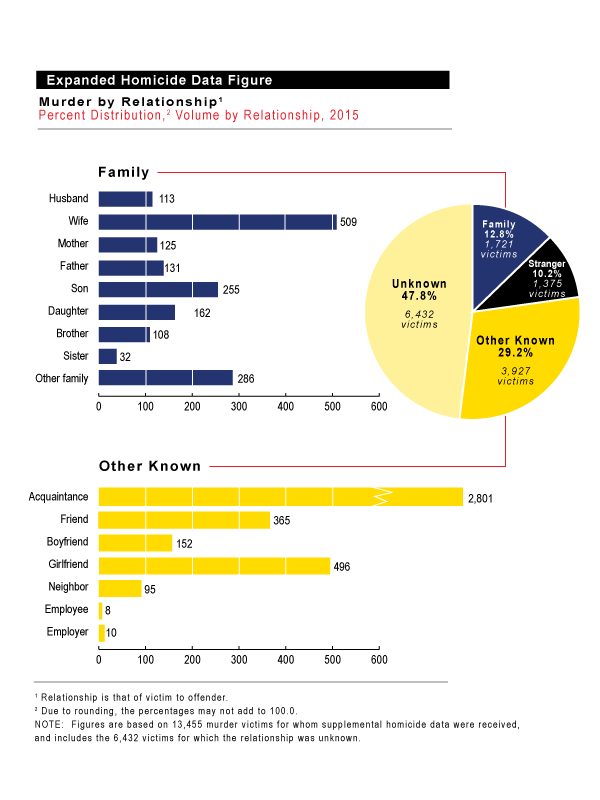
Published under the auspices of the Uniform Crime Reporting Program, the Crime in the United States report contains national data on homicides, violent crimes, arrests, clearances and police employment that has been collected since the 1960s. The UCR’s report is an invaluable resource for researchers who track national crime trends and is a rich reference database for journalists and members of the general public who are interested in official crime statistics. Among the data missing from the 2016 report is information on arrests, the circumstances of homicides (such as the relationships between victims and perpetrators), and the only national estimate of annual gang murders.
Tables, by category, in the FBI’s Crime in the United States report, 2015-16
| NUMBER OF TABLES | |||
|---|---|---|---|
| CATEGORY | 2015 | 2016 | CHANGE |
| Arrests | 51 | 7 | -44 |
| Context for crimes* | 23 | 6 | -17 |
| Crimes† | 25 | 17 | -8 |
| Police dept. employee counts | 12 | 7 | -5 |
| Clearances | 4 | 1 | -3 |
| Total | 115 | 38 | -77 |
* Expanded offense data beyond the aggregate number of crimes reported by law enforcement.
† Aggregates of the number of violent and property crime offenses reported by law enforcement.
Source: FBI
Changes to the UCR’s yearly report are not unheard of, and the press release that accompanies the 2016 report, which was published in late September, acknowledges the removal of some tables, saying that the UCR program had “streamlined the 2016 edition.” But changes to the report typically go through a body called the Advisory Policy Board (APB), which is responsible for managing and reviewing operational issues for a number of FBI programs. This time they did not.
In response to queries from FiveThirtyEight about whether the changes to the 2016 report had been made in consultation with the Advisory Policy Board, a spokesman for the UCR responded that the program had “worked with staff from the Office of Public Affairs to review the number of times a user actually viewed the tables on the internet.” When FiveThirtyEight informed a former FBI employee of the process, he said it was abnormal.
“To me it’s shocking that they made these decisions to publish that many fewer tables and they didn’t make the decision with the APB,” James Nolan, who worked at the UCR for five years and now teaches at West Virginia University, told FiveThirtyEight.
Nolan called the FBI’s removal of the tables for lack of web traffic, “somewhat illogical.” (A spokesman for the UCR program told FiveThirtyEight that in the last year, the UCR received 3,045,789 visitors.)
“How much time and savings is there in moving an online table?” Nolan said. “These are canned programs: You create table 71 and table 71 is connected to a link in a blink of an eye.”
These removals mean that there is less data available concerning a perennial focus of Trump and his attorney general, Jeff Sessions: violent crime. Trump and Sessions have frequently talked about MS-13, a gang with Salvadoran roots, as a looming problem in the country. MS-13 has been cited in 37 Department of Justice press releases and speeches in 2017, compared to only nine mentions in 2016 and five in 2015. Sessions gave a speech on the organization last month, while Trump gave a speechon Long Island in July, saying the gang had “transformed peaceful parks and beautiful quiet neighborhoods into bloodstained killing fields. They’re animals.” Trump also frequently refers to gun violence in Chicago, and at the beginning of his presidency, he established a Victims of Immigration Crime Engagement Office, which aims to study and promote awareness of crimes committed by immigrants who entered the country illegally.
Although the removal of the tables makes it more difficult to get information on one of the White House’s most prominent causes, it also seems like part of a trend in the Trump administration: the suppression of government data and an unwillingness to share information with the press and public. About two weeks after Hurricane Maria devastated Puerto Rico, the FEMA website stopped displayingkey metrics relating to island residents’ access to drinkable water and electricity. The data was later restored. The early days of the Trump administration were marked by reports that federal agency employees had been instructed not to talk to the press and to restrict social media postings.
Since Trump took office, government watchdog groups have been concerned about access to government data and maintaining the integrity of that data. Before Trump’s inauguration, Louis Clark, the executive director and CEO of the Government Accountability Project, an organization that protects whistleblowers, told FiveThirtyEight that he worried that the public information offices in various agencies could interfere with transparent sharing of information with the public.
The fact that the FBI Office of Public Affairs rather than the Advisory Policy Board determined which data tables to remove hearkens back to patterns of suppression from the George W. Bush administration. “They set up all these PR operations,” Clark said about the Bush administration’s tactics. “If a reporter called up and wanted to know about the Arctic, the scientists getting the question couldn’t answer and were required to send the reporter to the government PR person.”
The data missing from the report is mostly about arrests and homicides. There were 51 tables of arrest data in the 2015 report, and there are only seven in the 2016 report. Data about clearance rates — essentially the percentage of crimes solved — was covered in four tables in 2015 but just one in 2016. The expanded offense data — information collected by the FBI beyond the number of crimes committed, such as the type of weapon used or the location of a crimes — went from 23 tables in 2015 to 6 in 2016.
There were 15 tables of murder data in 2015, but in 2016 there were only a few tables offering expanded insights on homicides. The expanded homicide data from 2016 doesn’t include statistics on the relationship between victims and offenders; victims’ and offenders’ age, sex, race or ethnicity; or what weapons were used in different circumstances. Practically speaking, that means that researchers can no longer easily identify the number of children under the age of 18 murdered by firearm in a given year. Additionally, data tables used to identify the number of women murdered by their partners are similarly no longer available.
The removal of this expanded homicide information is not acknowledged in the report. Also, the FBI’s 2016 definition of expanded homicide data, which is identical to the one from 2015, says that the agency collects “supplementary homicide data that provide the age, sex, race, and ethnicity of the murder victim and offender; the type of weapon used; the relationship of the victim to the offender; and the circumstance surrounding the incident. Statistics gleaned from these supplemental data are provided in this section.” This suggests that murder circumstance data will be provided, though none is.
While the UCR says that the data no longer included in the report was available upon request, the FBI only provided a raw data file, which is more difficult to analyze — especially compared to easily accessible data tables — and does not always match the figures posted online in the UCR reports.
The FBI noted that in addition to its decision to streamline the report, UCR had launched a Crime Data Explorer, which aims to make crime data more user-interactive. But data contained in the explorer does not replicate what is missing from the 2016 UCR report, and it doesn’t allow users to view data for particular years, but rather aggregates trends over a minimum period of 10 years. The National Incident-Based Reporting System is another tool the FBI uses to provide more detailed information on crimes, but it too does not replicate what is missing from the 2016 UCR report and has a substantially lower participation rate from police departments across the country.
Richard Rosenfeld, former president of the American Society of Criminology and a professor at the University of Missouri, St. Louis, noticed that the 2016 report no longer had data for a trend area that he tracks — homicides related to the narcotic drug trade. “One could argue the Trump administration is interested in the opioid epidemic and might be interested in its criminal justice consequences,” he said.
“I simply don’t understand why they would omit any of the tables that they have included from years past.”
If you have any tips or insights into the changes to the 2016 Crime in the United States Report, please send them to <a href=”mailto:clare.malone@fivethirtyeight.com”>clare.malone@fivethirtyeight.com</a>.
By Andrew Harrer/Bloomberg/Getty Images.
In recent weeks, both Democrats and Republicans on the Senate Intelligence Committee have expressed doubts that they will reach a clear-cut conclusion, conceding that Robert Mueller’s F.B.I. investigation is more likely to yield such results. Despite having a long list of remaining witnesses to question, Senator Richard Burr, the chairman of the committee, said he hopes to complete the inquiry by February. “If there’s evidence that there was something there, that will be laid out. If there’s no evidence, how could anybody object to it?” Burr told Politico. Other Republicans have taken their criticism of the ongoing probes a step further. “We’ve hit the point of diminishing returns long ago,” Senator Jim Risch of Idaho said. “We’ve looked at lots of stuff. At some point in time, the jury needs to reach a verdict.”
Pressure to issue said verdict is highest in the House, where the panel tasked with exploring the breadth of Kremlin influence during the election has been plagued with partisan infighting. Congressman Mike Conaway—who took over the probe after Devin Nunes was forced to step down amid accusations that he was protecting the White House—told reporters that he wants to reach a conclusion as soon as possible. “I have no interest in prolonging this one second longer than [necessary],” he said, according to The Hill, although he conceded that completing a thorough investigation “takes some time.”
But Democrats on the House committee could impede Conaway’s plan. Adam Schiff, the ranking Democrat on the panel, derided his colleague’s timeline as unrealistic and, along with other members of his party, has argued that while the congressional committee hasn’t yet surfaced conclusive evidence of collusion. “We’ve certainly seen evidence of an intention by the Trump campaign to collude with the Russians,” Schiff told Politico. “I would hope that, at the end of the day, we’ll come to a common conclusion on that as well.” Eric Swalwell, another outspoken Democrat on the House Intelligence Committee, echoed the sentiment. “We may not find the crime on videotape, but I believe we have already seen evidence of intent,” the California lawmaker said. “But our investigation is ongoing and we haven’t reached a conclusion.” (Other Democrats have tried to lower expectations on what the committees will deliver: “The probability that we’re going to produce a report that buttons down every question is pretty low,” said Jim Himes, a Democrat from Connecticut.)
Beyond timeline, there are also growing concerns that Democrats and Republicans in the House and Senate will arrive at starkly different conclusions. In an attempt to avoid this outcome, Conaway is pushing to work with Schiff, Burr, and Mark Warner, the ranking Democrat on the Senate Intelligence Committee, on a unified conclusion—an idea Schiff supports. But Warner dismissed the idea that the various committee members aren’t already in sync. “We’re still operating in a very collaborative fashion,” Warner told Politico.
As lawmakers debate what constitutes a “thorough” Congressional investigation, they are also girding themselves for a partisan battle over the budget for Mueller’s probe. Every six months, Mueller is required to generate a spending report, the first of which will soon be made public following a Justice Department review. As Politico points out, Congress doesn’t have direct control over Mueller’s budget, which is not subject to the typical appropriations process; instead, it’s monitored by Deputy Attorney General Rod Rosenstein, who is overseeing the special prosecutor’s work after Jeff Sessions recused himself earlier this year. Critics have already begun to launch political attacks at Mueller, arguing that his ever-widening inquiry is an unfair burden on taxpayers, and threatening to restrain it either through Congress’s oversight over the Justice Department or through new legislation. “For them to say to us, ‘Vote for an open-ended appropriation into a Mueller witch hunt,’ I think you’ll see significant objection there,” Congressman Steve King of Iowa told Politico. Others have expressed doubts that attacks against Mueller—whose sterling reputation precedes him—will stick. “I’d be inclined to approve it,” Senator Lindsey Graham, who sits on both the Senate Appropriations and Judiciary committees, told Politico in reference to the budget, adding, “He seems to be a pretty frugal guy.”
Trump, naturally, is siding with Republicans. The president took to Twitter on Friday morning not only to claim that there was no collusion between his presidential campaign and the Kremlin, but also to highlight the cost of the multiple investigations. If Republicans concede and attempt to shut down the inquiries, Democrats must either go along, or risk denting the investigations’ integrity by cementing their status as a partisan issue.
See All Players

|
Russia’s worrisome push to control cyberspace
The Keene Sentinel Russia’s bid to rewrite global rules through the U.N. was matched by a personal pitch on cyber-cooperation in July from President Vladimir Putin to President Trump at the G-20 summit in Hamburg. Putin “vehemently denied” to Trump that Russia had … |
Putin and the Russian Mafia – Google News

Vanity Fair |
Are Republicans Trying to Shortchange the Russia Investigations?
Vanity Fair In recent weeks, both Democrats and Republicans on the Senate Intelligence Committee have expressed doubts that they will reach a clear-cut conclusion, conceding that Robert Mueller’sF.B.I. investigation is more likely to yield such results. Despite … Republicans are winding down their Russia probes without tackling the big questionThe Week Magazine House Republicans growing impatient with Russia probeThe Hillall 3 news articles » |

Los Angeles Times |
Trump administration belatedly takes step toward new Russia sanctions
Los Angeles Times In early August, after considerable delay, Trump signed into law a measure that required the new sanctions, which target individuals with ties to Russian defense and intelligence agencies. Under the law, companies that do business with those … The Trump administration is delaying Russia sanctions that Congress demandedVoxall 63 news articles » |
trump russian ties – Google News
FiveThirtyEight |
The First FBI Crime Report Issued Under Trump Is Missing A Ton Of Info
FiveThirtyEight Every year, the FBI releases a report that is considered the gold standard for tracking crime statistics in the United States: the Crime in the United States report, a collection of crime statistics gathered from over 18,000 law-enforcement agencies in … |
Trump FBI file – Google News
Late-night on Thursday hosts addressed Donald Trump’s interview with Fox News anchor Lou Dobbs, as well as the administration’s response to the opioid epidemic.
“Sometimes I feel sorry for Donald Trump, but not as often as he does,” Stephen Colbert began. “He’s always complaining about his media coverage. So last night, he just unplugged, got away from it all, and sat down for his 19th interview with Fox News. In this case, it was a full-blown rubdown from anchor and unrefrigerated Lou Dobbs, Lou Dobbs.”
Related: Late-night hosts call Trump ‘the crazy old guy yelling on his front lawn’
Related: Trump declares health emergency over opioids but no new funds to help
Continue reading…
ThinkProgress |
Lawmakers demand investigation into no-bid contract between Puerto Rico and Trump-connected company
ThinkProgress Whitefish Energy will get paid through the Federal Emergency Management Agency (FEMA), not Puerto Rico’s government, Bloomberg News reported Thursday. The contract with PREPA is among the biggest yet awarded in the wake of Hurricane Maria, … Congressional committee asks for records of Whitefish Energy dealWashington Post Whitefish Energy contract bars government from auditing dealThe Hillall 133 news articles » |
trump under federal investigation – Google News
New York Daily News |
Trump tries to take Russia collusion heat off himself by pointing the finger at Clinton over dossier, uranium deal
New York Daily News In addition to the dossier and collusion allegations, special counsel Robert Mueller is investigating whether Trump obstructed justice by firing FBI Director James Comey. Trump has repeatedly cast doubt on the intelligence community’s assesment that … Wow: This Is How Much Time The Liberal Media Has Wasted On The Trump/Russia Collusion NonsenseTownhallall 728 news articles » |
trump and intelligence community – Google News
Tampabay.com |
Column: Trump bowing to CIA on JFK files is a reminder of how the presidency changes people
Tampabay.com At the request of the CIA, FBI and others in the national security community, President DonaldTrump made a last-minute decision last week to delay the release of thousands of pages of classified documents related to the John F. Kennedy assassination.and more » |
Trump FBI file – Google News

The Hill |
FEMA has ‘significant concerns’ with Puerto Rico’s $300m power deal
The Hill The Federal Emergency Management Agency (FEMA) is sounding an alarm over Puerto Rico’s $300 million contract with a small Montana company to restore power infrastructure, amid concerns over the firm’s tiny staff and lack of competitive bidding. Puerto Rico’s Frantic Search for Someone to Turn on the LightsNBCNews.com FEMA Disavows Puerto Rico Power Contract Amid InvestigationsU.S. News & World Report Congressional committee asks for records of Whitefish Energy dealWashington Post TIME –E&E News –Nasdaq –TPM all 128 news articles » |

Scrutiny mounts for Trump digital operation
Trump Impeachment: Trump Tower Server Holds Key To End Trump …
Investigations into Trump’s links with Russia raise more questions …
A timeline: Mike Pence’s role in the White House’s Russia scandal

Scrutiny mounts for Trump digital operation
Stepan Company (NYSE:SCL) Shares Bought by Vanguard Group Inc.
House Intel looking at Cambridge Analytica in Russia probe
Russia Probe Now Investigating Cambridge Analytica, Trump’s …
Blog–Slate Magazine (blog)–Oct 11, 2017


Scrutiny mounts for Trump digital operation
Media Matters for America–Oct 26, 2017
Facebook, Twitter, Google ’embeds’ boosted Trump campaign: study
In-Depth–Salt Lake Tribune–14 hours ago
Trump digital director, originally paid $1500 for Trump website …
Opinion–Washington Post–Oct 9, 2017
Trump Campaign Staffers Pushed Russian Propaganda Days …
The newest developments in the Trump-Russia scandal, explained
Opinion–Chicago Tribune–Oct 25, 2017
Trump campaign data may be directly tied to social media manipulation, according to an investigation at The Guardian. If that is the case, then take a back seat, fake news, because what we could have is a deliberate right-wing propaganda machine that is altering the way that voters perceive candidates and issues. It could be much more detrimental to our democracy than any fake news.
The Guardian has revealed that extreme conservative ideology is cycled through popular social media sites through algorithms so it becomes pervasive, dominant, and constant.
Social media manipulation is trouble for democratic society everywhere.

Cambridge Analytica’s Data Mining and Trump’s Victory
One company that drives data, Cambridge Analytica, goes so far as to take credit for Trump’s election win through its ability to manipulate media messages targeted at persuadable voters. According to the homepage of its website, Cambridge Analytica (CA) uses data to change audience behavior. If you click on the “Political” tab, you can eventually find a description that says,
“CA Political’s industry-leading data services help you to find, understand, and engage with voters more effectively. Our services can be purchased individually and tailored to your needs, but combined they offer a fully end-to-end campaign package. CA Political provides clients with a truly quantifiable approach to campaigning.”
It is a company that openly brags that the “expertise and intelligence” it provided to the Trump campaign spurred his election win. How did CA’s data analysis lead to what CA describes as the “most remarkable victory in modern U.S. political history?” Why is CA now suing The Guardian for a 2017 article titled, “Robert Mercer: the big data billionaire waging war on mainstream media?“
That article now has a subtitle, “This article is the subject of a legal complaint on behalf of Cambridge Analytica LLC and SCL Elections Limited.”
What exactly happened with the Trump campaign data, according to The Guardian‘s inquiry? And do the forces behind his win continue to use data manipulation to influence the US government today?
How Trump Campaign Data Links to Google Searches
How does a 21st century data-driven campaign for an unlikely candidate for President of the USA work? By designating three integrated teams — research, data science, and digital marketing — CA was able to move millions of data points into targeted messages directed at “the most persuadable voters and the issues they cared about.” The purpose? Hit them with messages at key times to get them to take action to vote for Donald Trump.
Doesn’t really sound like anything different than any other contemporary campaign, does it? Just wait.
Data mining to target voters is only one aspect of the controversy around CA and The Guardian. In December 2016, writer Carole Cadwalladr chronicled how some topics, when searched on Google, resulted in responses that “were being dominated by right wing and extremist sites.”
In an interview, Jonathan Albright, professor of communications at Elon University, North Carolina, says that his research reveals that right-wing news sites attempted to do what most commercial websites try to do: find tricks that elevate their placement on Google’s PageRank system. They try to “game” the algorithm. Albright’s mapping of the news ecosystem has divulged that millions of links between right-wing sites were “strangling” the mainstream media during the 2016 Presidential election.
CA was cited by Albright as a company that sites like Breitbart could use to track people as they surf the web, including their visits to Facebook. They wanted to direct specific ads to their advantage. According to Albright:
“They have created a web that is bleeding through on to our web. This isn’t a conspiracy. There isn’t one person who’s created this. It’s a vast system of hundreds of different sites that are using all the same tricks that all websites use. They’re sending out thousands of links to other sites and together this has created a vast satellite system of right wing news and propaganda that has completely surrounded the mainstream media system.”
“There’s large-scale, statistically significant research into the impact of search results on political views. And the way in which you see the results and the types of results you see on the page necessarily has an impact on your perspective.”
The results of Albright’s research that a vast network of right-wing sites feeds Google searches make me a little sick to my stomach.
The Case Study of Donald Trump for President: “A Full-Scale Data-Driven Digital Campaign”
Let’s return to the case study of CA’s data collection and analysis for the Donald Trump presidential campaign. Let’s try to figure out what CA did that was different — and how The Guardian‘s expose was so controversial that it led to a lawsuit.
CA built 20 custom data models to forecast the voter behavior of 180,000 individuals. Their digital marketing efforts led to a large-scale operation with 8-figure ad budgets and an infrastructure that supported all aspects of the campaign, “influencing voters where and when it counted.”
The responses from each individual polled by phone or online were matched with existing data in CA’s database. They analyzed numerous topics — “from their voting history to the car they drive.” As they did so, CA correlated individual behaviors with voting decisions. These models allowed CA to predict the way individuals would vote, even without the backdrop of knowing their specific political beliefs.
In essence, consumer and personal behaviors led to data organization and predicted which candidates the polled individuals would most likely prefer when it came time to vote.
Then CA organized voters into different categories and determined the best way to influence them through marketing. With these audience segments identified, CA created and implemented a marketing strategy for Trump fundraising. Get Out the Vote programs, heavily laden with persuasive motifs, included targeted advertisements in key battleground states that were directed to the most persuadable voters.
Designing Algorithms for Social Media Manipulation
What’s essential to understand here is that CA collaborated with “30+ ad tech partners.” Cadwalladr at The Guardian wrote that “Google’s search results on certain subjects were being dominated by right wing and extremist sites.” CA’s marketing operation utilized a number of platforms, including social media, search engine advertising, and YouTube. By using the social media that polled individuals tended to frequent most often, CA was able to appeal to voters using language and imagery in ways very familiar to this audience — ways they would understand and to which they would respond strongly.
“We used our data infrastructure to target voters who could be influenced in the most meaningful way. For example, if they cared about healthcare, targeted adverts directed them to websites explaining Trump’s views on the matter.”
Trump’s views on healthcare, according to a October 9, 2016, Business Insider article, were criticisms about the Affordable Care Act as having “resulted in runaway costs, websites that don’t work, greater rationing of care, higher premiums, less competition, and fewer choices.” Words like “runaway,” “don’t work,” “rationing,” “higher,” “less,” and “fewer” worked to demoralize persuadable voters who may have already been struggling with health care costs in addition to other living expenses.
If, as Albright’s research indicates, millions of links between right-wing sites were responsible for “strangling” the media, CA’s data mining and categorization during the Trump campaign may have worked as triggers to persuade undecided voters that the Trump Republican narrative was normal, sensible, and fiscally responsible.
CA kept polling and assessing the Trump campaign progress in an real-time basis, with 17 states pinpointed as essential battleground states and 1500 people polled weekly in those key areas. More important than any other element, CA could also identify which voters were likely to support Donald Trump. Through social media portals that rerouted right-wing messages in deeply complex cycles, potential voters viewed right-wing rhetoric so frequently that it became a familiar message.
Dr. Jonathan Rust, director of Cambridge University’s Psychometric Centre, says,
“The danger of not having regulation around the sort of data you can get from Facebook and elsewhere is clear. With this, a computer can actually do psychology, it can predict and potentially control human behavior. It’s what the scientologists try to do but much more powerful. It’s how you brainwash someone. It’s incredibly dangerous.
“It’s no exaggeration to say that minds can be changed. Behavior can be predicted and controlled. I find it incredibly scary. I really do. Because nobody has really followed through on the possible consequences of all this. People don’t know it’s happening to them. Their attitudes are being changed behind their backs.”
So, CA influenced voter intention, and it also inspired people to take specific actions. What were the results? “Donations increased, event turnouts grew, and inactive voters who favored Trump were motivated to get out and vote on election day.”
In the final months, reports based on the new data that emerged from polling were sent daily to the Trump campaign. Those reports demonstrated how voters might be shifting their perceptions of issues and candidates. What might that have looked like? Well, with CA’s ability to assess state-by-state reactions to any political event, they were able to understand any unexpected shifts in voting intention. The constant FBI Director Comey announcements about Secretary Clinton’s emails come to mind.

With great pride, CA argues that its “work informed the campaign strategy and meant key voters, who might otherwise have stayed home, were reached in their own backyards. This ultimately contributed to the extraordinary victory of Donald Trump in the 2016 presidential election.” CA’s efforts toward the Trump campaign, with data-driven marketing techniques, changed behavior in target populations. In other words, CA assisted the Trump campaign to use technology platforms to give voice to racists and xenophobes, according to Cadwalladr in another story in The Guardian.
And the results continue to snowball. Trump boasted that Apple CEO Tim Cook called to congratulate him soon after his election victory. “And there will undoubtedly be pressure on them to collaborate,” says Moore at the Centre for the Study of Media, Communication, and Power.
There are other reasons to be really concerned over and above Google right-wing search domination and CA’s 30+ media technology partners that have contributed to social media manipulation.
What if one person has donated $45 million to different Republican political campaigns and another $50 million to right-wing, ultra-conservative nonprofits? Is he, as Cadwalladr suggests, “trying to reshape the world according to his personal beliefs?”
Hedge Fund Billionaire Robert Mercer: The Man behind the Trump Data Mining & Manipulation
He’s a brilliant but reclusive computer scientist. He made his fortune in language processing science that fed into today’s AI. Afterward, as joint CEO of Renaissance Technologies, a hedge fund that makes its money by using algorithms to model and trade on the financial markets, he became a billionaire.
What has Mercer done to single-handedly promote right-wing agendas? He:
- funded the Heartland Institute, renowned for its climate denial and across-the-board fight against regulation;
- donated to the Media Research Center, which has a mission of “correcting liberal bias;”
- propped up Steve Bannon with $10 million for Breitbart; and,
- reportedly holds a $10 million stake in Cambridge Analytica (CA), which was spun out of a bigger British company called SCL Group.
The Guardian claims that, “with links to Donald Trump, Steve Bannon, and Nigel Farage, the right wing U.S. computer scientist is at the heart of a multi-million dollar propaganda network.” And we are its tools: our social media conversations and interests are being redirected to win votes through ideological mechanisms that are invisible to us. Maybe it’s a coincidence that Greg Gianforte, a Republican technology executive who was charged with assault, defeated Rob Quist, the Democratic candidate, in a special election for Montana’s at-large House of Representatives seat. Or maybe not.
Emma Briant, a propaganda specialist at the University of Sheffield, says that CA and other data mining sites like it have the technological tools to effect behavioral and psychological change. The social media sites where we go for leisure and relaxation are a new space where international geopolitics is being played out in real time, and we’re pawns in the game.
It’s a new age of persuasion and social media manipulation, and, if Cadwalladr’s research stands up in court, we need to be hypervigilant about the sources we believe and the inferences we make based on those sources.
Photo credits: NegativeSpace and KOMUnews via Foter.com / CC BY
Check out our new 93-page EV report, based on over 2,000 surveys collected from EV drivers in 49 of 50 US states, 26 European countries, and 9 Canadian provinces.
Tags: Facebook, Google, persuasion, propaganda, Republicans, Robert Mercer, Social Media
About the Author

Carolyn Fortuna Carolyn Fortuna, Ph.D. is a writer, researcher, and educator with a lifelong dedication to ecojustice. She’s won awards from the Anti-Defamation League, The International Literacy Association, and The Leavy Foundation. She’s molds scholarship into digital media literacy and learning to spread the word about sustainability issues. Please follow me on Twitter and Facebook and Google+
The study was published Thursday in the journal Political Communication.
Kreiss and the University of Utah’s Shannon McGregor interviewed tech company liaisons to the Trump and Clinton operations as well as officials from a range of campaigns, including those of former Gov. Jeb Bush and Sens. Bernie Sanders, Ted Cruz and Marco Rubio.
The researchers’ findings add to the many questions surrounding the part that the country’s biggest tech companies played in the 2016 election. Facebook, Google and Twitter already face heavy criticism for allowing the spread of disinformation, “fake news” and divisive advertising during the campaign — much of which targeted Clinton. All three companies are set to testify at congressional hearings beginning next week on Russian use of their platforms to interfere with the election.
The idea that the tech companies were so deeply enmeshed in the efforts to elect Trump in particular could also complicate the companies’ reputations as political actors. Facebook CEO Mark Zuckerberg is among those in liberal-leaning Silicon Valley who have roundly condemned Trump’s actions as president on topics like LGBT issues and immigration.
As Trump emerged as the likely Republican nominee, staffers from each of the three companies set up shop in a strip-mall office rented by the Trump campaign in San Antonio, Texas, home to the campaign’s lead digital strategist, Brad Parscale, the study reports. It attributes that information to Nu Wexler, a Twitter communications official at the time, who is explicit about the value of the arrangement for Trump.
“One, they found that they were getting solid advice, and two, it’s cheaper. It’s free labor,” Wexler said in the study.
While the paper does not detail the specific tasks Facebook carried out for Trump, it describes the sort of work the company did generally for 2016 candidates, including coordinating so-called dark posts that would appear only to selected users and identifying the kinds of photos that perform best on Facebook-owned Instagram. Twitter, meanwhile, would help candidates analyze the performances of their tweet-based fundraising pushes to recommend what moves the campaigns should make next. Google kept tabs on candidates’ travels to recommend geographically targeted advertisements.
Digital experts interviewed by the researchers concluded that the tech company employees, who would work in San Antonio for days at a time, helped Trump close his staffing gap with Clinton.
The White House referred questions to the Trump campaign, and Parscale did not respond to requests for comment. Parscale said in an Oct. 8 episode of “60 Minutes” that he actively solicited the companies’ support, saying that he told them: “I wanna know everything you would tell Hillary’s campaign plus some. And I want your people here to teach me how to use it.”
A source close to the Clinton campaign rejected the notion that her team failed to take advantage of a valuable resource, arguing that her operation was in regular contact with the tech companies to tap their expertise. The source, who would only speak anonymously because of the sensitivity around attributing causes of Clinton’s defeat, said there would have been no advantage to having tech company employees sitting at desks at Clinton’s Brooklyn headquarters.
One unnamed tech company staffer is quoted in the study as saying, “Clinton viewed us as vendors rather than consultants.”
Story Continued Below
Asked about the arrangement with Trump, the tech companies were quick to point out that they make their services available to all political players regardless of party.
“Facebook offers identical levels of support to candidates and campaigns across the political spectrum, whether by Facebook’s politics and government or ad sales teams,” a spokesperson for the social network said in a statement.
That sentiment was echoed by Twitter, which said it offered help to both the Clinton and Trump campaigns, and by Google, which stressed that it is up to each candidate to determine how extensively to work with the company. During the primary season, Google made available to each candidate an eight-hour session with the company’s creative teams, but only Kentucky Republican Sen. Rand Paul’s campaign took them up on it, according to the study.
But at least one tech veteran said he can see how it would raise alarms that the bulk of Silicon Valley’s hands-on campaign support went to Trump rather than to Clinton.
“It can be confusing from the outside looking in when it appears one campaign or another is getting more support,” Adam Sharp, a former Twitter executive who led the company’s elections team from 2010 to 2016, said in an interview. But while the companies strive to be balanced, they cannot inform voters “when a candidate doesn’t heed the help,” he said.
An intimate relationship between tech companies and candidates has considerable upside for both. The campaign gets high-quality advice and advance notice on cutting-edge products. The company gets national exposure for its products and builds relationships with politicians who might be in a position to regulate it once they get to Washington.
Silicon Valley had additional considerations during the 2016 campaign. The big tech companies were eager to fight the perception they were unfair to conservatives — and few in the liberal-leaning industry expected Trump to win, with or without their assistance.
Kreiss and McGregor recount one interview in which a pair of Facebook reps struggled to come up with a shorthand way of describing the support they provide candidates. Katie Harbath, head of Facebook’s elections team, suggested “customer service plus.” Ali-Jae Henke, who as an account executive at Google worked with Republican campaigns, including Trump’s, described the role as “serving in an advisory capacity.”
The history of the tech companies’ campaign outreach dates back to the 2008 presidential contest. That year, Randi Zuckerberg, sister of Facebook’s CEO, traveled to both the Democratic and Republican conventions to pitch the political utility of the then-4-year-old social network. Around that same time, the company began offering congressional offices one-on-one guidance on how to use Facebook.
The outreach didn’t always work at first. “I was, like, begging people to meet with us,” Randi Zuckerberg said of the GOP’s 2008 convention. But as political spending on Facebook’s ad products and elected leaders’ dependence on the platform skyrocketed over the years, so too did the company’s close work with politicians.
One constant in the dynamic: The companies break down their political outreach teams along party lines. Facebook’s point of contact to Clinton’s 2016 White House run, Crystal Patterson, was a veteran of Democratic politics, and Henke — Google’s liaison to the Trump operation and other 2016 Republican bids — was once the director of operations for the Western Republican Leadership Conference.
That partisan matching is needed, company representatives say, to allow all involved to speak freely when providing advice. Caroline McCain, social media manager for Rubio’s White House bid, is quoted in the paper saying that when tech company staffers have a similar political background as the campaign they’re assigned to, it raises the campaign’s comfort level in working with them.
“When you realize, ‘Oh yeah, the person I’m working with at Google, they actually worked on Romney back in 2012,’ like, ‘Oh, okay, they actually might have our best interest at heart,’” McCain said. After the campaign, McCain took a position at Facebook.
Kreiss, the paper’s co-author, said the symbiotic relationship between Silicon Valley and political campaigns demands further examination.
“It raises the larger question of what should be the transparency around this, given that it’s taking place in the context of a democratic election,” he said.
According to University of Utah study, the Trump campaign viewed …
Scrutiny mounts for Trump digital operation
The newest developments in the Trump-Russia scandal, explained
Opinion–Chicago Tribune–Oct 25, 2017

The contents of this site are ©2017 Capitol Hill Publishing Corp., a subsidiary of News Communications, Inc.
Scroll down for next story
x

Share this story on NewsBlur
Trump Data Guru: I Tried to Team Up With Julian Assange
The newest developments in the Trump-Russia scandal, explained

New York Times |
A Half-Century Later, Papers May Shed Light on JFK Assassination
New York Times As a new trove of documents about the killing of President John F. Kennedy is released, the New York Times correspondent Peter Baker walks us through who’s who in this historic American tragedy. By NATALIE RENEAU and PETER BAKER on Publish Date … JFK files: Trump teases release as deadline arrivesCNN What Could Be in the New Kennedy Assassination Records?NBCNews.com The JFK Files: More Than 50 Years of Questions, ConspiraciesVoice of America Pittsburgh Post-Gazette –The Guardian –Philly.com –New York Post all 138 news articles » |
NPR |
Trump Administration To Declare Opioid Crisis A Public Health Emergency
NPR The Trump administration will declare a public health emergency to deal with the opioid epidemic Thursday, freeing up some resources for treatment. More than 140 Americans die every day from an opioid overdose, according to the Centers for Disease … Exclusive: Trump to declare public health emergency for opioids, a partial measure to fight drug epidemicUSA TODAY Trump will stop short of declaring national emergency on opioids: reportsThe Hill The Note: For conspiracy-loving Trump, JFK files are a big momentABC News Bloomberg –Quartz –Politico –cleveland.com all 116 news articles » |
The Hill |
Hurricane Maria caused largest-ever US blackout
The Hill The blackout caused by Hurricane Maria in Puerto Rico and the U.S. Virgin Islands is the United States’ largest in history, according to a new report. Economic consulting firm Rhodium Group determined in a Thursday report that Maria caused 1.25 billion … Puerto Rico Faces Possible Court Battle Over Agency ControlBloomberg Whitefish Energy regrets Twitter spat with San Juan mayorBBC News Powerless Puerto RicoNew York Times WTOP –BuzzFeed News –Vanity Fair all 161 news articles » |

Puerto Rico residents fleeing to Florida after Hurricane Maria
In-Depth–Miami Herald–13 hours ago
USA TODAY |
Puerto Rico’s Gov. Rosselló orders audit of Whitefish contract to fix power grid
USA TODAY Puerto Rico Gov. Ricardo Rosselló wants the inspector general of the Department of Homeland Security to look into a contract awarded to a small Montana firm to rebuild portions of the island’s hurricane-ravaged electric grid. Montana-based Whitefish … PR gov. threatens ‘hell to pay’ as probes of Whitefish contract beginABC News Whitefish’s No-Bid Puerto Rico Contract Spotlights Troubled FEMA GrantsBloomberg Whitefish Energy regrets Twitter spat with San Juan mayorBBC News Vanity Fair –Washington Examiner –Seattle Times –U.S. News & World Report all 61 news articles » |

Stars and Stripes

|
Infighting plagues Senate Judiciary Committee’s Russia investigation
ABC News “The committee is investigating improper political influence or bias in Justice Department (DOJ) or FBI activities during either the previous or the current administration [and] the removal of James Comey from his position as director of the FBI,” one …and more » |
Juliette Kayyem is a national security expert who regularly appears on cable news. This time around she appeared on Boston public radio (link) to discuss the Trump Russia scandal. Here’s what she had to say: “I think it is safe to say that before Thanksgiving … something’s going to drop with Mueller. The pace is too much right now. Every 12 hours we’re now dealing with a piece of this story at a pace we haven’t seen.”
Thanksgiving is just four weeks away from today, so she’s talking about Mueller being weeks away from the kind of breakthrough that will turn the Trump Russia scandal on its head and shatter the Trump administration. Some have misinterpreted her words to mean that the Mueller investigation will be finished by Thanksgiving. But that’s not remotely possible, because Mueller’s plan is to bring indictments against nearly everyone involved in order to pressure them to flip on Trump.
So what we’re talking about by Thanksgiving is the kind of indictment or indictments, or deals cut with Trump co-conspirators, that will bust the scandal open and leave Donald Trump in an impossible position. It’s why Trump and the Republicans in Congress are suddenly scrambling in such buffoonish fashion to try to distract from what they know is coming. They know Trump will be taken down by this; they’re just trying to prop him up long enough try to ram through some toxic legislation in the meantime.
The post Expert: Robert Mueller to drop the hammer on Donald Trump within weeks appeared first on Palmer Report.
|
Deep State “Intelligence” Threatens Trump, Self-Government
The New American Amid a high-profile showdown with the “intelligence community” early in his term, President Donald Trump was repeatedly and viciously threatened — even with prison and death. What kind of people can threaten the democratically elected President of the … |
trump and intelligence community – Google News
ABC Online |
Despite the conspiracies, Donald Trump and Vladimir Putin are going backwards fast
ABC Online It is telling that his first official meeting with Putin did not occur until after he had been in the White House for six months, and then only as a bilateral in the margins of a multilateral summit. The delay was partly due to the political …and more » |
Putin and American political process – Google News
ABC Online |
Despite the conspiracies, Donald Trump and Vladimir Putin are going backwards fast
ABC Online On the surface, Trump and Putin agree on much. They subscribe to a realist view of international relations, and reveal a certain authoritarian like-mindedness. They resent the establishment — domestic in Trump’s case, international in Putin’s. The … White House facing scrutiny for Russia sanctions delayCNN Congress seeks answers as Trump drags his feet on Russian sanctionsMSNBC Time’s up for Trump to implement new Russia sanctionsWashington Post Shareblue Media all 20 news articles » |
trump and putin – Google News

Calling the epidemic “a national shame”, Mr Trump announced a plan to target the abuse of opioids, which kill more than 140 Americans each day.
The president has previously promised to declare a national emergency, which would have triggered federal funding to help states combat the drug scourge.
The move instead redirects grant money to be used in dealing with the crisis.
Mr Trump said on Thursday at the White House: “More people are dying from drug overdoses today than from gun homicides and motor vehicles combined.
“These overdoses are driven by a massive increase in addiction to prescription painkillers, heroin and other opioids.”
He added: “The United States is by far the largest consumer of these drugs using more opioid pills per person than any other country by far in the world.”
Mr Trump is signing a presidential memorandum directing his acting health secretary to declare a nationwide public health emergency and ordering all federal agencies to take measures to reduce the number of opioid deaths, according to senior White House officials.
The order will also ease some regulations to allow states more latitude in how they use federal funds to tackle the problem.
But the White House plans to fund the effort through the Public Health Emergency Fund, which reportedly only contains $57,000 (£43,000).
The Trump administration will then work with Congress to approve additional funding in a year-end spending package, senior officials said.
Other elements of the directive include:
- Allow patients further access to “telemedicine” so they can receive prescriptions without seeing a doctor
- Make grants available to those who have had trouble finding work due to addiction
- The Department of Health and Human Services will hire more people to address the crisis, particularly in rural areas
- Allows states to shift federal funds from HIV treatments to opioids, since the two are linked as drug users often share infected needles
Proponents suggest Mr Trump’s announcement is a critical step in raising awareness about the nationwide epidemic, while some critics argue the move does not go far enough.
“The lack of resources is concerning to us since the opioid epidemic presenting lots of challenges for states’ budgets,” Michael Fraser, executive director of the Association of State and Territorial Health Officials, told Politico.
“My hope is people will realise with no new money the ball is going to be in Congress’s court,” he added.
Taking the first step
Rajini Vaidyanathan, BBC News, Washington
Addiction to painkillers and heroin has blighted so many communities across the US – both urban and rural.
As I travelled the country reporting on last year’s election, I remember the hairdresser in Arkansas whose ex-husband died from medicines he’d been given for his bad back, the family in New Hampshire who’d lost a teenage daughter to an overdose and heard stories of doctors who’d become hooked on the very pills they’d prescribed.
President Trump has stopped short of declaring this crisis a national emergency, despite earlier indications he would.
Instead his public health emergency is more of a short-term measure which doesn’t allocate as much funding. Recovering addicts and charities I’ve talked to say more investment in round-the-clock rehab and treatment is what is needed to make a difference.
But while today’s announcement is welcome, many will now be looking to Congress to take more action and secure more money to deal with this crisis.
Since 1999, the number of deaths involving opioids have quadrupled, reaching 33,000 deaths in 2015, according to the Presidential Commission on Combating Drug Addiction and the Opioid Crisis, citing data from the US Centers for Disease Control and Prevention (CDC).
The CDC first declared opioids, a class of pain medications as well as some street drugs, to be an “epidemic” in 2011.
Mr Trump first announced his intention to declare opioid abuse a “national emergency” in August.
“The opioid crisis is an emergency, and I’m saying officially right now: It is an emergency. It’s a national emergency,” he said at the time.
Experts had urged Mr Trump to use his presidential power under the Stafford Act to declare a national emergency, which would have given states access to money from the federal Disaster Relief Fund.
States would have had immediate access to funding, much like they would after a natural disaster.
But senior officials told reporters that declaring that sort of emergency was not a good fit for an ongoing crisis.
The announcement comes after Mr Trump’s pick for drug czar withdrew his nomination following a report that he helped neuter government attempts to tackle the opioid crisis.
Pennsylvania congressman Tom Marino pushed a bill that reportedly stripped a federal agency of the ability to freeze suspicious painkiller shipments.
Health Secretary Tom Price also resigned last month after it was revealed he was using expensive private planes for official business.
As a candidate, Mr Trump frequently pledged to tackle the drug crisis, and often campaigned in the hardest-hit states.
More on the US opioid crisis
Juliette Kayyem is a national security expert who regularly appears on cable news. This time around she appeared on Boston public radio (link) to discuss the Trump Russia scandal. Here’s what she had to say: “I think it is safe to say that before Thanksgiving … something’s going to drop with Mueller. The pace is too much right now. Every 12 hours we’re now dealing with a piece of this story at a pace we haven’t seen.”
Thanksgiving is just four weeks away from today, so she’s talking about Mueller being weeks away from the kind of breakthrough that will turn the Trump Russia scandal on its head and shatter the Trump administration. Some have misinterpreted her words to mean that the Mueller investigation will be finished by Thanksgiving. But that’s not remotely possible, because Mueller’s plan is to bring indictments against nearly everyone involved in order to pressure them to flip on Trump.
So what we’re talking about by Thanksgiving is the kind of indictment or indictments, or deals cut with Trump co-conspirators, that will bust the scandal open and leave Donald Trump in an impossible position. It’s why Trump and the Republicans in Congress are suddenly scrambling in such buffoonish fashion to try to distract from what they know is coming. They know Trump will be taken down by this; they’re just trying to prop him up long enough try to ram through some toxic legislation in the meantime.
Help fund Palmer Report:
Thanks for reading Palmer Report. Check out this great content:
Share this story on NewsBlur
Trump to Declare Opioid Crisis a ‘Public Health Emergency’
Highly Cited–USA TODAY–6 hours ago
Live Updating–CBS News–59 minutes ago
We are supposed to believe that it bought the American presidential election last year with $100,000 in Facebook ads and some other digital activity. Frankly, if American democracy can be purchased this cheap — a tiny fraction of the $7.2 million William Seward paid to buy Alaska from the Russians back in 1867 — it’s probably not worth having.
Beginning of dialog window. Escape will cancel and close the window.
The latest obsession in the Russian collusion story, the Kremlin’s digital activity has generated headlines and put Facebook and all of Silicon Valley on the defensive, although this looks to be one of the most overhyped stories of the year.
The Russians, as far as we know, bought more than $100,000 in Facebook ads between June 2015 and May 2017. A little more than half was spent after last November, when, obviously, Donald Trump had already won.
The scale here is singularly unimpressive. A serious House campaign might spend $100,000 on digital. In a presidential campaign, the amount is a rounding error. The Trump campaign spent around $90 million on digital in 2016. Hillary Clinton employed a considerable digital staff, and announced she was spending $30 million on digital the last month of the campaign alone.
If tens of thousands of dollars was decisive amid this tsunami of tens of millions, the Russian trolls working somewhere in St. Petersburg should strike out on their own and start a political consultancy or an internet publishing company. They are geniuses.
It doesn’t appear that much of the Russian material was explicitly advocating for Trump’s election, and some of it wasn’t even right-wing. One Russian Facebook page highlighted discrimination against Muslims. Another promoted anti-police videos for a Black Lives Matter audience. A pro-gay-rights page was called LGBT United.
Other pages were on the right and supportive of Trump. But much of the Russian Facebook activity was peddling online tripe indistinguishable from indigenous American online tripe — in fact, it was ripped off from content produced by Americans. If the Russians are going to decide our elections on social media, one assumes it will require at least a little originality.
One suspicion has been that the Trump campaign helped direct the Russian online effort. What we know about the Russian activity so far makes that doubtful. Why, if the Trump campaign was running its own digital campaign that was magnitudes larger, would it bother with a tiny Russian effort that wasn’t always focused on Trump or his message?
The Daily Beast ran a story last week with the headline “Trump Campaign Staffers Pushed Russian Propaganda Days Before the Election.” This referred to Kellyanne Conway and others associated with the Trump campaign retweeting posts from a Twitter account that masqueraded as a project of the Tennessee Republican Party, when it was really operated by Russian trolls. Conway tweeted a post from the account once, according to the story. And the report adduces no evidence that the Trump supporters knew the origin of the account.
It is outrageous that Russians meddled in our democracy at all, and if there are ways to lock them out of our social media going forward, we should do it. Let’s not pretend, though, that the Russian online activity was the key to the election. This is classic conspiracy thinking — that some small secret cabal is responsible for a world-historical outcome that had much more obvious causes (Hillary Clinton’s poor campaign, for one).
There may yet be truly damaging Russia revelations. Trump’s campaign manager during a decisive phase of the primary campaign, Paul Manafort, worked with shady characters from that part of the world. The notorious Don Trump Jr. meeting with Russians promising oppo on Clinton spoke of a willingness to cooperate with anyone who might be useful. The Trump family’s business dealings could always produce a nasty surprise.
But all the focus on Facebook serves, for now, as a substitute for a smoking gun in the absence of a real one.
Rich Lowry is editor of National Review. Twitter: @RichLowry.
(c) 2017, King Features Syndicate
Business Recorder |
Ignatius: Russia’s worrisome push to rewrite cyberspace rules
The Daily Herald Russia’s bid to rewrite global rules through the U.N. was matched by a personal pitch on cybercooperation in July from President Vladimir Putin to President Trump at the G-20 summit in Hamburg. Putin “vehemently denied” to Trump that Russia had … David Ignatius: Russia’s worrisome push to control cyberspaceWinston-Salem Journalall 109 news articles » |
Putin and the Russian Mafia – Google News


Newsmax |
Google Avoids Spotlight During Russia Investigation
Newsmax Google has done its best to avoid getting involved in Congress’ ongoing investigation into Russia’s actions during the 2016 presidential election, Axios reports. Facebook and Twitter have been very public in their response to the reports that Russian …and more » |
CBS News |
Founder of opioid maker Insys indicted for fraud, racketeering
Financial Times The billionaire founder of Insys, which makes a controversial opioid-based drug, has been indicated on racketeering and fraud charges, sending shares in the group 4 per cent lower. John Kapoor, who stepped down as Insys chief executive in January, … John Kapoor, Founder Of Insys, Indicted On Charges Of Bribing Doctors To Overprescribe OpioidsBenzingaall 11 news articles » |
donald trump racketeering – Google News
Sen. Bob Corker, chairman of the Senate Foreign Relations Committee, articulated his frustration with the Trump administration on Wednesday over the administration missing its Oct. 1 deadline to implement Russia sanctions, according to Politico. Trump signed the bipartisan sanctions bill in August, but his administration has yet to penalize certain Russian entities. Sens. John McCain and Ben Cardin have also expressed concern over the sanctions delay. Corker notably did not accuse the administration of purposeful delay, but intends to “check into it.”
Marine Gen. Joseph F. Dunford Jr., the chairman of the Joint Chiefs of Staff, arrived in Seoul on Thursday for his annual meeting with South Korean military officials, the Washington Post reports. Dunford will discuss, among other things, improving South Korea’s ballistic missiles and upgrading their military networks. Defense Secretary James Mattis will head to Seoul next week following Dunford’s departure.
Army Sgt. Bowe Bergdahl’s sentencing proceedings continued yesterday with emotional testimony from James Hatch, a former Navy SEAL whose military service dog was killed in a mission to retrieve Bergdahl, according to the Washington Post. Hatch’s testimony is part of an ongoing process to determine whether the consequences, often deadly, that followed Bergdahl’s abandonment of his post should factor into the sergeant’s punishment. Hatch, who suffered career-ending injuries during the mission, delivered the tattered harness of his deceased military dog as evidence in the sentencing proceedings.
In an interview with several U.S. publications, Iraqi Prime Minister Haider al-Abadi urged the U.S. and Iran not to involve Iraq in growing conflicts over the nuclear deal and U.S. sanctions, the Wall Street Journal reports. Abadi reiterated his support for U.S. forces in Iraq fighting the Islamic State group, but that any attacks on coalition forces in Iraq, including those that U.S. officials believe are Iran proxies, would be considered “an attack on Iraq, on the sovereignty of Iraq, the sovereignty of the state.”
President Donald Trump admitted that he did not authorize the mission in Niger resulting in the deaths of four U.S. special forces members, according to the Hill. Trump stated that his generals had the authority, clarifying that he “gave them authority to do what’s right so that we win.” On Monday, Gen. Dunford said that the soldiers were on a reconnaissance mission that did not require the president’s authority.
ICYMI, Yesterday on Lawfare
Ashley Deeks, Sabrina McCubbin and Cody Poplin considered what the U.S. could learn from Cold War anti-propaganda strategies.
Ian Hurd discussed why both liberal and realist theorists incorrectly interpret the international laws of war.
The Lawfare Editors flagged the next Hoover Book Soiree with Susan Landau on Nov. 1.
Bobby Chesney and Steve Vladeck posted this week’s National Security Law podcast.
Garrett Hinck summarized the European Commission’s privacy shield review.
Matthew Kahn posted the live stream of a House hearing on the risk that Kaspersky Labs products pose to the federal government.
Kahn also posted the Oct. 24 executive order to resume the U.S. refugee admissions program.
Email the Roundup Team noteworthy law and security-related articles to include, and follow us on Twitter and Facebook for additional commentary on these issues. Sign up to receive Lawfare in your inbox. Visit our Events Calendar to learn about upcoming national security events, and check out relevant job openings on our Job Board.
Lawfare – Hard National Security Choices

By now, it should be clear to anyone following the news that Russian intelligence made a formidable effort to approach the Trump campaign and assess the potential to manipulate its members. As a former officer of the CIA’s Directorate of Operations, I can tell you that Russian security services would have been derelict not to evaluate the possibility of turning someone close to Trump. While the question of collusion remains open, it’s beyond dispute that Russia tried to get people around the president to cooperate. The June 2016 meeting in Trump Tower is indication enough, but other encounters bolster the argument.
How do you get someone to do something they should not do?
Story Continued Below
Generally, an intelligence officer looks for a person’s vulnerabilities and explores ways to exploit them. It usually comes down to four things, which—in true government style—the CIA has encompassed in an acronym, MICE: Money, Ideology, Coercion, Ego. Want to get someone to betray his country? Figure out which of these four motivators drives the person and exploit the hell out of it.
It is important to note, too, that a person might not know he is doing something he shouldn’t do. As former CIA Director John Brennan testified in May, “Frequently, people who go along a treasonous path do not know they are on a treasonous path until it is too late.” Sometimes, such people make the best assets. They are so sure in their convictions that they are acting in their own best interest or in the best interest of their country that they have no idea they are being completely manipulated.
The Russians know all this, too.
From an intelligence point of view, the people surrounding Trump, and Trump himself, make easy targets for recruitment. This is not to say these people have definitely been recruited by Russian intelligence—and they’ve all denied it repeatedly—but you can be sure that Russia’s intelligence services took these factors into consideration when they approached the campaign.
So, what pressure points might Russian intelligence officers have used to get their desired outcome with Trump’s Recruitables?
Paul Manafort: Money
Anyone who has lobbied on behalf of leaders ranging from Zaire’s Mobutu Sese Seko to the Philippines’ Ferdinand Marcos to Equatorial Guinea’s Teodoro Obiang likely has no set ideology or moral compass and is motivated primarily by making money. People like this make very good targets. There is no emotion involved. Getting the person to do something is a fairly straightforward transaction. For example, getting someone to buy real estate to help launder Russian funds, in return for a handsome fee, would be a pretty simple transaction. As soon as the person has done it one time, it is much easier to get them to do something else for you.
A real opportunity came when Manafort went to work on the campaign of Viktor Yanukovych for president of Ukraine. Yanukovych was close to Russian leader Vladimir Putin and was corrupt. By being willing to play in these circles, Manafort signaled his willingness to look the other way as long as the payoff was right. A ledger found in Yanukovych’s abandoned palace showed he was paid $12 million (Manafort denied taking such payments, but the AP has confirmed that two of his companies did indeed receive part of this money). Putin pal Oleg Deripaska reportedly paid him $10 million a year to push Putin’s agenda. Press reports also state he received loans of up to $60 million from Deripaska.
Was he in debt, which made him vulnerable to coercion? Or were these loans not actually loans, but payments that Manafort was never expected to pay back? Either way, money was clearly Manafort’s weakness, and Russian intelligence would have known that, given his demonstrated willingness to work for just about anyone with deep pockets.
Michael Flynn: Money, Ideology, Ego
Flynn was at the top of his game as director of intelligence at JSOC, the Joint Special Operations Command. During his tenure, JSOC became a lean fighting machine, able to execute a hit on a target in a war zone and immediately process any actionable intelligence in order to hit the next target immediately, before the bad guys could move on. He moved up the intelligence ladder and landed the top spot at the Defense Intelligence Agency in 2012. Here, the Peter Principle quickly set in. Castigated for his lack of vision for the agency, his inability to manage a large organization, his unconventional approach to counterterrorism, and his “Flynn facts,” it became evident in Washington circles that Flynn was over his head. President Barack Obama fired him.
Oh, how the mighty had fallen.
A top military figure, with a large ego, who felt slighted by Obama, the intelligence community and the military, Flynn was down. From the heights of JSOC to being fired—wrongly fired, no less, in his view—Flynn at this point would have made any foreign intelligence officer salivate. The man was vulnerable on several levels. His ego had taken a massive, public blow. He also firmly believed he was right, that he knew better than the president how to save the country from Islamic terrorists. Add to the mix that so many other military men had gone on to make millions in the private sector, cashing in on their military careers, their time in war zones, their connections to people both in government and in large defense companies. Flynn launched his own security consulting company and certainly might have thought: Where is mine?
This would have been a good moment for the Russians to send in a clever operative, stroke his ego, and tell Flynn how smart he was and how ridiculous Obama was for firing him. We’ve got a lot of people at RT who agree with you, the person might have added, while making it clear, “Our president agrees with you.” Payments, made through speaking fees and consulting contracts, would have helped smooth the deal.
Story Continued Below
Does this mean Flynn was recruited as a traditional asset, fully under Russian control? No. The Russians are concerned with being able to influence people only as much as they need to. And with Flynn, who reportedly developed an obsession with collaborating with the Russians against ISIS and even defended RT as no different than CNN, had readily demonstrated his willingness to follow and promote the Kremlin’s agenda in return for a certain amount of ego stroking (which, in turn, might have helped him actually believe what he was saying).
Felix Sater: Money, Coercion, Ego
In an article in the Atlantic, titled “Why Didn’t Trump Build Anything In Russia?” Julie Ioffe painted a picture of Trump’s former real estate partner as someone who really wanted to be part of the rich Moscow club but who lacked krysha, or “roof”—the political protection, Ioffe explains, to act as insurance should a deal go wrong—to be able to do it. “He tries to create the impression of someone who is extremely well-connected and very busy,” a source who had worked with Sater told Ioffe. Sater made a few forays into Moscow business circles but could never convert and was unable to win the trust of anyone who would have mattered. As Ioffe wrote, Sater was worried about his image. So worried, in fact, he looked into hiring a PR firm to help build up his reputation. He was, in the end, an outsider who really wanted to be an insider.
Give this person the chance to say he is wheeling and dealing with Very Important People, and he will bend to your will. Russian security services could offer at least the appearance of “roof,” even if they never intended to help Sater make money. His increased cachet would have been worth it to someone so image-conscious.
Jared Kushner: Money, Coercion
Kushner had a rocky entrée into Manhattan real estate. His purchase of 666 Fifth Ave. at $1.8 billion in 2007—that is, just before the market tanked—was perhaps not the strongest display of business acumen. And now, with payments due and business going badly, he was in a pickle. Perhaps the Russians had a great way for him to get out of that pickle. So they introduced him in December 2016 to Sergey Gorkov, the head of the Russian state investment bank Vnesheconombank, or VEB, who would have made it clear that he was in a position to help.
Donald Trump Jr.: Money, Ego
Junior is a lot like dad in his need to feel important. He was certainly a target because he manages access to his father, and his arrogance makes him easy to read. There is probably quite a bit of insecurity behind the smugness. Sure, he’s done a few international deals, but it’s going to take more than that to please daddy (Junior certainly could see that his dad never really pleased his father; Junior didn’t want to repeat that). Access to deals and money would certainly be a way to manipulate him, but mostly it would be stroking the Trump ego. The most important thing for Junior was that daddy win, at any cost. The perks and business deals would be a nice bonus, but I don’t think Junior even equated those perks with aid to his father’s campaign. Why wouldn’t he accept help for his father’s campaign? He likely didn’t even realize there was anything wrong with a foreign adversary lending a hand. As he wrote when approached with derogatory information on daddy’s opponent, “I love it.”
Donald Trump: Ego
A lot has been made of the possible existence of a peepee tape that Putin could lord over Trump to make him do Putin’s bidding. (Trump denies it.) But the president has been revealed time and again as a deadbeat who does not pay his bills, a serial philanderer and a confessed sexual predator. He has bragged about walking in on women at the Miss America contest and grabbing women “by the pussy” whenever he likes. Would anyone really be surprised or shocked by such a tape? This is not to say such a tape does not exist, only that its role as kompromat is limited.
Ego is clearly the best way to get Trump to do anything. The Saudis certainly understood this, feting him with gold and orbs and displaying his enormous portrait on the side of a hotel, right next to the king’s portrait. The Saudis had this man in the palm of their hands, hence Trump’s pro-Saudi stancesince the trip, despite his campaign rhetoric shouting down the kingdom.
Trump’s ego wanted to win and, he figured, everyone else wanted him to win, too. He was under the impression that everyone loved him and appreciated his greatness. Of course everyone wanted to help him win. If he accepted help from Russia, it’s possible he didn’t realize there was anything wrong with doing so. Why wouldn’t they help him win, he might have thought, and why shouldn’t he accept that help? For an experienced chekist like Putin, manipulating his ego is almost too easy.
Politico |
The Recruitables: Why Trump’s Team Was Easy Prey for Putin
Politico “He tries to create the impression of someone who is extremely well-connected and very busy,” a source who had worked with Sater told Ioffe. Sater made a few forays into Moscow business circles, but could never convert and was unable to win the trust … |
felix sater – Google News
1. Trump Circles: Elections from mikenova (16 sites)
Politico |
The Recruitables: Why Trump’s Team Was Easy Prey for Putin
Politico “He tries to create the impression of someone who is extremely well-connected and very busy,” a source who had worked with Sater told Ioffe. Sater made a few forays into Moscow business circles, but could never convert and was unable to win the trust … |
felix sater – Google News

That’s right: Despite the liberal media fanning the flames, there is still no evidence for the oft-repeated claim that President Trump and the Russian government somehow colluded to win the 2016 election. It comes as no surprise to the nearly 63 million people who voted for the president, despite the Left’s insistence they were somehow influenced by the Kremlin. But the FBI’s lack of progress speaks volumes nonetheless.
Recent weeks have raised, however, serious questions about the FBI’s own credibility. It starts at the top, with Special Counsel Robert Mueller. Look closer at Mueller’s probe and you’ll find a purely partisan witch hunt. Several members of Mueller’s team have ties to the Democratic Party. Not only did Jeannie Rhee donate to a Hillary Clinton super PAC, but she also represented the Clinton Foundation in a 2015 racketeering case and Clinton herself in a lawsuit seeking access to her emails. Andrew Weissmann donated six times to Obama-affiliated groups. James Quarles gave to more than a dozen Democratic PACs since the 1980s.
As Sidney Powell, a longtime federal prosecutor who served both political parties, recently explained: “The Mueller investigation has become an all-out assault to find crimes to pin on [the president]—and it won’t matter if there are no crimes to be found.”
Even worse, the FBI’s diminishing credibility transcends the current Trump probe. Earlier this month, government documents and interviews revealed the FBI had knowledge of Russian misconduct long before the Obama administration—and one Hillary Rodham Clinton—approved the controversial 2010 uranium deal. Before the Obama-Clinton team agreed to give Moscow control of a large swath of American uranium, the FBI had already gathered substantial evidence linking Russian nuclear industry officials to bribery, kickbacks, extortion, and money laundering—all in an attempt to grow Vladimir Putin’s atomic energy business on our soil.
Moreover, the FBI found out the Russian officials had routed millions of dollars to the Clinton Foundation during the time then-Secretary of State Clinton signed off on the uranium deal.
And the agency still did nothing. Rather than bring immediate charges in 2010, Eric Holder’s Department of Justice (DOJ) continued investigating the matter for nearly four more years. In other words, the DOJ sat on the information for political reasons. This essentially left Congress and the American people in the dark about Russian nuclear corruption on U.S. soil.
And we’re now trusting federal prosecutors to probe the Trump administration fairly? Mueller’s vendetta resembles anything but “justice.”
Perhaps the FBI should focus on its Las Vegas investigation, which has yielded no real insight into the shooter’s motives or the sequence of events. The agency refuses to release any information concerning the investigation of the worst mass shooting in U.S. history—which tragically claimed 58 innocent lives—even as evidence is continually released and then changed within days. The liberal media, meanwhile, has moved on from the Las Vegas shooting to undermine the Trump agenda at every turn. Coverage of the FBI’s investigation has largely subsided, even though countless Americans demand answers.
In lieu of an explanation, Robert Mueller will give them more of the same anti-Trump witch hunt. Don’t buy any of it.
Given the FBI’s history of corruption and cover-up, there’s no reason to trust Mueller or his liberal accomplices. Don’t be fooled by a crooked cop playing a good guy.
Ted Harvey is chairman of the Committee to Defend the President.
Views expressed in op-eds are not the views of The Daily Caller.

2 Breitbart alumni just abandoned the most Pro-Trump candidate of …
GOP senators ‘risk careers’ in stunning anti-Trump revolt
Trump’s re-election edge is greatly exaggerated | Opinion

As GOP Bends Toward Trump, Critics Either Give In or Give Up
Washington Examiner–Oct 24, 2017
<a href=”http://WND.com” rel=”nofollow”>WND.com</a>–Oct 25, 2017
In-Depth–Toronto Star–19 hours ago
The Delusional Optimism On Both Sides Of The Political Aisle
Every day, we bring you a different dispatch on Trump’s America. Today’s focus: Opioid deja vu.
Thursday’s Dispatch: More than two months later, action on the opioid crisis
Thursday’s presidential press conference will be a prime example of how Donald Trump runs the federal government.
More than two months after Trump declared the opioid crisis “a national emergency,” as of last week, the government had still not formally declared a national emergency. That designation would send additional federal funds to hospitals, addiction clinics and first responders dealing with the historic rate of opioid-driven drug overdoses in America.
Nearly two weeks ago, Mic asked the White House for an update on the emergency declaration. The Trump administration issued Mic the same statement that had been issued in August, saying the government was focused on opioids and already treating it like an emergency.
As with health care, tax reform and a host of other initiatives, Trump’s rhetoric on opioids has been long detached from his administration’s policy initiatives.
The president said last week that he would soon formally declare a national emergency over opioids. Now, reports indicate the president will declare the crisis a public health emergency — but stop short of the more sweeping declaration.
The public health emergency will do less than a more sweeping national emergency. It will have to be renewed every 90 days. It will not provide federal funding for addiction treatment centers with more than 16 beds, a key recommendation of Trump’s own opioid commission.
“I think our general feeling is, that’s a good step, but it’s a temporary step, and it’s a transitional step,” Jim Blumenstock, chief of health security for the Association of State and Territorial Health Officers, told USA Today. Trump’s public health declaration is not expected to come with a further ask of money from Congress, which could designate funds to get more life-saving naloxone into the hands of first responders.
The cold reality: Nearly 65,000 people died of drug overdoses between February 2016 and February 2017, the most recent data available. That’s more people than were killed in car accidents last year.
Watch for Trump’s speech on the opioid crisis at 2 p.m. Eastern.
Thursday in Trump’s America:
Establishment Republicans know they’re fighting for their lives. After very public rebukes of Trump by Sens. Bob Corker (R-Tenn.) and Jeff Flake (R-Ariz.), the GOP is launching an assault on Steve Bannon to protect other Republican incumbents up for reelection next year, the Washington Post reported. Bannon and his wealthy allies are sensing the opportunity to pick off multiple Republican senators in a bid to drive the GOP to become more nationalist and isolationist.
The average premium increase of the most popular plans purchased on Obamacare’s individual health care exchange will be 34% next year, a new study said. That’s driven by instability in the marketplace created by Trump’s decision to end subsidies to health insurers and general anxiety surrounding the Affordable Care Act’s future.
And the bipartisan legislation that would stabilize the marketplace — which Trump opposes — would cut $3.8 billion from the deficit.
USA Today reported the new U.S. refugee admission program could block nearly half of the people seeking to come to the United States this year compared to last.
The Republican candidate running for governor in Virginia is running anti-immigrant ads as he aims to pull off an upset in the gubernatorial race. Will it work? And Mic broke down how a new Democratic super PAC is trying to win back state legislatures — starting with a data-driven prototype in next month’s Virginia election.
Why the Senate’s late-night vote on an obscure financial regulation will make it harder for you to fight for your money back.
What to know about who Donald Trump may pick at the next chair of the Federal Reserve. (Bored by monetary policy? Give this a click.)
House Republicans are barreling toward passage of a budget that would pave the way for tax reform — and $1.5 trillion in tax cuts. The Senate passed it last week.
Sometime today, the National Archives will post thousands of documents related to the John F. Kennedy murder investigation. Continually update this webpage.
Shortly after being slammed by a hurricane, Puerto Rico signed a $300 million contract with a two-person energy company based in the Montana hometown of Interior Secretary Ryan Zinke. Now, San Juan’s mayor said the contract should be voided — and Whitefish Energy apologized for feuding with her.
“I’m a very intelligent person.” Trump said journalists are making him out to be “more uncivil” than he actually is.
Today’s MicBite:
The feud that has consumed the last few weeks: Trump vs. Corker, a history. Tap or click below to watch.
Senator Chuck Grassley, the chairman of the Senate Judiciary Committee, sent a letter to the Treasury Department’s Financial Crimes Enforcement Network — FinCEN for short — on September 29, seeking information about any suspicious financial transactions banks may have flagged on the individuals and businesses since Jan 2015. Banks are required by law to flag such transactions for FinCEN.
The Judiciary Committee is one of three congressional committees looking into Russian interference. Its investigation only recently got off the ground after months spent negotiating the scope of its probe, two staffers told BuzzFeed News, and a rift has reportedly been developing between Grassley and Dianne Feinstein, the top Democrat on the committee. Feinstein did not sign the letter.
- Rinat Akhmetshin, and Natalia Veselnitskaya, the Russian-American lobbyist and the Russian lawyer who met with Donald Trump, Jr. at Trump Tower in June 2016.
- Robert Arakelian, another lobbyist who works with Akhmetshin.
- Human Rights Accountability Global Initiative Foundation, the Washington, DC-based nonprofit headed by Veselnitskaya whose stated goal is to “restart American adoption of Russian children” but has lobbied to repeal the Magnitsky Act, the 2012 law that imposed sanctions on Russian officials.
- Glenn Simpson, Thomas Catan, Peter Fritsch and their private investigation firm Fusion GPS, which commissioned the so-called “dossier” that alleged the Russian government had been “cultivating, supporting and assisting” President Donald Trump.
- Christopher Steele, the former British intelligence agent who collected the intelligence for the dossier; his business partner, Christopher Burrows; and their firm Orbis Business Intelligence.
- Perkins Coie, a law firm that reportedly retained and paid Fusion GPS on behalf of the Clinton campaign for research that ended up in the dossier.
- Prevezon Holdings, a Russian-owned company that was charged with money laundering and settled with the Department of Justice earlier this year, and eight of its related companies.
- The law firm Baker Hostetler, which was hired to defend Prevezon, and two of the firm’s attorneys, John Moscow and Mark Cymrot.
Banks, hedge funds, casinos, and other financial institutions are required under the Bank Secrecy Act to file suspicious activity reports with FinCEN when money laundering or fraud is suspected. They are also required to file SARs for certain cash or wire transactions of $10,000 or more, even if those transactions seem legitimate. SARs contain personal financial information, such as bank account numbers and a record of financial transactions. FinCEN may not have SARs on all the individuals and businesses the Committee named.
A spokesperson for Grassley, Michael Zona, did not respond to requests for comment about the committee’s investigation. Simpson, the Fusion GPS co-founder, declined to comment. Simpson’s business partners, Fritsch and Catan, did not respond to requests for comment. Burrows declined to comment on behalf of himself, Steele, and Orbis. Neither Cymrot nor a spokesperson for Baker Hostetler responded to requests for comment. Moscow, the other Baker Hostetler attorney, declined to comment. Akhmetshin, Arakelian, and Veselnitskaya also did not respond to requests for comment. Officials at Prevezon could not be reached. A spokesperson for Perkins Coie said that the firm “rigorously adheres to all laws and regulations including those that protect the integrity of our financial systems, and any suggestion that the law firm has acted inappropriately is wholly unfounded.”
Grassley’s letter set an October 13 deadline for FinCEN to turn over the financial information to his committee. But according to three sources, no suspicious activity reports have been sent to the committee.
Contact Jason Leopold at jason.leopold@buzzfeed.com.
Got a confidential tip? Submit it here.
BuzzFeed News |
Senate Committee Escalates Russia Probe, Digs Into Finances Of Nearly 40 Individuals And Businesses
BuzzFeed News A congressional committee investigating Russia’s interference in the 2016 presidential electionhas stepped up its probe over the past month, requesting that an agency that combats financial crime turn over confidential banking information on nearly 40 …and more » |
Los Angeles Times |
The Trump wing of the GOP is winning battles. But will it lose the war to keep the Senate in Republican hands?
Los Angeles Times Sen. Jeff Flake’s surprise decision against seeking reelection marked a major victory for Stephen K. Bannon and his pirate band of Republicans. But the larger question Wednesday was whether the insurgency will cost the GOP its thin majority on Capitol … The unfair criticism that Sen. Flake’s anti-Trumpism speech was too little, too lateWashington Post Flake drops out of Senate race, torches Trump in speechThe Hill The liberal-left divide reshaping American politicsThe Guardianall 4,085 news articles » |
trump russian candidate – Google News

OregonLive.com |
Russian Facebook ads made no difference in the election
Standard-Examiner The Trump campaign spent around $90 million on digital in 2016. Hillary Clinton employed a … If the Russians are going to decide our elections on social media, one assumes it will require at least a little originality. One suspicion has been that the … Lowry: US democracy not for sale to RussiaBoston Herald Rich Lowry: The Facebook farceOregonLive.comall 16 news articles » |
Freepress Online |
America Asleep at the Keyboard as Cyber Warfare Gets Real
Freepress Online In 2015, shortly after Fancy Bear was unleashed and started roaming around the DNC network, the hack was detected by the allied intelligence service monitoring Russian cyberespionage. They alerted U.S. intelligence, and the intel made its way to the …and more » |
Russian Intelligence services – Google News