
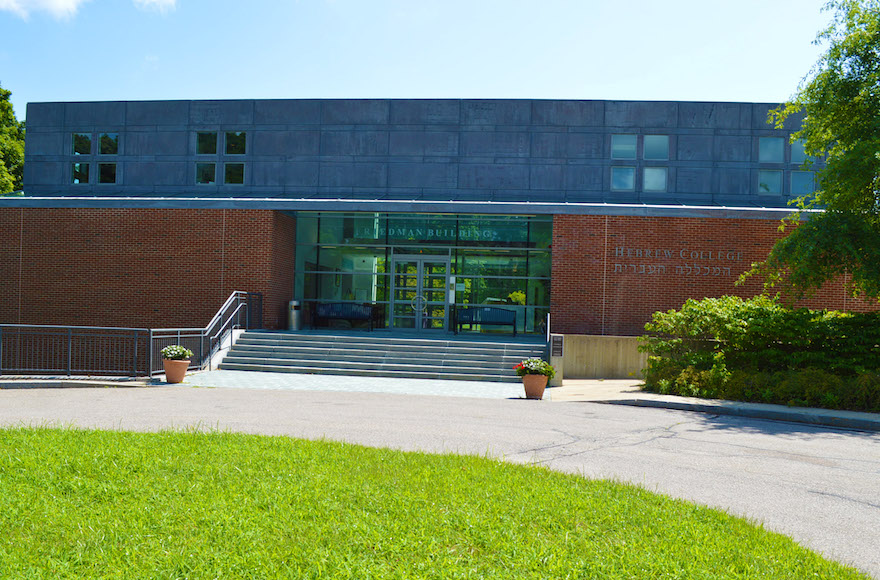
In a momentous decision, Hebrew College in Massachusetts revoked a policy in place since the seminary’s inception in 2003: The religious affiliation of the partners of applicants and students will no longer be a barrier to consideration for admission to and ordination from Hebrew College.
In an email released on Jan. 31, the college articulated standards and expectations for prospective students, in which being in an interfaith relationship is no longer grounds for exclusion.
The Hebrew College decision is a breakthrough. It amounts to a statement by a leading progressive element in the liberal Jewish community that interfaith marriage is valued equally with in-marriage, at a moment when Israel is considering limiting the privileges of non-halachically Jewish individuals. After the Reconstructionist Rabbinical College and now the Hebrew College decisions, it is time for Hebrew Union College to reverse its status as the last major Reform seminary with this restrictive policy standing.
The decision is especially important at this time because it counters a steady drumbeat of recent negative messages about interfaith marriage from Jewish communal sources. Right-wing elements of the new Israel government want to change the Law of Return because, as explained by Orthodox leader Rabbi Avi Shafran, allowing people who are not halachically Jewish to become citizens of Israel will increase intermarriage between Jews and non-Jews. For those who “consider the continuity of the Jewish people of utmost importance,” Shafran writes, intermarriage presents “a threat to the integrity and unity of the Jewish community.”Similarly, the president of the European Jewish Congress, Ariel Musicant, believes that intermarriage is the main threat to the Jewish diaspora.
Important elements of American Jewish media continue to tout Birthright Israel as successful because trip participants intermarry less. They continue to equate assimilation and intermarriage, lament their “huge toll” on the Jewish community, and blame intermarriage for American Jews’ alienation from Israel.
Related
The attitude that interfaith marriage is bad and wrong is so deep-seated, it even surfaced in a recent oral argument at the U.S. Supreme Court. Justice Alito posed this hypothetical: “A Jewish man and a Jewish woman who are engaged to be married ask a Jewish website designer to build a website to celebrate their upcoming nuptials — no problem…. Many Jews consider intermarriage an existential threat to the future of Judaism. Does that website have to accept the second [intermarrying] couple?”
Hebrew College’s decision is hugely consequential because people will only engage in a community if they feel included. National and local Jewish community studies show that many partners from different faith backgrounds are made to feel like outsiders in Jewish settings. Seminary policies not to admit or ordain rabbinic students who are in interfaith relationships contribute directly to that othering.
The only rationale for those policies is that interfaith marriage is wrong and that Jews marrying Jews is the Jewish ideal. This sends a message to interfaith couples that their marriage choices are not ideal but second-rate and regrettable. In the eyes of the Jewish community, their beloved partners from different faith backgrounds are undesirable.
Rabbi Michael Marmur of HUC, the Reform seminary that has yet to remove this type of restriction, acknowledges that “suggesting that our students should be held to a higher standard implies that there is something ‘lower’ about the family arrangements from which many of our students come.” Who would want to be part of a community that views their marriage and one of the partners so negatively? But with a 72% rate of interfaith marriage among non-Orthodox Jews, the future of liberal Judaism depends on engaging more and more of these couples and families in Jewish life.
Hebrew College’s decision helps to make interfaith marriage normative — like in-marriage has always been — and views partners from different faith backgrounds not as suboptimal, but as capable of being fully engaged in Jewish life and community. Rabbi Deborah Waxman explained in the RRC’s 2015 decision to revoke their policy excluding intermarried students that their primary desire is for all rabbinical candidates to model a commitment to Judaism in their communal and personal lives. “We see Jews with non-Jewish partners” Waxman said, “demonstrating these commitments every day in many Jewish communities.”
Defenders of the policies argue that rabbis should be “role models.” But as Rabbi Ellen Lippman, who has an unconverted partner from a different faith tradition, said in 2013 in an open letter to HUC, her alma mater, interfaith families she’s worked with tell her that having a rabbi who is also in an interfaith relationship makes a tremendous difference to them being able to commit to Jewish life. “A rabbi is a role model, and there are many kinds of role models. Intermarriage is a fact of American Jewish life.”
After the RRC and now the Hebrew College decisions, it’s time for HUC to reverse its status as the last major Reform seminary with this restrictive policy standing. A policy that discriminates against any group with higher-than-average rates of interfaith marriage (including Jews of Color, LGBTQ Jews, and children of intermarried parents), restricts the pool of eligible students at a time of shrinking enrollment, and directly harms the cause of engaging interfaith families Jewishly, has no place in the Reform movement or in liberal Judaism.
All major liberal seminaries should unite in declaring the equal value of interfaith marriage and interfaith families in Jewish communities.
To contact the author, email opinion@forward.com
Related
The post Another seminary welcomes students in interfaith relationships. It’s time for the rest of liberal rabbinic schools to follow suit appeared first on The Forward.