
Like hundreds of synagogues across the nation, Newark’s Congregation Ahavas Sholom is celebrating Black History Month.
The largely Ashkenazi synagogue is also making history itself.
Last September, the United Synagogue of Conservative Judaism affiliate appointed as its first associate rabbi Eliyahu Elijah Collins, a fifth-year student at the Israelite Rabbinical Academy in Queens, N.Y. The shul also last year brought on Robert Azriel Devine, another Israelite Academy student, as a rabbinical intern.
Crossovers between mainstream Judaism and Hebrew Israelites — largely African American groups that range from radical street preachers to others resembling Conservative congregations — are not rare. There are many people who practice both streams of the related faiths, including Collins and Devine, who refer to themselves as both Israelites and Jews.
But their appointments are unusual, if not precedent-setting, as possibly the first Israelite-affiliated clergy to regularly lead a mainstream Jewish congregation.
Unusual, but not at all unimaginable, in the view of Eric Freedman. Ahavas Sholom’s longtime president, Freedman said since childhood he’s never recognized a distinction between mainstream Jews and Israelites.
“If anything, they are more observant than we are,” he told the Forward.
‘It felt normal’
The Israelite adherents Freedman has become most familiar with evolved out of the Commandment Keepers in New York, a congregation led through most of the 20th century by Rabbi Wentworth Arthur Matthew and connected to the Israelite Academy and other Ethiopian Hebrew congregations across the country. Though most members are Black Americans, there are those of other races, including whites and a growing Latinx population.
For Freedman, the outreach across racial lines as well as religious barriers that deem who is or isn’t Jewish serves two purposes. One is to help bridge racial divides in mostly Black Newark as that city’s “last remaining synagogue born of the Great European Migration at the turn of the 20th century,” as the shul bills itself. The other is to attract new worshippers to the historic but dwindling congregation.
“We have humble goals, most of which is trying to keep the synagogue alive,” Freedman said, adding that before the rabbinical pair joined, Ahavas Sholom had other African American members. “We had eight to 10 Hebrew Israelite community members who were congregants at one time. For me, it felt normal. I realize immediately if people are regular members of the community, everything becomes normalized.
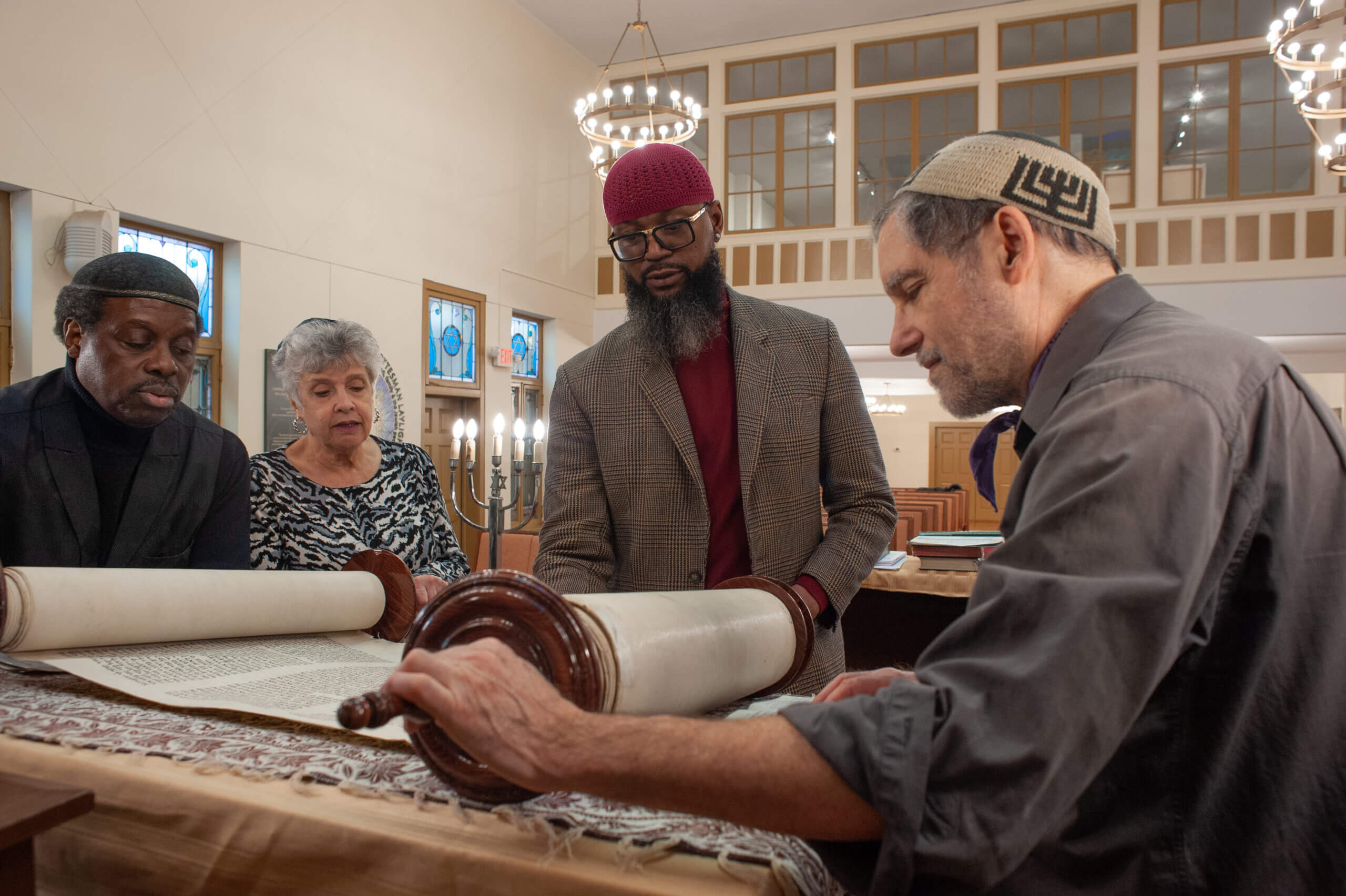 Robert Azriel Devine, Amy Schonhaut, Eliyahu Elijah Collins and Jeff Haveson roll up a Torah scroll at Newark’s Congregation Ahavas Sholom. The Conservative synagogue has added Devine and Collins, who are students at New York’s Israelite Rabbinical Academy, to its spiritual staff. Photo by Tim Lee
“The idea of African American Jews never seemed strange to me,” Freedman continued, adding he never asks first-time attendees if they are Jewish.
More diplomatically, he may instead query “Kohen or Levi?” before allowing a new face up to the bimah.
That respect is missing in far too many congregations, Freedman said. “If an African American walks in, the question becomes much more heightened. It’s crazy. It shouldn’t be that way.”
The appointments of Collins, 47, and Devine, 66, followed conversations over several years between Freedman and Rabbi Capers Funnye, Jr., the spiritual leader of Chicago’s Beth Shalom B’nai Zaken Ethiopian Hebrew Congregation. Funnye is also a Conservative Jew and the chief rabbi of the International Israelite Board of Rabbis.
When Ahavas Sholom reopened for in-person gathering after the building was closed for two years during the pandemic, Freedman said the discussions with Funnye and other Israelite leaders turned to the idea of taking on interns.
“I said, ‘Let’s see how our community reacts to being led by a Black rabbi. I need to get them in front of people,’” Freedman said.
Familiar tunes
Another reason for adding spiritual staff was that the synagogue’s rabbi, Simon Rosenbach, has aphasia, a condition that diminishes the capacity to understand or express speech. “My aphasia brought me to the end of the road. I will retire as of June 30, 2023,” he wrote in a recent synagogue bulletin.
Devine, the rabbinical intern, said he developed a bond with Rosenbach. Both men turned to the rabbinate in middle age, enrolling at the Academy for Jewish Religion, an interdenominational seminary founded in 1956 and based in New York and Los Angeles. Devine later left and is completing study at the Israelite Academy.
“I really connect with him a lot,” Devine said of Rabbi Rosenbach. “He sees my mannerisms on the bimah. He’ll say, ‘This is supposed to be like that. This is supposed to be like this,’ which is very helpful.”
Devine may not need much help, however. Though his impending smicha is under Israelite auspices, as was that of his late father, an esteemed Israelite rabbi, the younger Devine grew up in a Conservative environment at Chicago’s Congregation Rodfei Zedek.
“I had my bar mitzvah there. I went to Hebrew school, summer camp at Camp Ramah,” he said. “I’ve had a lot of good experiences with Conservative shuls.”
Wouldn’t a Conservative bar mitzvah make you Conservative? he was asked.
“It makes you a Jew,” he replied.
Elaborating, Devine described Collins and himself, saying, “We’re Hebrew Israelites who practice Judaism, as opposed to some other denominations that include the New Testament” — or more radical factions better known for antics especially targeting Jews.
Returning to his Conservative upbringing, Devine said of Ahavas Sholom: “I was familiar with the melody and tunes because I grew up in Rodfei Zedek. The liturgy is the same. Eric has always encouraged us to daven the way we do in our community. I sing in a very operatic style, but they like it.”
Added Collins: “There wasn’t that much of a difference except for the cadence
and in various tunes. I’m very, very familiar with the liturgy.”
“Ahavas does not play musical instruments on shabbat. Neither does Beth Shalom,” Collins continued in a comparison to his Israelite home congregation in New York.
There is a difference in the absence of a mechitzah to separate women worshippers from men at the Newark shul, and its presence at the Israelite synagogue.
Or its mental presence.
“Beth Shalom had it, but they did some construction of the sanctuary and the mechitzah was not erected again. However, everyone is accustomed to going to their sides.”
‘Driven by Torah precepts’
While Freedman’s recruitment through the Israelite Academy may be groundbreaking, it may not have been in accordance with rules of the shul’s rabbinical authority, according to Steve Rabinowitz, a spokesperson for the United Synagogue of Conservative Judaism and its affiliated rabbis’ group, the Rabbinical Assembly.
“United Synagogue and the Rabbinical Assembly have real guidelines about recruitment of rabbis, about advertising and about vacancies. Their members are expected to follow them,” he told the Forward.
“This particular shul did not use those guidelines. They found this rabbi on their own,” he continued, declining further comment except to say, “In the hundreds and hundreds of placements, it’s fairly rare.”
In Newark, both nascent rabbis spoke with affection about their congregants, giving particular praise to Freedman.
“Eric’s congeniality intrigued me,” Collins said. “His compassion to reach out and build bridges was in alignment with my own.”
Said Devine: “Eric is tops among all my relationships. I call him my friend.”
Freedman said the most important result of his outreach is how well both men fit in.
“If you come to a service on Shabbat and listen to Azriel and Eliyahu give a drash, it’s blatantly obvious they’re driven by Torah precepts and that’s how they go about their lives,” he said.
“I just want people to come to Shabbos services and say, ‘This is normal,’” he said — adding, however: “The goal is not to turn them into Ashkenazi clones.”
The post Conservative synagogue makes history with hiring of Hebrew Israelite clergy appeared first on The Forward.