Before the pandemic, it was a classic, time-honored pastime, particularly among women: over-60 movie lovers, retired and with time to kill, would head out for an early discount show at the multiplex and spend the day sneaking into the other movies on offer. This is how, not so long ago, your tracksuit-and-sneaker-wearing grandmother or aunt might have started the day with a mainstream crowd-pleaser like The Post and ended it having seen at least parts of, say, Blade Runner 2049 or Get Out. Bad for the movie industry, but good for the soul. And proof that people with a lifelong moviegoing habit are also likely to have curiosity in their bones, an eagerness to check out new things even if they’re not the target audience.
[time-brightcove not-tgx=”true”]
That was the world then. Now, we know that fewer middle-aged and older adults are going to the movies (according to some estimates in early 2022, frequent attendance was down by roughly half), some out of not-unfounded health fears but perhaps many more out of habit. It’s easier just to stream at home, especially now that the big studios seem to be catering mostly to teenagers and comic-book fans. This is the landscape into which 80 for Brady—a comedy starring veteran performers Jane Fonda, Lily Tomlin, Rita Moreno, and Sally Field—is dropping. Another comedy starring Tomlin and Fonda, Moving On, will be released in March. And Book Club: The Next Chapter, a sequel to the 2018 hit (which earned $104 million and also featured over-60 actors), is due this spring. The obvious question is whether movies like these, designed to draw out an audience of senior and younger women alike, stand a chance at the box office. But beneath that question floats a more metaphysical one: What have we lost if they fail?
80 for Brady is brassy, ridiculous, and shameless. It’s also irresistible, maybe because watching older ladies having fun is almost embarrassingly seductive. (For convenience’s sake, let’s treat older as a neutral adjective, a kind of shorthand for a person who’s done some living but isn’t nearly done yet.) Tomlin, Fonda, Field, and Moreno play four football-crazy seniors who almost miraculously score tickets to the 2017 Super Bowl in Houston to see their idol, the New England Patriots’ Tom Brady (who also appears in the film), play against the Atlanta Falcons. Calamities ensue: Field’s Betty, a math professor and the member of the group deemed the most responsible, is entrusted to take care of the tickets—but even a numbers whiz can have a bout of forgetfulness, and the women, dressed in matching jerseys with Brady’s number emblazoned in sparkles, have to scheme their way into the stadium. (It’s Billy Porter who saves the day, having bonded with Moreno’s Maura in a charity poker game the night before.)
You can roll your eyes at the ladies-getting-into-scrapes plot device. And of course, you’ve seen it before, in fairly recent movies like the 2019 Poms (in which a group of women from a retirement community, including Diane Keaton and Pam Grier, form a cheerleading squad) and in slightly older ones, like 2003’s Calendar Girls and the Mamma Mia! franchise. And in Book Club—starring Keaton, Fonda, Mary Steenburgen, and Candice Bergen—lifelong friends read two of E.L. James’ Fifty Shades books, igniting sparks that shake up their lives. These films aren’t trying to reinvent any wheels.
Read more: The Icons of Book Club on Sex, Sexism and Life After 70
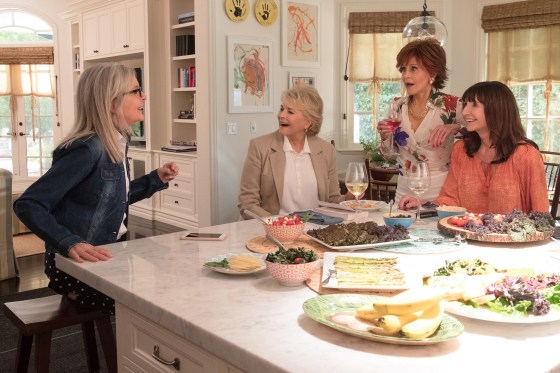
Melinda Sue Gordon—ParamountA toast to the sisterhood of badass older ladies in Book Club
And so in the canon of Films That Matter, as decided by people who think they know what they’re talking about, these movies rank somewhere in nowheresville, grouped into the sad, dismissive category of “films my mom would see,” a posture that endures maybe because the loudest film critics, professional or otherwise, tend to be men. But it’s time to reframe and reclaim these films as part of something bigger that does matter, both in the world of movies and in real life. Some of these films may be better conceived and more artfully directed than others, but that’s beside the point. They’re an expansion of the classic genre known as the women’s film, whose 1930s and ’40s heyday brought us pictures like Stella Dallas, Imitation of Life, and Now, Voyager, movies in which women sometimes suffered dramatically, but were also often re-vitalized with a new sense of self.
As we age, nearly all women notice that they become somewhat invisible in the world, but in the golden era of the women’s film, older women really were expected to fade quietly into the wallpaper. Aging actresses would be relegated to playing anonymous matrons and dowager aunties. But the women in 80 for Brady and Book Club want to be seen on their own terms, whatever those might be. The driver behind Book Club is that your sex life hardly has to end with your child-bearing years. (Bergen plays a divorced federal judge who resigns herself to trying Bumble but has no interest in concocting a glamour portrait; for kicks she posts a selfie with her face slathered in cold cream, and it works.) And there’s a scene in 80 for Brady in which the women dress up for a gala party they’ve landed invitations for. Fonda’s Trish, a beauty queen who’s still got it, comes decked out in a great wig (she travels with a suitcase full of them) and some sort of evening garb. But Tomlin strides in, leggy and elegant, in a drapey black sequined tuxedo that, rather than coming off as an effort to turn back the clock, merely stops time. It’s a statement look that whispers rather than shouts, a kind of shorthand for all the ways it’s possible to assert your space in the world, through word and deed as well as the way you present and carry yourself.
Read more: The 49 Most Anticipated Movies of 2023
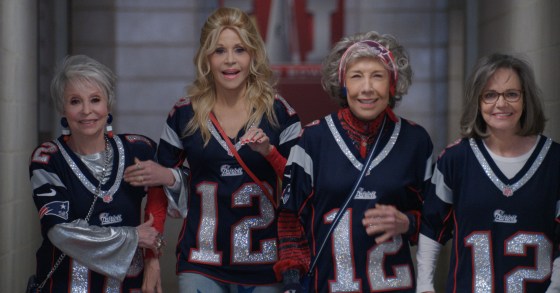
Paramount PicturesRita Moreno as Maura, Jane Fonda as Trish, Lily Tomlin as Lou, and Sally Field as Betty in 80 for Brady
These movies have a kind of vitality that supersedes most accepted notions of what a “good” movie should be. It’s true that Hollywood doesn’t offer the same range of material to its older actresses that, say, the French do: over the past decade, Catherine Deneuve and Isabelle Huppert have often made multiple movies per year, in an assortment of roles that include, but aren’t limited to, comedies. But even if you deem movies like 80 for Brady and Book Club a little silly, it’s worth asking yourself what types of roles you’d want to see these actors in. Would it be better to see them relegated to playing old people nobly facing cancer, or Alzheimer’s, or just garden-variety death? (There is a cancer subplot in 80 for Brady, though it’s somewhat subdued.) Do we really want to see them stuck playing wise matriarchs of big, sprawling families? Ho-hum to that. Comedies like 80 for Brady—which speak of the possibility of renewal at any age, and reaffirm the value of good friendships, both new and enduring—are at least moving toward joy. We all know what other thing we’re all moving toward. Why rush?
There’s something else too: we mark the passage of time in our actors’ faces, much easier than scrutinizing our own, of which we’re usually so critical, and which change only incrementally as we look in the mirror each day. It’s true that in 80 for Brady Fonda’s cosmetic surgery has perhaps smoothed out the planes of her face a little too much. But then, if you were once Barbarella, how impossible it would be to surrender the vision of the self you once where.
And Tomlin’s face—the face of Laugh-In’s Ernestine, the persnickety telephone operator, and of the preternaturally wise 5-year-old Edith Ann—is also that of Linnea Reese in Nashville, a gospel singer, wife, and mother who subconsciously yearns to claim something for herself outside of those roles. In a nightclub, Keith Carradine’s Tom, a rootless musician and a player if ever there were one, sings “I’m Easy” to that face. With his charm, he can have any woman in the world, but it’s Linnea’s face, Tomlin’s face—a map of question marks, of veiled desire, of understated starlight radiance—that moves him. And if 1975, the year of Nashville, seems like forever ago, you’re right. You’re also right if it seems like yesterday.