By Taylor Redd, Norman Eisen, Colby Galliher
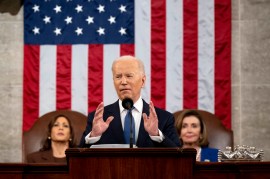
Next week President Biden will give his annual State of the Union address. The address will take place against the backdrop of an ongoing special counsel investigation. Although Biden’s document mishandling is unlikely to lead to charges, (it is more like former Vice President Mike Pence’s situation and unlike former President Donald Trump’s) it raises the question—how will he treat it? Other presidents have delivered the State of the Union address against background controversies. In predicting what to expect in Biden’s speech next week, a look at how Presidents Donald Trump, Bill Clinton, and Richard Nixon dealt with their own (far more serious) controversies is instructive.
At the time of his 2019 State of the Union address, Trump faced a looming investigation by the House Oversight Committee, which was looking into his tax returns, and an ongoing one by special counsel Robert Mueller, who was probing Trump’s alleged dealings with Russia during the 2016 election. During the 1999 State of the Union, Clinton’s Senate impeachment trial, prompted by his alleged perjury before a grand jury and obstruction of justice (in an effort to conceal his affair with former White House intern Monica Lewinsky), was well underway. By the time of his 1974 State of the Union address, Richard Nixon was navigating the wake of the Saturday Night Massacre of October 1973 and had been at the center of a Senate committee and a special counsel investigation for months.
All three former presidents referenced their respective controversies during their speeches, though in different ways. Clinton took the lightest touch. He did not address his political adversaries’ efforts directly. Rather, he alluded at the end of his remarks to overlooking “controversy” in favor of “a new dawn for America.” Trump was more overt, lamenting “ridiculous partisan investigations,” seemingly in reference to the House and Mueller probes. Nixon, whose problems were the most severe, dealt with them at the most length. He dedicated multiple paragraphs to dismissing “the so-called Watergate affair” and asserted that he would not be going anywhere.
To the extent history guides what Biden should and will do, it counsels the Clinton approach. That was and continues to be regarded as a political triumph. Trumps was met with mixed reviews. Nixon’s dismissal of Watergate aged poorly with the impeachment proceeding and his subsequent resignation. Biden, like Clinton, should use this year’s State of the Union address primarily as a means of promoting policy, avoiding Trump’s angry tone and Nixon’s extended treatment of the investigation.
Indeed, Biden could go Clinton one better by using the documents controversy as a springboard for policy promotion. Document mishandling will not stop with Biden (or Pence or Trump) unless the rules are changed. One of the authors of this blog, Eisen, served as a drafter of Executive Order 13526, which governs the current classification regime, and has recently written about several reforms to it. They include requiring that the National Archives review documents and other items that presidents and vice presidents take with them when they leave office. Steps should be put in place to ensure that no documents belonging to the government—classified or not—remain in those locations or get mixed in with personal belongings at term’s end.
How will Biden handle this controversy? The most likely prospect is that classified documents are not mentioned at all, since his controversy hardly rises to the level of his predecessors. But he should consider taking at least the Clinton approach, keeping any reference to the controversy short and to the point. And for extra credit, he should consider offering a policy solution to the classified document handling problem that his situation, and that of Pence and Trump, demonstrates exists.