
In much of China, prevailing local regulations and social mores make having a third child—or any child at all if you’re unmarried or LGBT—nearly impossible. But for the more than 83 million people in the southwestern province of Sichuan, that’s about to change.
The province’s health commission announced last month that starting on Feb. 15, there will no longer be a limit on the number of childbirths a person can register, nor will there be any more restrictions on who can register new births. Previously, only married couples could register up to three children. While other births could go unregistered, and many have, such children and their parents may be deprived of access to vital public resources as a result. The new policy, which was issued internally on Dec. 29 and made public in January, will be in effect for five years.
[time-brightcove not-tgx=”true”]
The amendments to Sichuan’s rules are a stunning about-face for a province that only began to relax its one-child policy less than a decade ago, but it notably comes on the heels of China experiencing its first population decline in more than 60 years. The Sichuan policy reform has been widely perceived as an initiative to boost falling fertility rates and help combat the country’s aging population problem.
Read More: China’s Population Is Shrinking—and Graying. Here’s What It Means for the Future
Experts have described the change as a desperate move by the government. The easing of restrictions to register new births, however, doesn’t just signal a political evolution but also a potential cultural one—which may be necessary to address the daunting demographic challenge China faces.
“I think this shift has been, like in people’s mind, in policymakers’ mind for quite some time,” says Zheng Mu, an associate professor of sociology at the National University of Singapore.
Over the last several years, the Chinese Communist Party and President Xi Jinping have attempted to reverse course from decades of previous stringent efforts to limit population growth, as elder generations are increasingly outnumbering younger ones, threatening to hamper the economy and strain social services.
In 2016, the CCP changed its national one-child policy to a two-child policy, and in 2021, it upped the limit to three. Since then, the government has offered incentives for people to have more children, including cash subsidies, tax deductions, and low-cost child-rearing programs. But given that China remains a traditionally conservative country, those benefits were largely restricted to married couples.
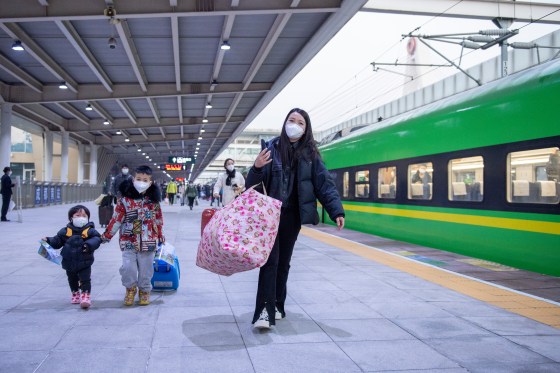
Liu Zhongjun—China News Service/VCG/Getty ImagesA woman and two children prepare to board a high-speed train at the Chengdu South Railway Station in Sichuan, China, on Dec. 26, 2022.
Why is Sichuan’s policy change significant?
China’s national family planning policies don’t account for single parents or same-sex parents (since marriage is defined as between a man and a woman). While neither the Population and Family Planning Law nor the Marriage Law explicitly prohibits unmarried parenthood—and the latter ostensibly guarantees equal rights to children born out of wedlock—many local governments, which often better reflect social stigmas, have adopted harsher rules toward “unplanned” children, which includes those born to unmarried parents or those born past the allowed limit per couple.
In many parts of the country, public services, including health care, are dependent on registration at birth, for which marriage is a prerequisite. Unmarried mothers can be denied maternity leave, and unregistered children may lack access to education and, later, employment. In some places, such families can even face hefty fines.
Mu tells TIME that having children outside marriage is perceived as “irresponsible behavior,” or even “privileged” due to the high costs it entails. In addition to the legal hurdles, she says, there is also “a moral consequence, a moral cost associated with this.”
When Sichuan’s health commission announced its birth registration reform, many on Chinese social media interpreted it as an encouragement for people to have children out of wedlock. The provincial government has said that is not the case and that the policy change is simply designed to carry out better population monitoring. The new rules, however, do lower a considerable barrier that may have deterred some unmarried people from having children.
“This institutional change,” Mu says, “has definitely indicated a shift toward more social changes.”
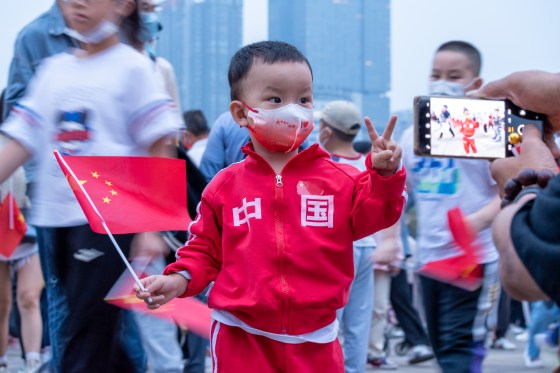
Wu Ke—VCG/Getty ImagesA child poses for a photo at Tianfu Square during a flag-raising ceremony in celebration of the 73rd anniversary of the founding of the People’s Republic of China, in Chengdu, Sichuan, Oct. 1, 2022.
Will the new policy help solve China’s population problem?
Sichuan is not the first local government to ease birth-related policies. In 2021, for example, Shanghai lifted the requirement of a marriage certificate to apply for maternity benefits, and last year, similar to Sichuan now, the province of Guangdong lifted all restrictions on birth registration, allowing unlimited registrations with no marriage prerequisite, for the stated purpose of better population monitoring. It’s too early to tell if those changes have affected birth rates.
Adam Cheung, an associate professor of sociology at Hong Kong Baptist University who studies China, tells TIME that making unmarried parenthood legally permissible will not necessarily increase the number of children born of unmarried parents by a noticeable amount, as it remains socially frowned upon. “Out-of-wedlock childbirth [is] legal in other East Asian societies, but they are only a small proportion of all childbirth[s] because it is still less preferred, if not stigmatized, in these societies,” he wrote over email.
Moreover, a broader set of demographic and economic factors also play an important role in the country’s fertility rate. Due in large part to the country’s longtime one-child policy and a notable cultural preference for sons, China now faces one of the most skewed sex ratios in the world: as of 2022, there are 32 million more men than women, which has substantial implications for marriage and birth rates.
Not to mention, many younger people in China no longer consider marriage and childbirth to be the definitive goalposts for success, especially among urbanites pursuing higher education and professional careers. And despite the country’s rapid economic growth in recent years, many young people are still struggling amid high costs of living and a lack of employment opportunities.
Stuart Gietel-Basten, a professor of social science at Khalifa University in Abu Dhabi, emphasized to TIME before the Sichuan policy announcement that a “pronatalist agenda” alone will not resolve China’s demographic woes.