
In December 2018, 14-year-old Henny Scott was found dead two weeks after she went missing near Lame Deer, Mont. In August 2019, 18-year-old Kaysera Stops Pretty Places was found dead four days after she went out with friends in Hardin, Mont. In January 2020, 16-year-old Selena Not Afraid was found dead along Interstate 90 three weeks after she was reported missing. All three girls lived in Big Horn County in southern Montana, which has one of the highest rates of missing and murdered Indigenous women and girls in the U.S.
Over three episodes, the docuseries Murder in Big Horn—streaming Feb. 3 and on air starting Feb. 5 on Showtime—lays out how cases like these, and the grassroots organizing by the girls’ families, steadily drew attention to the growing Missing and Murdered Indigenous Women (MMIW) movement on a national scale.
[time-brightcove not-tgx=”true”]
“If Henny was the spark, and Kaysera was the kindling, then Selena was the forest fire that just ignited across the media,” says Luella Brien, the former general manager and editor of Big Horn County News, in one episode. “People wanted to know what the hell is happening in Big Horn County.”
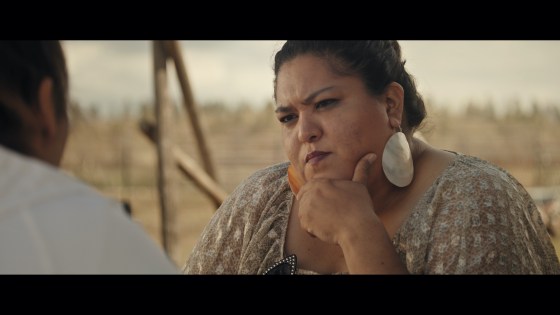
Courtesy of ShowtimeJournalist Luella Brien interviews Nakia Spotted Horse, a friend of Kaysera Stops Pretty Places.
Big Horn County, with a population of roughly 13,000, sits on the Montana-Wyoming border and encompasses part of the Northern Cheyenne Reservation and most of the 2.2-million acre Crow Reservation. The final episode lists 82 MMIW cases in Big Horn County and its vicinity.
Not Afraid was last seen alive at the rest stop between Billings and Harden on Interstate I-90. The highway, which runs from Seattle to the East Coast, runs straight through the Crow Reservation and Billings, forming an artery for sex traffickers. In July 2018, 19-year-old Shacaiah Blue Harding also went missing from the Billings area. Months later, the series reveals, some of Harding’s peers came forward and said that she had been sold for drugs.
Harding and Not Afraid came from turbulent pasts. Harding’s mother was an addict and Harding lacked a stable home; she was later diagnosed with meth-induced schizophrenia herself. Not Afraid lost three siblings: her twin sister to suicide at age 11, her older sister to a hit and run, and her older brother to a police shooting.
Directors Razelle Benally (Oglala Lakota/Diné) and Matthew Galkin don’t shy away from these truths. But they also make sure to let viewers know: Selena Not Afraid had a contagious smile, a dark sense of humor, and people wanted to be around her. Henny Scott was a tomboy who played football and basketball and adored her younger siblings. And Kaysera Stops Pretty Places was a fun-spirited, loving protector of her siblings, who was always there for her friends.
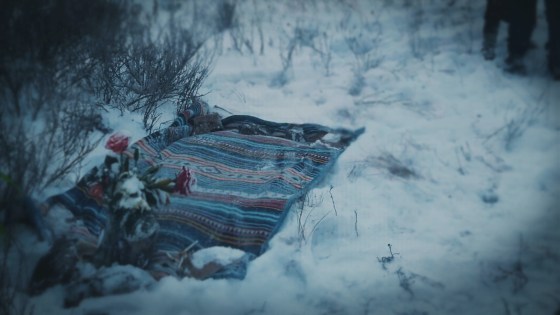
Courtesy of ShowtimeA memorial to 14-year-old Henny Scott in the spot where she was found.
“It was imperative for us to try to make them as well-rounded as we could,” Galkin tells TIME. “Because that was one of our first objectives in the series, is how do we pay respect to them and their families, and not treat them as one-dimensional, true crime characters?”
Galkin previously directed the 2019 Showtime true crime series Murder in the Bayou, and the network approached him with the general idea for Murder in Big Horn the following year, after the New York Times covered Selena Not Afraid’s case. He reached out to Bird Runningwater, then the head of the Sundance Institute Indigenous Program, and Sterlin Harjo, who would go on to create Reservation Dogs, and they directed him toward Benally, who had written for the noir Navajo Tribal Police investigation drama series Dark Winds, which premiered on AMC in 2022. Both directors wanted to veer away from true crime itself and instead use the tropes of the genre to examine the historical factors behind such high rates of missing and murdered Indigenous women.
“These families deserve justice. They deserve answers,” Benally says. “And I’m so less concerned about the general populace not having an answer, because these families won’t, in a lot of these cases. And that’s something we should be angry about.”
None of the cases covered in the docuseries wrap up neatly—the investigation into Selena Not Afraid’s death was ongoing as of 2021. As the filmmakers dug into the stories, they followed a trajectory similar to that faced by the victims’ families: police stonewalled them by refusing to communicate.
“There’s a lot of biases and discrimination that we had to combat that was pre-existing in Big Horn County, amongst specifically law enforcement and government and agencies, against Native peoples,” Benally says. “When you reduce a person down to something like that, it allows for people to disregard the importance of these human lives.”
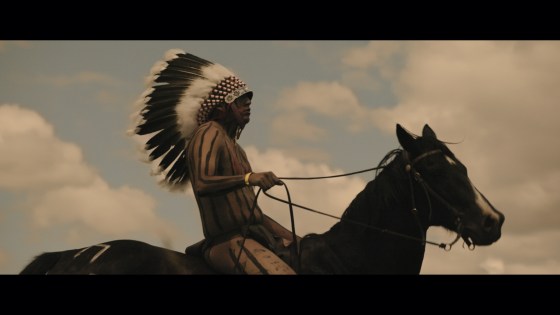
Courtesy of ShowtimeA still from ‘Murder in Big Horn.’
The Big Horn County Sheriff’s Office did not respond to the production team’s requests for comment. “The sheriff’s office in Big Horn County would have retribution against you if you spoke up,” Eric Winburn, the former undersheriff of Big Horn County, says in the show. “They’d just make your life hell there. You’d have to move.”
The directors discovered that most of the cases were never thoroughly investigated. “That is as eye-opening as the whodunit aspect,” Galkin says.
Big Horn County—and Indian Country in general—is a jurisdictional vortex. On county land outside of the reservation, the Big Horn County Sheriff’s Office has jurisdiction. On tribal lands, the FBI and the Bureau of Indian Affairs (BIA) hold authority. But the BIA can’t exercise criminal jurisdiction over non-Natives when they commit crimes on tribal land. And the FBI often waits until it is “invited in” by local authorities to open investigations.
“To figure out who has jurisdiction at any given time, you have to know: who is the victim? Are they Indian or not? Who is the perpetrator? Are they Indian or not? Where did the crime occur? On Indian land or not?” Lucy Rain Simpson, the executive director of the National Indigenous Women’s Resource Center, says in the show. “When it comes to violence against Native women, when it comes to missing and murdered situations, oftentimes we don’t know.”
Murder in Big Horn also delves deep into two tough issues: the continued impact of the damning history of colonization on Native peoples and the existence of Native-on-Native violence. Benally grappled personally with how to address the latter, and how her community would receive it.
“When you take away the things that make a person: language, land, responsibilities, people become lost and they don’t know what to do with themselves,” Benally says. “And so as a result of colonization, you get the effects of that, which includes addiction, abuse, violence.”
“And it’s hard to talk about, but if we’re talking about all these other things,” she continues, “then we have to be real with ourselves as a people and see that we need to start taking accountability and responsibility if we want things to change.”