
As Russia’s invasion of Ukraine approaches the one-year mark, all eyes are trained on one small, war-ravaged city: Bakhmut. There, in Ukraine’s eastern Donetsk region, is where one of the fiercest and bloodiest battles of the war is currently playing out as Russia tries to achieve its first major battlefield victory since its capture of the eastern cities of Severodonetsk and Lysychansk over the summer.
Although Ukrainian President Volodymyr Zelensky described the situation on the frontline as “very difficult” in his Sunday evening address to Ukrainian citizens, Russian forces have yet to encircle the city.
This months-long battle for Bakhmut has come at the cost of hundreds of Ukrainian and Russian casualties per day, according to some estimates, as well as the city of Bakhmut itself. “Burnt ruins” is how Zelensky described it during one of his nightly addresses in December, the outcome of what has been likened to World War I-style trench warfare.
[time-brightcove not-tgx=”true”]
Russia’s offensive on eastern Ukraine, parts of which Moscow purported to annex in September, reflects Vladimir Putin’s long-held aim of capturing Ukraine’s eastern regions of Donetsk and Luhansk, collectively known as the Donbas—a tall order that Russian troops have been tasked with achieving by March, according to Ukrainian officials.
Yehor Cherniev, a Ukrainian lawmaker and head of the Ukrainian delegation to the NATO parliamentary assembly, tells TIME that although Bakhmut “is not of strategic importance” to Kyiv, they will nonetheless “try to hold it as long as possible.”
“We are gradually grinding down the most combat-ready units of the Russians,” says Cherniev. “Regardless of the future fate of Bakhmut, we managed to win precious time. In our next counter-offensive campaign, we will return much more.”
Here’s what to know about Bakhmut and its potential impact on the war.
What is the history of Bakhmut?
Before Russia’s invasion of Ukraine, this small city was home to a salt mining industry, a non-ferrous metal plant, a winery, and more than 70,000 people. Though it takes its name from the Bakhmutovka river, it was renamed Artyomovsk during the Soviet era, which stuck until 2016 when its original name was restored as part of Ukraine’s “decommunization” effort.
For residents of Bakhmut, their time on the frontlines didn’t begin in 2022, but in 2014, when fighting ensued between Ukraine and Russian-based separatists in the Donbas. Today, less than 1% of Bakhmut’s pre-war population remains in the city, living without power, water, or heating.
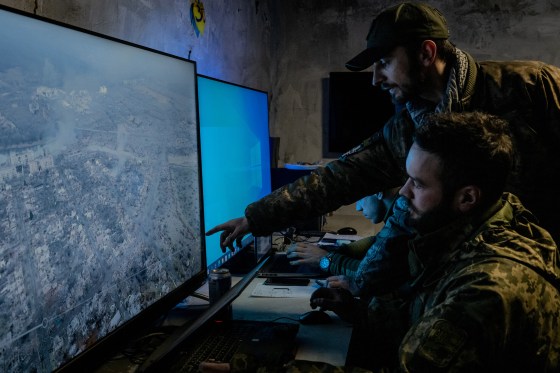
Nicole Tung—The New York Times/ReduxUkrainian analysts review drone operators’ footage near Bakhmut, Ukraine, on Jan. 6, 2023.
Why is Russia fighting so hard over Bakhmut?
If Moscow’s aim is to seize Donetsk and Luhansk by the spring, then capturing Bakhmut could be an important stepping stone in its eastern push. Michael Kofman, the director of Russia Studies at the U.S.-based Center for Naval Analyses, says that Bakhmut represents “a gateway” to Sloviansk and Kramatorsk, both of which have been subject to recent Russian missile strikes.
Such an outcome is not necessarily imminent, let alone likely. Ukrainian and Russian forces have been fighting in the Bakhmut area since at least May. This long, drawn out battle of attrition gained Bakhmut outsized significance as a theater of war, especially as troops and resources began pouring into the small city. Bakhmut “has become this rallying cry in the Russian information space,” says Karolina Hird, a Russia analyst at the Washington, D.C.-based Institute for the Study of War, noting that the small city represents one of the few places where its forces have been making tangible gains. Among Ukrainians, “Bakhmut holds” has become a national battle cry.
But Russian forces have so far been unable to advance beyond the city’s urban outskirts, nor have they been able to disrupt the crucial ground lines being used to supply Ukrainian forces in the city. “We continue to assess that the imminent fall of Bakhmut through a Russian encirclement is very unlikely,” adds Hird—a prognosis that bodes poorly for Putin’s greater territorial aspirations in the region.
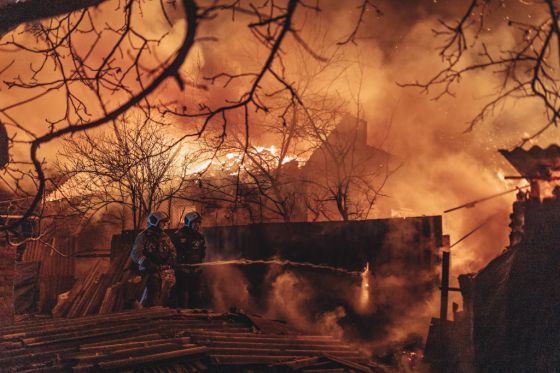
Diego Herrera Carcedo—Anadolu Agency/Getty ImagesEmergency service workers extinguish a fire after shelling on the Bakhmut frontline in Ivanivske, Ukraine on Jan. 2, 2023.
What happens if Bakhmut falls?
The fall of Bakhmut would be a modest tactical victory for Russia. But it would also be a pyrrhic one, given all the resources used. Indeed, Western officials reportedly estimate that the number of Russian troops who have been killed or wounded in the war so far is nearing 200,000, up from estimates of just 80,000 in August.
“In recent months, the Russians have been forced to spend a colossal amount of resources and reserves to take Bakhmut,” says Cherniev. “In this regard, our plan was a success.”
Hird and Kofman agree that while the loss of Bakhmut would be symbolically damaging for Ukraine, which is loath to cede any of its territory to Russia, it wouldn’t have a meaningful impact on Kyiv’s war effort. “Bakhmut in and of itself isn’t that significant,” says Kofman, noting that even if Russian forces were to march onward toward Sloviansk and Kramatorsk, they would run into yet another, even more fortified Ukrainian defensive line.
“It took Russian forces eight months to advance from occupied Popasna in Luhansk Oblast to their current position in Bakhmut,” says Hird, a distance of roughly 20 miles. With the journey from Bakhmut to Sloviansk and Kramatorsk taking closer to 30, only one outcome is guaranteed: “Months and months and months of grinding, attritional conflict.”
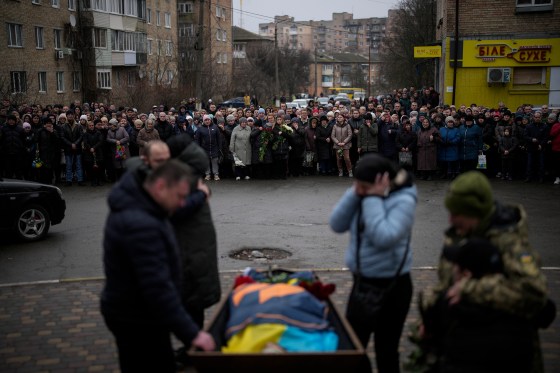
Daniel Cole—APBucha relatives gather to mourn the body of Oleksiy Zavadskyi, a Ukrainian serviceman who died in combat on Jan. 15 in Bakhmut, during his funeral in Bucha, Ukraine, Jan. 19, 2023.
What is the Wagner Group’s stake in the fight over Bakhmut?
The Russian paramilitary group commands as many as 50,000 fighters in Ukraine who are deployed alongside conventional troops, according to Britain’s defense ministry. The vast majority of them are believed to have been sourced from Russian prisons. Though the mercenary group hasn’t played a widespread role in the Russian war effort so far, it claims credit for delivering Kyiv’s first major territorial loss in months with the recent capture of the salt mining town of Soledar, just nine miles north of Bakhmut.
Demonstrating military success may be politically essential for the Wagner Group—especially its leader, Yevgeny Prigozhin, who is one of the most visible leaders of the war. His visibility is thanks in part to his frequent video commentary about the battle for Bakhmut on the messenger app Telegram, which has emphasized the Wagner Group’s role and at times even contradicted the Russian defense ministry’s own statements. In a January interview with TIME, Denis Korotkov, a former journalist for the independent Russian newspaper Novaya Gazeta and current investigator for the London-based Dossier Center, argued that it’s essential for Prigozhin to continuously show that the Wagner Group can deliver wins, especially because Prigozhin is unpopular with other Russian dignitaries. “Any defeat could lead to the loss of Putin’s goodwill,” said Korotkov.
Read More: What to Know About Notorious Mercenary Organization ‘The Wagner Group’ and Its Founder
Wagner’s role as a proxy fighting force has been on full display in the battle for Bakhmut, where its mercenaries have been tasked with wearing down Ukrainian defenses in the run-up to an offensive by more conventional Russian troops, including Moscow’s elite VDV airborne force.
“The Wagner Group offensive on Bakhmut really culminated after they took Soledar,” says Hird, though she noted that “they haven’t really been able to make significant progress since then.” U.S. officials estimate that at least 4,000 Wagner mercenaries have been killed and a further 10,000 injured in Soledar and Bakhmut.
How is Russian media reporting on the battle for Bakhmut?
Many news articles about the battle for Bakhmut published within Russia praise the Russian offensive and overstate its success and importance. Moscow owns or tightly restricts media published within the country. Many of these articles say, for example, that Russia launched the “special military operation” in Ukraine to “liberate” Donbas and defend it from the Ukrainian military. These articles also refer to Bakhmut by its Soviet name, Artyomovsk.
One article quotes the Wagner Group’s Prigozhin as saying that defeating Ukrainian troops in Bakhmut would “cut the Ukrainian offensive in any direction,” a claim that runs counter to what experts tell TIME.
Russian media has also spread what many experts say is disinformation related to Bakhmut. The state-owned RIA Novosti has repeated a baseless accusation from Denis Pushilin, the head of the separatist group Donetsk People’s Republic, that Ukraine used chemical weapons against Russian troops near Bakhmut.